
Decades of canceled projects and paper studies have long characterized the pursuit of nuclear spaceflight. However, NASA’s newly announced Space Reactor-1 Freedom (SR-1 Freedom) mission signals a major pivot toward pragmatism, aiming to launch the world’s first nuclear-powered interplanetary spacecraft to Mars by late 2028. From an engineering and systems integration standpoint, the agency is leveraging existing hardware, scaling down power requirements, and opting for nuclear-electric over nuclear-thermal propulsion to finally bring fission technology out of the laboratory.
Here is a breakdown of the SR-1 Freedom mission architecture and the current maturity of its underlying technologies.
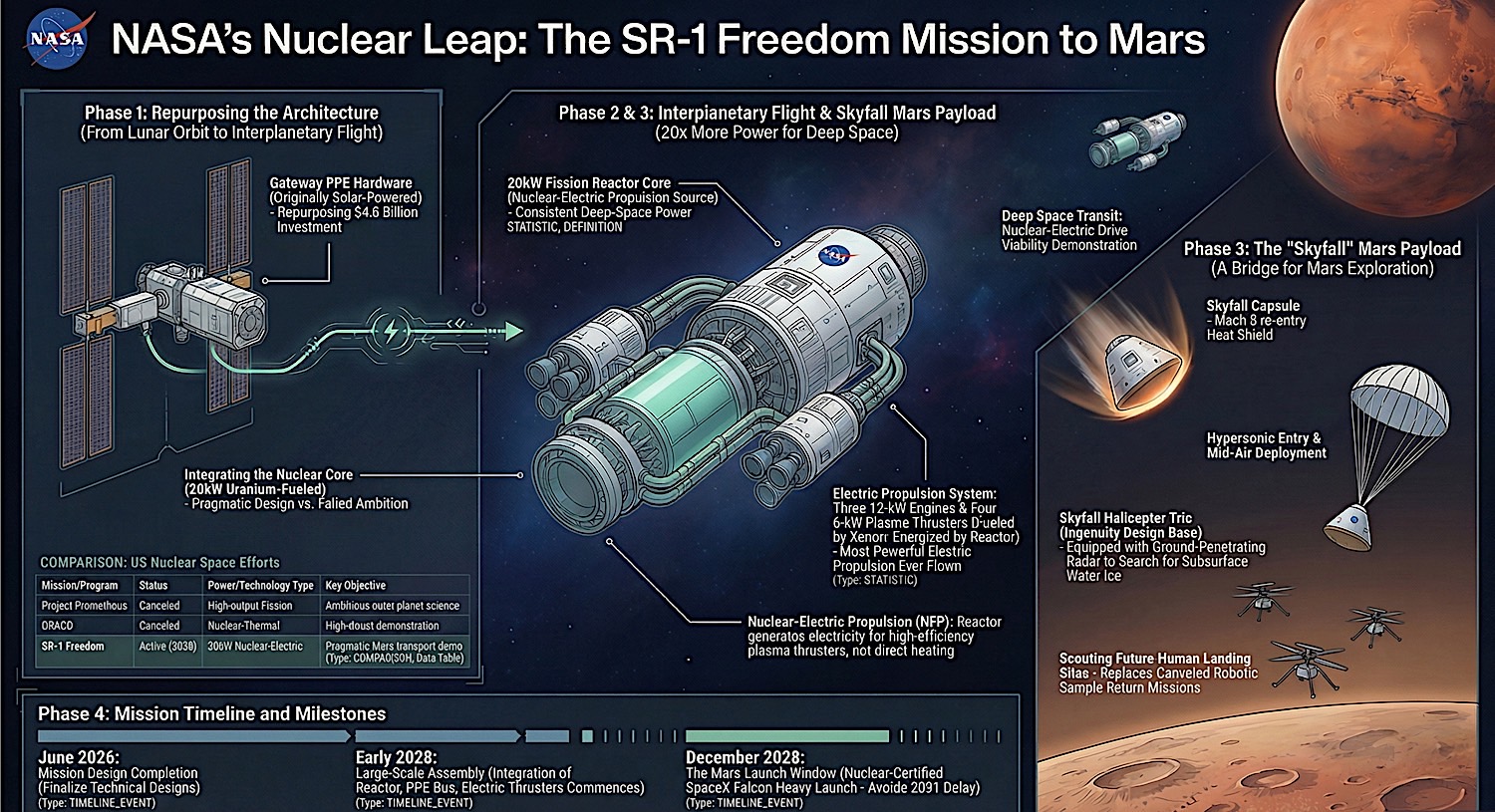
System Architecture: Nuclear-Electric Propulsion (NEP)
To navigate the vast distances of deep space where solar arrays lose effectiveness, engineers can utilize nuclear-powered rocket engines, which are significantly more efficient than chemical rockets. These engines generally fall into two categories: nuclear-thermal and nuclear-electric.
While the recently canceled DARPA/NASA DRACO mission attempted to build a nuclear-thermal rocket—which generates high thrust by using reactor heat to directly expand chemical propellant—SR-1 Freedom relies on a nuclear-electric propulsion (NEP) system. NEP systems generate lower thrust but operate with far greater efficiency. Instead of relying on solar panels to energize xenon fuel, SR-1 will utilize electricity generated by a roughly 20-kilowatt uranium-fueled fission reactor to power conventional plasma thrusters.
The spacecraft’s thruster array will feature three 12-kilowatt engines and four 6-kilowatt thrusters, making it the most powerful electric propulsion system ever flown in space.
State of Technology Development: Hardware Over Concepts
Historically, US space nuclear programs have suffered from scope creep, convoluted multi-agency management, and immensely complex designs. For example, a major engineering bottleneck for the DRACO nuclear-thermal rocket was the inability to easily and inexpensively test the engine on Earth, as the exhaust would need to be scrubbed of radiological material.
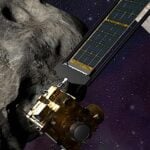
To bypass these developmental hurdles, NASA is cannibalizing flight hardware that has already been manufactured. The centerpiece of the SR-1 mission is the Power and Propulsion Element (PPE), originally constructed at Lanteris Space Systems in California for the lunar Gateway station. By modifying this existing spacecraft bus—which was initially designed for solar power—engineers will integrate the fission reactor alongside traditional solar arrays.
According to Steve Sinacore, NASA’s program executive for space reactors, the agency’s primary hurdle is not scientific discovery. The technology itself is mature; rather, “the lack of an operational space nuclear reactor is not a technology problem, it’s an execution problem”. By limiting the reactor’s output to 20 kilowatts—a fraction of what past initiatives like Project Prometheus aimed for, yet still 20 times more powerful than the radioisotope thermoelectric generators (RTGs) currently on Mars rovers—NASA is taking a manageable bite out of a historically complex engineering challenge. NASA Administrator Jared Isaacman emphasized this practical approach, noting the mission relies on a reactor that is mostly built and fuel that is mostly paid for.
Integration Challenges and Mission Timeline
Despite the use of existing hardware, assembling SR-1 Freedom requires near-perfect engineering execution. The primary technical challenge will be operating a coupled nuclear reactor, power conversion system, and electric propulsion thruster network beyond Earth orbit for the first time.
The timeline is exceptionally tight, governed by unforgiving orbital mechanics. Large-scale assembly must begin in early 2028 to meet a December 2028 Mars launch window; missing this deadline pushes the mission back to the next Earth-Mars alignment in 2031. Furthermore, launching radioactive fuel necessitates complex regulatory approvals from the Department of Energy and requires the launch vehicle to undergo specialized nuclear certification.
If successful, SR-1 Freedom will not only deploy a payload of three Ingenuity-class helicopters (dubbed “Skyfall”) into the Martian atmosphere, but it will also establish the critical flight heritage and regulatory precedents necessary to activate a commercial industrial base for deep-space fission power systems.
REFERENCES
- Clark, Stephen. “Here is NASA’s plan for nuking Gateway and sending it to Mars.” Ars Technica, March 25, 2026.
- Low, Lauren E. “NASA Unveils Initiatives to Achieve America’s National Space Policy.” NASA Headquarters, Release 26-026, March 24, 2026. Additional details regarding the “Ignition” news are available at https://www.nasa.gov/ignition.
- Smithsonian Magazine. “NASA aims to launch the world’s first planet-hopping spacecraft powered by nuclear fission.” Available at: https://www.smithsonianmag.com/smart-news/nasa-aims-to-launch-the-worlds-first-planet-hopping-spacecraft-powered-by-nuclear-fission-180988433/ (Note: This link was provided in our previous conversation history).