
As NASA targets the opening of its launch window on April 1, 2026, the Artemis II mission is officially in its final pre-launch phases. Marking the first crewed lunar mission since Apollo 17 in 1972, this 10-day flight will validate the Space Launch System (SLS) Block 1 rocket and the Orion spacecraft (recently named Integrity) for future deep-space operations.
LIVE STREAM:
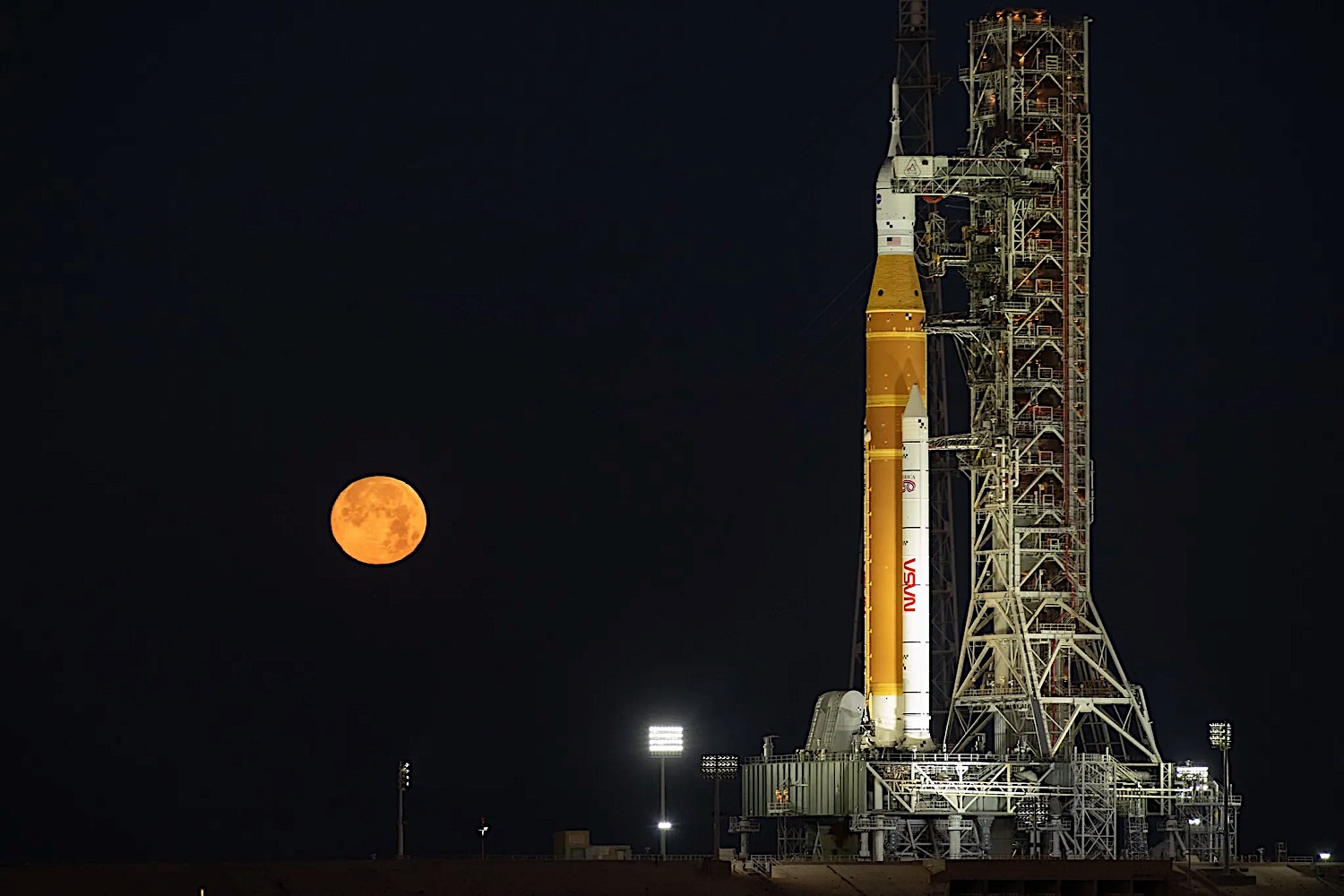
Here is a technical overview of the mission’s current status, critical hardware updates, and the engineering adjustments made leading up to the launch.
Launch Prep and Vehicle Rollout
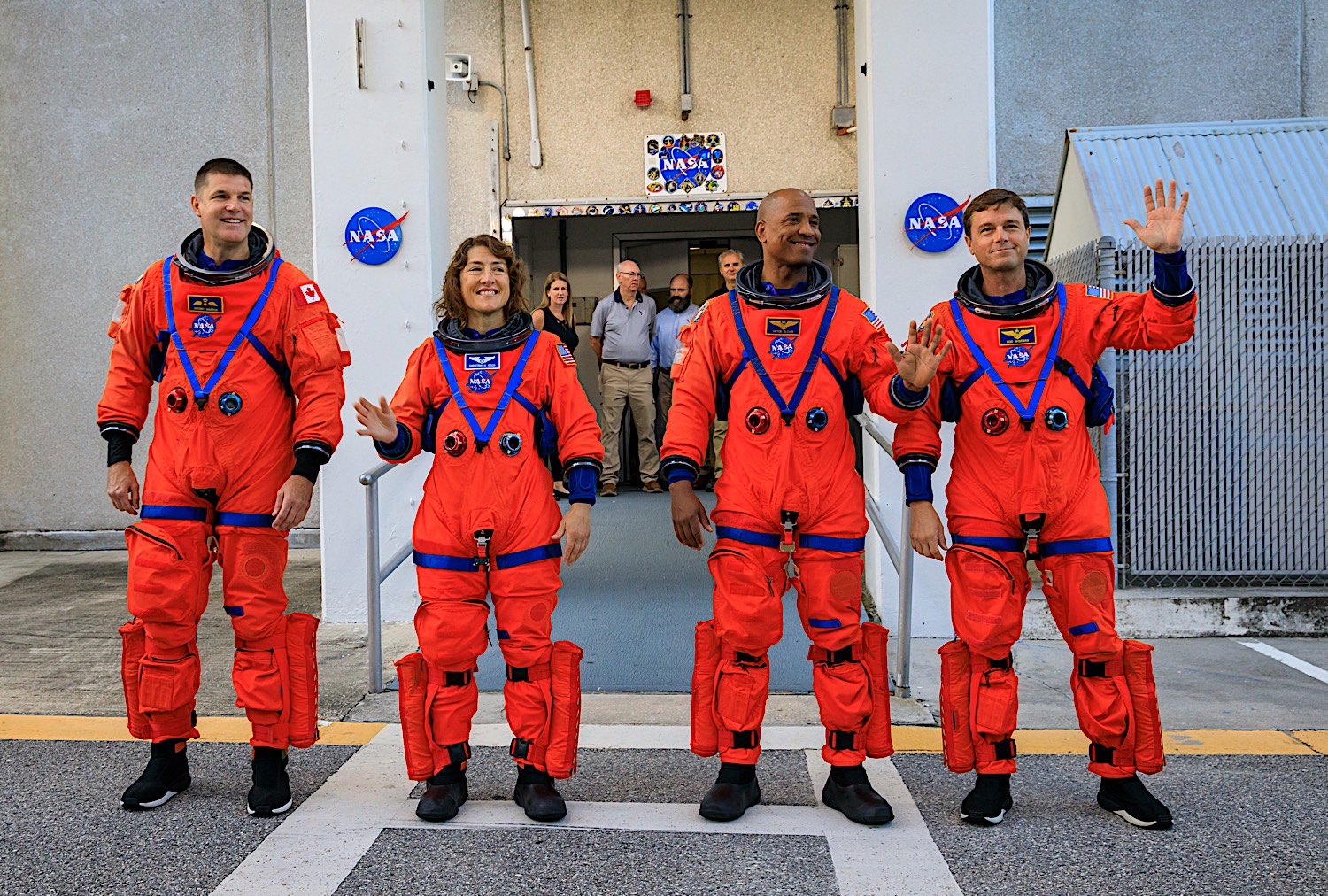
As of mid-March 2026, the 11-million-pound integrated SLS and Orion stack is undergoing its final rollout from the Vehicle Assembly Building to Launch Pad 39B at Kennedy Space Center. Utilizing NASA’s crawler-transporter 2, the vehicle is navigating the four-mile route at approximately 1 mph, an operation taking up to 12 hours. Simultaneously, the four-person crew—NASA astronauts Reid Wiseman, Victor Glover, Christina Koch, and Canadian Space Agency astronaut Jeremy Hansen—officially entered quarantine on March 18 to ensure health readiness.
On the propulsion side, the SLS core stage relies on four RS-25 engines. Interestingly, engineers had to replace engine E2063 with E2061 in April 2025 after detecting a leak in the oxygen valve hydraulics. The integrated stack recently completed a successful wet dress rehearsal on February 19, 2026, clearing the way for this final pad rollout.
Heat Shield Remediation and Reentry Trajectory Adjustments
One of the most heavily scrutinized engineering elements leading up to Artemis II has been the Orion heat shield. Post-flight inspections of the uncrewed Artemis I mission revealed unexpected char loss and erosion in the AVCOAT ablative material.
NASA engineers concluded that the root cause was trapped gases within the AVCOAT material, which expanded and caused cracking and localized spalling during the extreme 25,000 mph reentry environment. After an independent review concluded in December 2024, NASA opted against a complete heat shield redesign for this flight. Instead, engineers mitigated the risk by altering Orion’s flight mechanics: NASA eliminated the originally planned aerodynamic “skip reentry” and instituted a steeper entry profile. This modified trajectory reduces the spacecraft’s duration in the peak thermal environment, and structural modeling confirms that the Orion capsule’s underlying structure will maintain its integrity and protect the crew even if extensive char loss occurs.
Mission Profile and Proximity Operations
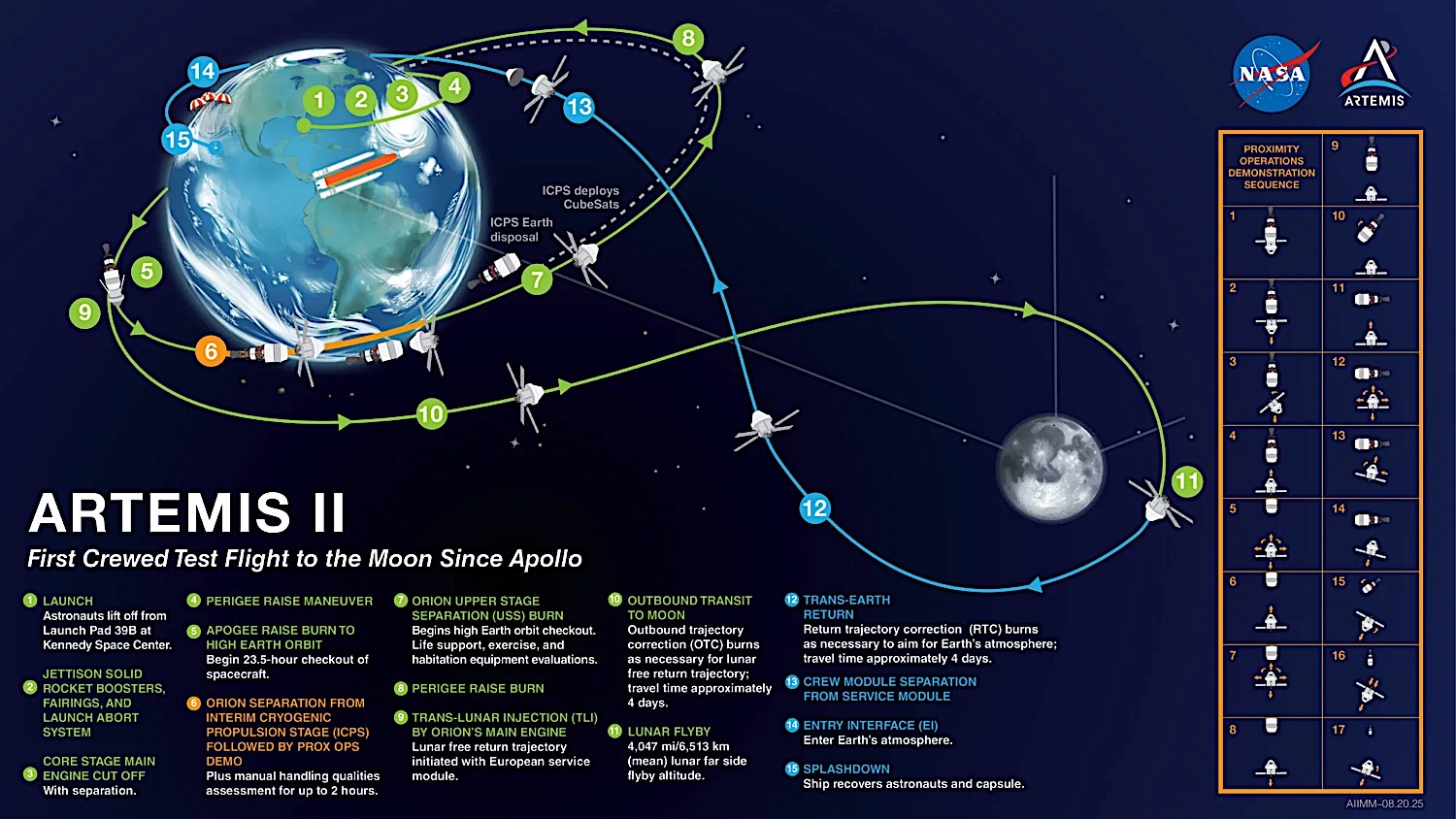
Artemis II utilizes a multi-trans-lunar injection (MTLI) mission profile. The launch will initially place Orion in a highly elliptical Earth orbit. Around 50 minutes post-launch, the Interim Cryogenic Propulsion Stage (ICPS) will ignite to raise the perigee, followed by a 15-minute burn to establish a 23.5-hour high Earth orbit with an apogee of 38,000 nautical miles.
During this high Earth orbit phase, Pilot Victor Glover will take manual control of the Orion spacecraft to perform a proximity operations demonstration. Using the spent ICPS as a visual target, the crew will conduct close formation flying and maneuvering tests to evaluate the spacecraft’s handling qualities against the Cooper–Harper rating scale. Following these tests and system verifications, Orion’s European Service Module (ESM) will execute the final trans-lunar injection (TLI) burn, placing the spacecraft on a free-return trajectory around the Moon.
Communications and Secondary Payloads
Artemis II will serve as a critical testbed for deep-space avionics and biomedical engineering:
- O2O Optical Communications: The mission will demonstrate the Orion Artemis II Optical Communications System (O2O). This module utilizes a 4-inch telescope and two gimbals to establish a laser communication link with ground stations in California and New Mexico, targeting downlink rates of up to 260 megabits per second.
- International CubeSats: The ICPS stage adapter ring will deploy five international CubeSats into high Earth orbit. Payloads include Germany’s TACHELES, designed to test electrical component degradation in space, and Argentina’s ATENEA, which will map the radiation environment and test long-distance communications.
- Biomedical Analogues: The crew will deploy the AVATAR (A Virtual Astronaut Tissue Analog Response) payload, utilizing organ-on-a-chip devices to measure the biological effects of deep-space radiation and microgravity on human tissue outside the protective Van Allen Belt.
Mission Outline (quoted from NASA) [6]
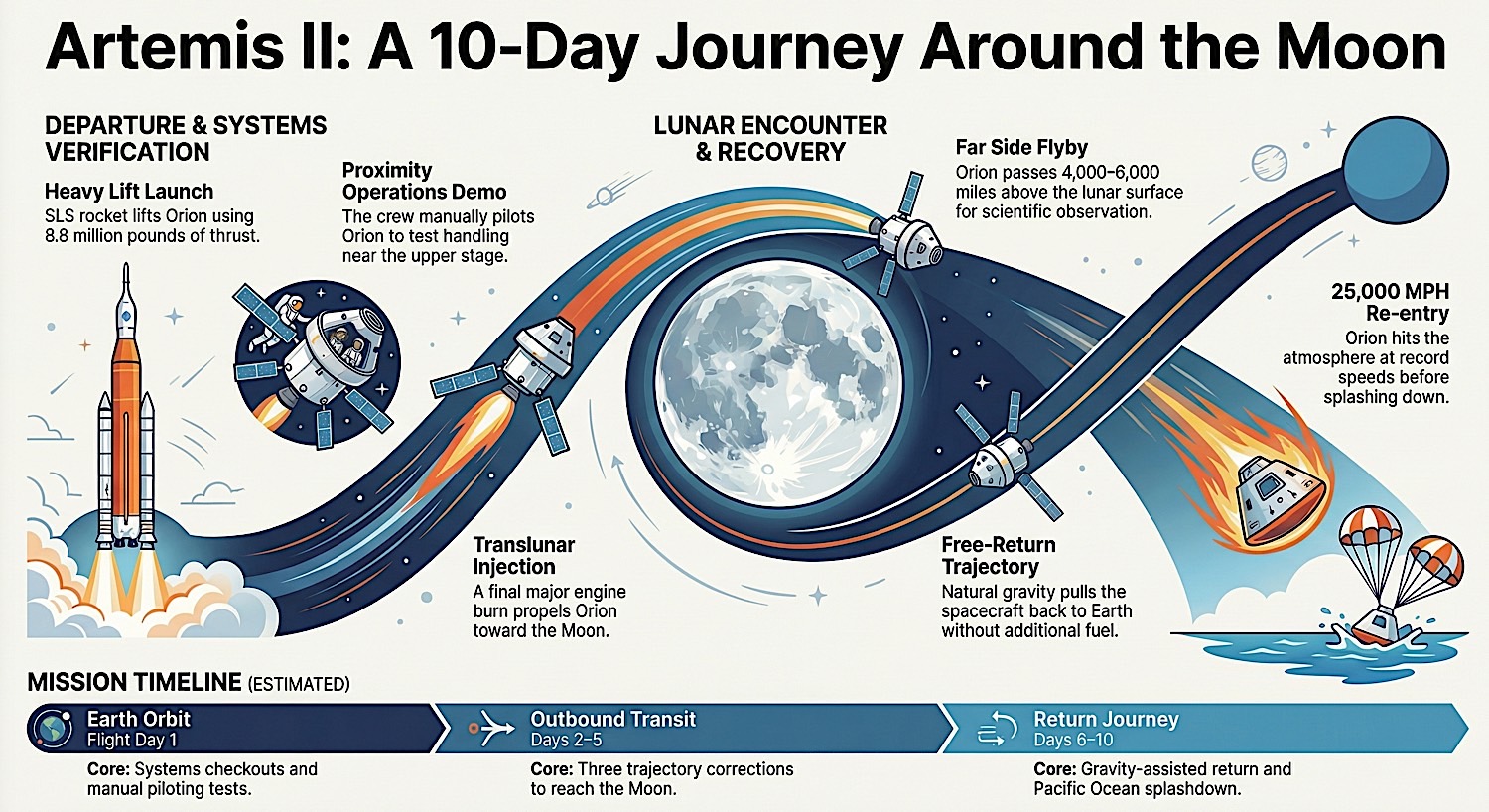
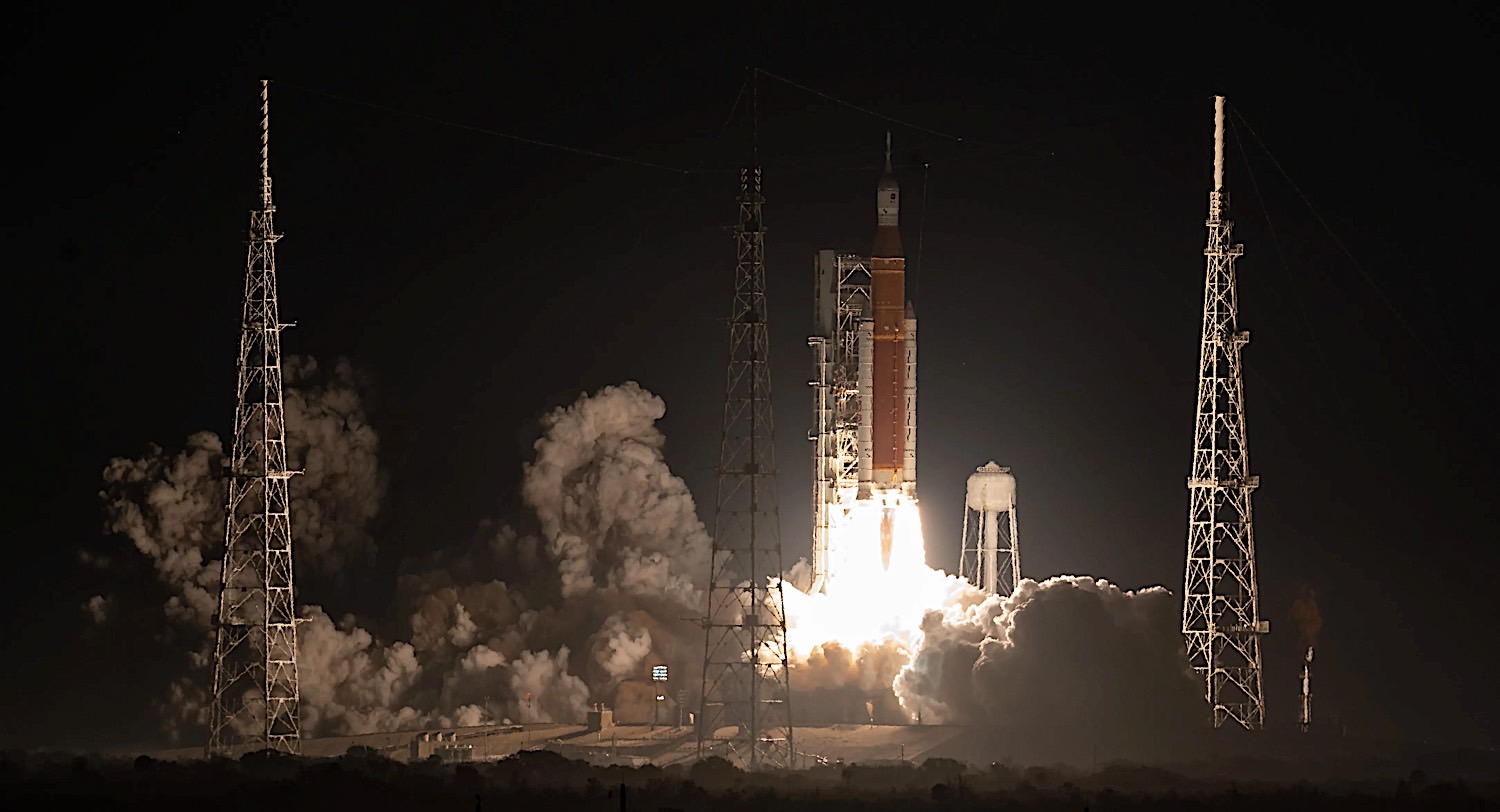
- Launch – The SLS will lift Orion and the crew away from the Earth using more than 8.8 million pounds of thrust.
- Jettison Rocket Boosters, Fairings, and Launch Abort System – As the rocket leaves the atmosphere, its solid rocket boosters will be discarded once they have been emptied of fuel, followed by the panels that protect the Orion service module, and the launch abort system that would pull Orion and the crew to safety in the case of early ascent emergencies.
- Core Stage Main Engine Cut Off – On reaching space, the SLS’s core stage engines shut down, and the core stage separates from the upper stage and Orion.
- Perigee Raise Maneuver – When Orion reaches the apogee, or highest point, of its early, sub-orbital trajectory, the ICPS upper stage will fire its engine to raise its perigee — the lowest point of its orbit – to a safe altitude of 100 miles. Once this burn is complete, Orion and the ICPS will be in a stable low-Earth orbit.
- Apogee Raise Burn to High Earth Orbit – ICPS will fire again roughly an hour later, this time at the perigee of its orbit, to continue raising Orion into a high Earth orbit. This begins a roughly 23-hour checkout of the spacecraft, while Orion and its astronauts are still relatively close to Earth.
- Orion Separation from ICPS followed by Proximity Operations Demonstration – Once the ICPS has done its job, it will separate from Orion and be repurposed as a target for a proximity operations demonstration test – an opportunity for the crew to verify they can safely pilot Orion in manual mode. The ICPS will stand in for spacecraft that Orion would dock to in future missions, while the crew practices flying Orion toward and around it.
- Orion Upper Stage Separation Burn – With proximity operations complete, the crew will use Orion’s orbital maneuvering system engine to move away from the ICPS and make additional observations of the upper stage as it gets farther away. About 15 minutes later, the ICPS will perform its own disposal burn, setting it on a path to reenter the Earth’s atmosphere and burn up over the Pacific Ocean.
- Perigee Raise Burn – At the end of Flight Day 1, the crew will be awakened to perform an additional engine firing to get Orion into the correct orbital geometry for its translunar injection burn on Flight Day 2.
- Translunar Injection by Orion’s Main Engine – The translunar injection burn is the last major engine firing of the mission. It propels Orion on a path toward the Moon and sets it on the free-return trajectory that will ultimately bring crew back to Earth for splashdown. Though only two days into the mission, it essentially doubles as Orion’s deorbit burn, as well.
- Outbound Transit to Moon – Three smaller outbound trajectory correction burns using Orion’s orbital maneuvering system engine over the course of the next three days will ensure the spacecraft stays on target for its journey around the Moon. Just before the crew goes to sleep on Flight Day 5, they’ll enter the lunar sphere of influence, where the pull of the Moon’s gravity will become stronger than the pull of the Earth’s gravity.
- Lunar Flyby – Exactly how close the Artemis II crew will fly to the Moon will depend on when they launch. The Moon will be in a different spot for each of the possible launch dates, and the exact distance will change accordingly, ranging from 4,000 to 6,000 miles above the lunar surface. This is farther from the Moon than Artemis I’s 80 miles above the surface, but still tens of thousands of miles closer than any human has been in more than 50 years. At this distance the Moon will appear to the crew to be about the size of a basketball held at arm’s length.
- The closest the crew will come to the lunar surface will be when Orion flies behind the Moon. At this point, the crew will lose communication with the Earth for anywhere from 30-50 minutes, depending on when they launched. During that time, they will be taking photos and video of the Moon’s far side and making observations to be shared with scientists on the ground after they regain communication.
- Trans-Earth Return – After Orion swings around the far side of the Moon and exits the lunar sphere of influence, its fuel-efficient free return trajectory will harness the Earth-Moon gravity field to pull Orion back to Earth naturally. As on the journey to the Moon, three small return trajectory correction burns along the way will ensure the crew is set up for a safe splashdown. The last of the trio of burns takes place on Flight Day 10, five hours before entry interface, once the crew has begun working through their preparations for coming home.
- Crew Module Separation from Service Module – With its work done, Orion’s service module, containing the engines responsible for the burns that steer the spacecraft and propel it through space, will separate from the crew module. This exposes the crew module’s heat shield, which will protect the astronauts through the heat of reentry. The service module will then be allowed to burn up in the Earth’s atmosphere.
- Entry Interface – The crew module’s reaction control system engines will steer the heatshield into the direction of travel to prepare for peak heating. While still 400,000 feet – almost 76 miles – above Earth, Orion will begin to feel the effects of the Earth’s atmosphere for the first time since launch. Within a matter of seconds, superheated plasma will begin to build up around the spacecraft as the friction of the surrounding atmosphere increases. Orion will experience temperatures around 3,000 degrees Fahrenheit, and communications with the crew will be temporarily blocked by the plasma.
- Splashdown – Once Orion has made it through the heat of reentry, the cover that has been protecting its forward bay is cast off to make way for the parachutes to deploy and begin slowing Orion down. Two drogue parachutes, each 23 feet in diameter, will unfurl at an altitude of 25,000 feet and slow the capsule down to 307 mph. At 9,500 feet, three 11-foot-wide pilot parachutes will deploy to pull the final three main parachutes. The 116-foot-wide main parachutes slow Orion from about 130 mph to just 17 mph for splashdown.
References
- “Artemis II” – Wikipedia Used for: Technical mission history, the RS-25 engine E2063 swap, heat shield (AVCOAT) inspection findings and trajectory adjustments, Orion orbit parameters, and secondary payload details (O2O communications, TACHELES, and ATENEA CubeSats). Link: https://en.wikipedia.org/wiki/Artemis_II
- “NASA Finalizes Artemis II Rollout, Crew Begins Quarantine” – NASA,, Used for: Current March 2026 rollout operations, including the 11-million-pound stack, crawler-transporter 2’s 1 mph/12-hour journey, and the crew entering quarantine in Houston on March 18. Link: https://www.nasa.gov/news/
- “Artemis II: NASA’s First Crewed Lunar Flyby in 50 Years” – NASA, Used for: Overview of the mission’s deep-space science objectives, specifically the AVATAR (A Virtual Astronaut Tissue Analog Response) payload and organ-on-a-chip devices. Link: https://www.nasa.gov/missions/artemis/
- “Our Artemis Crew” – NASA, Used for: Confirmation of the Artemis II crew roster (Commander Reid Wiseman, Pilot Victor Glover, Mission Specialist Christina Koch, and CSA Mission Specialist Jeremy Hansen) and their deep-space operational objectives. Link: https://www.nasa.gov/humans-in-space/astronauts/
- “Space Launch System (SLS)” – NASA Used for: Details on the SLS Block 1 capabilities and its role as the only rocket capable of sending Orion, astronauts, and cargo to the Moon in a single launch. Link: https://www.nasa.gov/missions/artemis/
- Artemis II Press Information page: https://www.nasa.gov/artemis-ii-press-kit/