
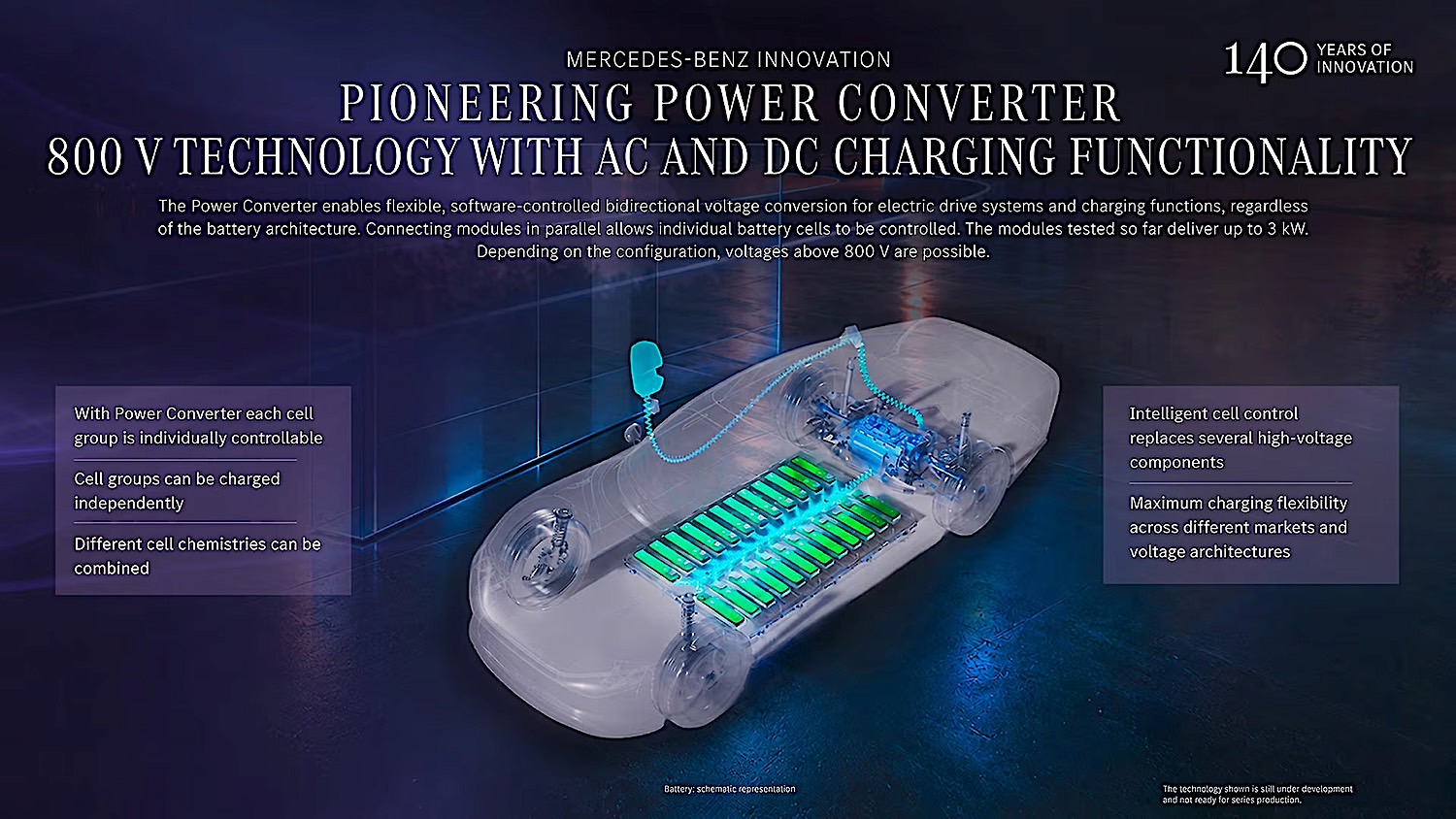
Engineered Desing Solution: Mercedes-Benz presented a research-stage power converter that uses programmable microconverters to regulate energy at the individual battery-cell or cell-group level, producing a stable high-voltage output of up to 800 V regardless of cell state of charge or ageing. The current generation delivers up to 3 kW per module and supports both AC and DC applications. Multiple units can operate in parallel to scale output. Mercedes has given no production timeline and no model assignment.
Engineered Design Challenge: the significance is not the 3 kW figure. It is the decoupling of pack voltage from cell count, and the consolidation of charging functions into a distributed, software-controlled power electronics layer inside the battery pack. That shifts design constraints for thermal management, serviceability, and pack architecture.
Top Five Things to Know
(From an Engineering Design Perspective)
1. The series-string constraint is being designed out.
In a conventional EV pack, the traction bus voltage is a direct function of how many cells are wired in series. To reach 800 V, you stack more cells, and the inverter, wiring, and converters are all designed around a bus voltage that swings with state of charge . Mercedes’ approach places programmable microconverters at the cell or cell-group level, with their outputs combined in parallel to supply a stable DC high-voltage output. The design implication is that pack voltage becomes a software-controlled output specification rather than a hard consequence of cell count.
2. Function consolidation is the real packaging play.
The converter architecture is intended to handle AC/DC conversion and bidirectional charging (V2H, V2G) within a common hardware family . That could eventually absorb the standalone onboard charger (OBC), which today handles AC-to-DC conversion for wallbox and public AC charging . For pack designers, this means power electronics migrate into the battery enclosure rather than sitting in a separate under-hood or rear-mounted box. The trade-off is serviceability: putting more power electronics at the battery means fault repair may require access to a more complex assembly, and how Mercedes packages the converters for service access remains unclear.
3. The 3 kW module figure defines the scaling problem, not the solution.
At 3 kW per converter, traction-level power would require many modules operating in parallel . That is not a flaw in the concept; it is the modular logic. But it means the engineering challenge is not making one converter more powerful. It is coordinating many converters, managing circulating currents, and distributing thermal load across the pack. The German trade press is explicit that the many decentralized converters increase electronics and control-software complexity, and raise requirements for semiconductors, cost control, long-term durability, and thermal management inside the pack . Those are the design bottlenecks, not the cell chemistry.
4. Stable bus voltage changes the inverter design envelope.
If the traction inverter sees a steady 800 V instead of a bus that falls as the pack discharges, it can be optimized around a fixed input rather than a wide operating window . Mercedes also frames the approach as enabling more compact and flexible battery and power-electronics designs, with potential efficiency gains across the electric chain . For inverter and motor designers, a regulated bus could simplify magnetics and switching-loss optimization. For pack designers, the constraint moves to ensuring the converter array can hold that bus under all load and temperature conditions.
5. Cell-level control opens degradation-management options, but adds thermal density.
Because individual cell groups can be controlled independently, weaker or ageing cells could be loaded less aggressively, and a failing cell group could theoretically be isolated to allow reduced-capacity operation . That is a durability and range-retention story, not a peak-performance story. The thermal counterpoint: power electronics distributed at cell level place heat sources inside the pack, adjacent to cells that are already thermally sensitive. The AutoScout24 analysis flags thermal management inside the battery pack as one of the unresolved hurdles alongside cost, durability, and semiconductor requirements . For cooling-system designers, this is the immediate first-order problem: where the heat goes, and whether the pack cooling plate can serve both cells and converters without a separate loop.
Engineered Design Highlights
What was announced. Mercedes-Benz presented the Power Converter on November 3, 2026, alongside separate display-technology research. The company describes it as a technology for future EVs, not a production-committed component. The German source materials state explicitly that the technology is still in development and not yet available for series production .
The architecture. Programmable microconverters sit at the cell or cell-group level. Multiple converters operate in parallel to provide a stable high-voltage DC output up to 800 V, independent of the number of series-connected cells . The current generation is rated at up to 3 kW per module and supports AC and DC applications, with bidirectional charging (V2H/V2G) identified as a future capability of the architecture .
The claimed benefits. Mercedes cites more flexible, efficient, and compact battery and power-electronics design; potential consolidation of currently separate charging hardware; and improved range and modularization for both BEV and PHEV powertrains . One analysis suggests a portion of the pack could stay idle on short trips and be reactivated for longer journeys, and that a failing cell could be isolated to maintain reduced-capacity operation . These are prospective capabilities, not measured results.
The honest caveat. No production timeline, no model assignment, and no validated thermal or durability data have been released . The 3 kW figure is converter capability, not vehicle charging speed or motor output . The concept’s viability depends on solving pack-level thermal management, semiconductor cost and supply, control-software complexity, and service access for distributed electronics inside the battery enclosure . Until those are demonstrated, this is a design-direction signal rather than a production forecast.
Citation List
1. EV Engineering & Infrastructure — “Mercedes-Benz develops programmable power converter for 800-V EV systems”
https://www.evengineeringonline.com/mercedes-benz-develops-programmable-power-converter-for-800-v-ev-systems/
Summary: Core technical description: cell- or cell-group-level energy management, stable 800 V output regardless of state of charge or ageing, parallel converter scaling, 3 kW current generation, AC/DC and bidirectional potential. Notes further development required for higher-power EV systems.
2. Charged EVs — “Mercedes-Benz develops a power converter that controls individual battery cells”
https://chargedevs.com/newswire/mercedes-benz-develops-a-power-converter-that-controls-individual-battery-cells/
Summary: Confirms the decentralized converter architecture, the decoupling of output voltage from series cell count, and the function-consolidation thesis. States 3 kW and AC/DC support, with V2H/V2G as prospective capabilities.
3. Mercedes-Benz Media (German) — Power Converter description
https://media.mercedes-benz.com/content/products-brands/mercedes-benz-cars/all-electric/eqs/(lightbox:image/10de2e9f-b4e5-4b6e-a642-1bb7f0270018)?entity=image&sort=display_date,desc
Summary: Primary manufacturer source (German). Confirms the technology is in development and not available for series production. Brief but citable for the official status statement.
4. everything PE — “Mercedes-Benz Advances EV Technology with 800 V Power Converter and Next-Generation Displays”
https://www.everythingpe.com/News/details/12362-mercedes-benz-advances-ev-technology-with-800-v-power-converter-and-next-generation-displays
Summary: Confirms 3 kW current generation, AC/DC support, parallel modular arrangement, and the prospective integration of V2H/V2G functions. Notes broader integrations remain prospective.
5. Driven Car Guide — “Mercedes tests windows that display warnings and separate passenger views”
https://www.drivencarguide.co.nz/news/mercedes-tests-windows-that-display-warnings-and-separate-passenger-views/#1
Summary: Useful for the caveat that 3 kW describes converter capability, not vehicle motor output or charging speed. Also notes no measured range increase was provided.
6. Auto Motor und Sport (German) — “Mercedes-Ladetechnik für Elektroautos: Power Converter hält 800-Volt-Spannung konstant”
https://www.auto-motor-und-sport.de/tech-zukunft/konstante-800-volt-trotz-zellalterung-mercedes-power-converter/#1
Summary: Strong technical analysis. Explains the conventional OBC role, how the Power Converter could absorb AC/DC and bidirectional functions, the break from series-determined bus voltage, and the parallel-module scaling logic. Notes Mercedes has announced no model or production timeline for the architecture.
7. Car-Revs-Daily — “Mercedes Targets a New Route to Improve Electric Vehicle Efficiency and Autonomy”
https://www.car-revs-daily.com/2026/11/05/mercedes-targets-a-new-route-to-improve-electric-vehicle-efficiency-and-autonomy/
Summary: Provides the November 3, 2026 presentation date, the cell-by-cell control thesis, and the prospective benefits around range retention, cell isolation, and slower degradation. Frames the technology as a research project with no model commitment.
8. AutoScout24 (German) — “Mercedes arbeitet an neuer 800-Volt-Batterietechnik”
https://news.autoscout24.ch/news/mercedes-entwickelt-flexiblere-800-volt-batterietechnik
Summary: Best source for the unresolved engineering hurdles: increased electronics and control-software complexity, semiconductor requirements, cost control, long-term durability, and thermal management inside the battery pack. Also notes theoretical possibility of mixed cell chemistries in one pack.
9. InsideEVs (German) — “Mercedes Power Converter: Neue Technik für 800 Volt vorgestellt”
https://insideevs.de/news/814510/mercedes-power-converter-technik-800volt/
Summary: Confirms the constant 800 V output independent of state of charge and ageing, 3 kW per module, AC/DC capability, and the potential to consolidate separate components into one hardware unit. States the technology is in development and not ready for series production.
10. Interesting Engineering — “Mercedes plans 800-volt EV system using 3 kW converters to boost efficiency”
https://interestingengineering.com/transportation/mercedes-targets-steady-800-volt-flow
Summary: Best source for the inverter-design implication (fixed 800 V input allows inverter optimization) and the serviceability question. Notes that putting more power electronics at the battery could complicate fault repair and that repair implications remain unclear.
11. AutoScout24 (English) — “Mercedes develops more flexible 800-volt battery technology”
https://news.autoscout24.ch/en/news/mercedes-develops-more-flexible-800-volt-battery-technology
Summary: English version of the German analysis. Same content on unresolved hurdles, mixed-chemistry theoretical possibility, and absence of production timing.
12. Automotive World — “Mercedes-Benz shows cell-level converter for 800V packs”
https://www.automotiveworld.com/news/mercedes-benz-shows-cell-level-converter-for-800v-packs/
Summary: Confirms no production timing was given. Notes that at 3 kW per unit, traction-level power would rely on many modules working together, and that combining functions could improve range for BEV and PHEV models.
13. Motor Fan (Japanese) — Microconverter architecture analysis
https://motor-fan.jp/article/1670174/
Summary: Tabular summary of specifications: max 800 V output, 3 kW prototype, AC/DC and bidirectional support, cell/cell-group parallel microconverter topology, BEV/PHEV target, production timing undetermined. Confirms the decoupling of high-voltage generation from physical series cell count.
14. Auto Journal (French) — “Mercedes explore une nouvelle piste pour rendre ses voitures électriques plus efficaces et autonomes”
https://www.autojournal.fr/actu/mercedes-nouvelle-piste-voitures-electriques-efficaces-autonomes-430489.html#1
Summary: Confirms November 3, 2026 presentation date. Frames the architecture as a research project with no specific model or production calendar announced.
15. Ecolo Auto (French) — “Mercedes-Benz développe un convertisseur électrique révolutionnaire pour la conception des batteries de 800 V”
https://ecoloauto.com/mercedes-benz-developpe-un-convertisseur-electrique-revolutionnaire-pour-la-conception-des-batteries-de-800-v/
Summary: Notes that 3 kW remains far from full propulsion needs (tens to hundreds of kW), and that the challenge is demonstrating scalability while retaining efficiency, compactness, and thermal management advantages.