
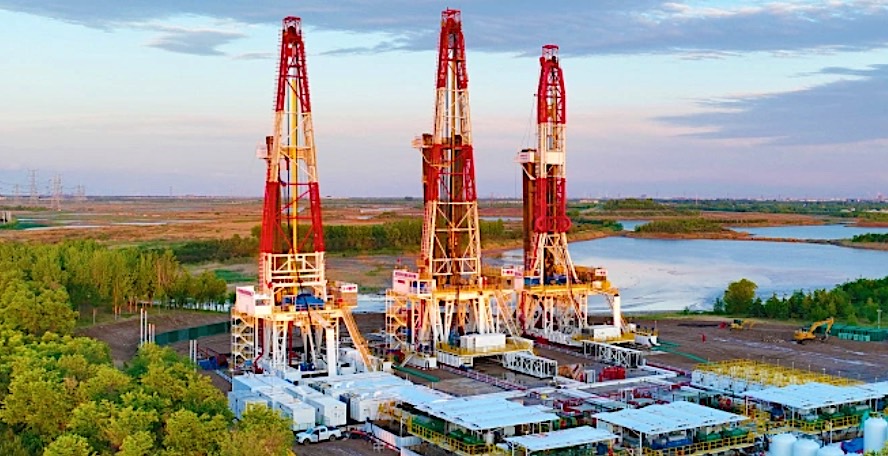
Engineered Design Opportunity: Sinopec’s Shengli Oilfield drilled the Fengye 1-8-B13HF well to 6,000+ meters in 11.68 days, setting a Chinese record for continental shale oil at that depth. The first batch of 12 wells on the Minfeng 8 pad averaged 13.83 days, with daily footage exceeding 2,000 meters . The pad uses a “new-type well factory” model in which three rigs share one surface system and drill wells in assembly-line sequence .
Engineered Design Innovation: For drilling and industrial engineers, the transferable innovation is not a faster bit or a new mud formula. It is the redesign of the pad as a shared-resource production system: fewer pumps, fewer tanks, staggered high-power operations, and a batch-drilling schedule that treats wells as units on a line rather than individual projects.
Top Five Things to Know
(From an Engineering Design Perspective)
1. The constraint was surface space, and the solution was scheduling, not footprint.
The Minfeng 8 pad sits on an area smaller than two football fields. Under a conventional small-well-cluster layout, the site could hold at most 18 wells. The team instead deployed 36 wells across the block in phased, multi-layer development, with drilling, fracturing, and commissioning linked in continuous sequence . The design decision was to accept a denser well plan and solve the resulting operational conflict through sequencing rather than expanding the site.
2. Three rigs sharing one surface system is the core architectural move.
The “three-rig integrated operation system” consolidates what would normally be three separate rig packages into one shared surface infrastructure. Drilling pumps dropped from 9 to 6; circulation tanks from 21 to 15 . The rig crews were reorganized from “one crew, one full set” to “one system, three drilling units” . For pad designers, this is a resource-pooling problem: which surface equipment can be time-shared without creating a bottleneck, and which must remain dedicated to avoid waiting.
3. Electrical load scheduling is as important as fluid logistics.
The team staggered high-power operations across shifts, cutting site electrical load by two-thirds . That is a significant grid-connection constraint removed, and it matters for remote pads where power supply is a design limit. The engineering implication is that the pad’s electrical load profile was treated as a schedulable variable, not a fixed demand. Pumping, hoisting, and circulation loads were sequenced to avoid coincident peaks.
4. The productivity gain came from reducing fixed cost per well, not from drilling faster in isolation.
A deep rig that previously completed 4–5 wells per year now delivers more than 10 . Drilling efficiency rose 75%, cycle time fell 82%, and per-well investment dropped 55% . Headcount fell 30% . These are system-level numbers: the rig’s annual fixed cost is spread across more wells because the shared surface system and batch schedule reduce the idle time between wells. For drilling engineers, the lesson is that pad-level scheduling can matter as much as rate-of-penetration improvements.
5. The model is being replicated, not treated as a one-off.
Shengli management describes the Minfeng 8 pad as a “mother body” for a “cell division” rollout: the model is intended to be copied to other pads in the Jiyang demonstration zone . The zone has reported 327 million tonnes of proven reserves and cumulative production above 2.2 million tonnes, with core equipment localization above 95% . The replication intent matters for engineering designers because it signals that the shared-surface, batch-schedule architecture is being standardized, not just demonstrated.
Highlights
The record well. Fengye 1-8-B13HF was completed in 11.68 days at the Minfeng 8 pad in the Jiyang national shale oil demonstration zone, Dongying, Shandong. The first 12 wells on the pad averaged 13.83 days .
The geological context. Jiyang shale is deep, high-temperature, and fault-dense. Early wells took more than 100 days to drill, and foreign companies reportedly assessed the resource as not commercially viable . The improvement from 100+ days to 13.83 days average is roughly a sevenfold reduction .
The resource target. Sinopec frames the operational breakthrough as opening a cost-effective development path for 10.52 billion tonnes of shale oil resources in the Jiyang area .
The honest caveat. All performance figures come from Sinopec’s announcement. The available sources do not describe independent verification of the drilling-cycle numbers or the efficiency percentages . The 11.68-day figure is a single-well record; the 13.83-day figure is the pad average for the first 12 wells. The 36-well pad is being developed in phases, and the full-pad performance has not been reported.
Citation List
1. Xinhua (Arabic) — “11.68 يوم.. الصين تحقق رقما قياسيا محليا في حفر بئر نفط صخري”
http://arabic.news.cn/20261116/f44cd8da71e345b7bf7403c418421d34/c.html
Summary: Official Xinhua account confirming the 11.68-day record, the 13.83-day pad average, the 2,000+ meter daily footage, the 75%/82%/55%/30% improvement figures, and the rig productivity increase from 4–5 to 10+ wells per year. Notes the shared-system model and the 10.5 billion tonne resource target.
2. CCTV (央视网) — “视频丨11.68天!我国深层页岩油钻井速度刷新纪录”
https://ysxw.cctv.cn/article.html?toc_style_id=feeds_default&t=1794617165696&item_id=15157525794489580722
Summary: Strongest source for the equipment consolidation details: three rigs integrated into one system, mud pumps from 9 to 6, circulation tanks from 20+ to 10 (the article says “10个” in one passage; other sources say 15), and the “one system, three drilling units” crew reorganization. Also confirms the 36-well phased plan and the small-pad surface constraint.
3. 中国发展网 (China Development) — “我国深层页岩油最短钻井周期纪录刷新”
http://www.chinadevelopment.com.cn/news/ny/2026/11/2025838.shtml
Summary: Best single source for the specific equipment counts and the electrical-load scheduling: drilling pumps 9 to 6, circulation tanks 21 to 15, staggered high-power operations, site power load cut by two-thirds, headcount down 30%. Also confirms the 36-well layout on a sub-two-football-field site, the 3.27 billion tonne proven reserves, and the “cell division” replication plan.
4. Global Times — “Sinopec sets Chinese drilling record for deep continental shale oil wells at Shengli Oilfield”
https://www.globaltimes.cn/page/202611/1374366.shtml
Summary: English-language confirmation of the core figures: 11.68-day record well, 13.83-day average, pump count 9 to 6, tank count 21 to 15, power load down two-thirds, headcount down 30%, efficiency up 75%, cycle down 82%, investment down 55%, rig productivity from 4–5 to 10+ wells/year.
5. chemXplore — “Sinopec sets record for deep shale oil drilling cycle”
https://chemxplore.com/news/china-deep-shale-oil-drilling-record
Summary: Concise English trade summary confirming the 36-well phased plan, the three-rig system, the power and labor reductions, and the demonstration zone reserve and production figures. Useful as a secondary confirmation.
6. Yahoo Finance — “Deeper than 19,685 feet: China sets new drilling speed record for shale oil wells”
https://finance.yahoo.com/energy/articles/deeper-19-685-feet-china-123004563.html
Summary: English-language account that explicitly notes all figures come from Sinopec’s announcement and that no independent verification was described. Useful for the sourcing caveat.
7. 人民日报客户端 / QQ News — “我国深层页岩油钻井周期刷新纪录”
https://news.qq.com/rain/a/20261116A0710000
Summary: People’s Daily client account confirming the 21-to-15 tank count, the 9-to-6 pump count, the staggered power scheduling, the 100+ day baseline, and the 36-well phased development plan. Notes the demonstration zone’s 3.27 billion tonne reserves and 2.2 million tonne cumulative production.
8. 科技日报 / 中国科技网 — “11.68天!我国深层页岩油钻井速度刷新纪录”
https://www.stdaily.com/web/gdxw/2026-11/16/content_613949.html
Summary: Brief Science and Technology Daily item confirming the 11.68-day record. Useful as a headline confirmation but lacks the equipment-level detail of the other sources.