
Problem to be Solved (with Engineered Design): How to get a fuel-less spacecraft into a retrograde heliocentric orbit without tilting a reflective sail to an attitude where it stops working.
Summary of Possible Solution: A Sun-facing diffractive sail (SFDS) using an H-reversal trajectory could deliver a kinetic impactor to asteroid Apophis at roughly 100 km/s within 200–300 days of launch, transferring far more energy per kilogram than the DART mission did . The Beihang team’s preprint reports that a one-stage diffraction-angle strategy increases impact velocity by 21% and reduces mission duration by 35% compared with a conventional reflective sail; a two-stage strategy adds another 9 km/s .
Top Five Things to Know
(From an Engineering Design Perspective)
1. The H-reversal maneuver is an orbital-mechanics trick, not a propulsion breakthrough.
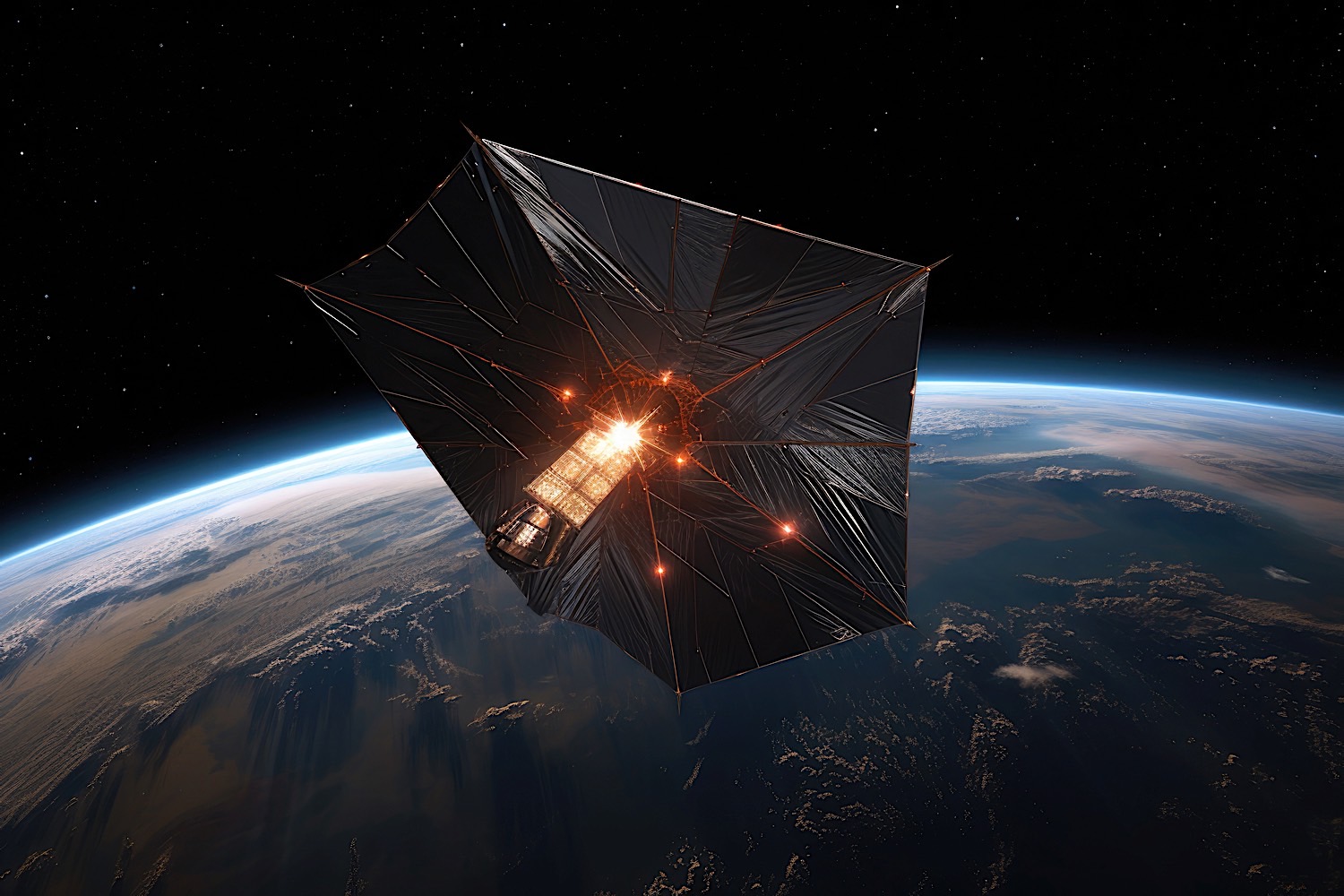
The concept, originally proposed by Giancarlo Vulpetti in the 1990s, uses the sail first as a brake to reduce the spacecraft’s angular momentum to near zero. Solar gravity then pulls the craft inward toward perihelion. At closest approach, the sail generates thrust again and slings the craft outward into a retrograde orbit . No chemical propellant is burned after launch. The engineering question is whether the sail can survive the thermal environment at perihelion and execute the thrust reversal precisely enough to achieve the target orbit.
2. The diffractive sail exists because reflective sails are bad at this maneuver.
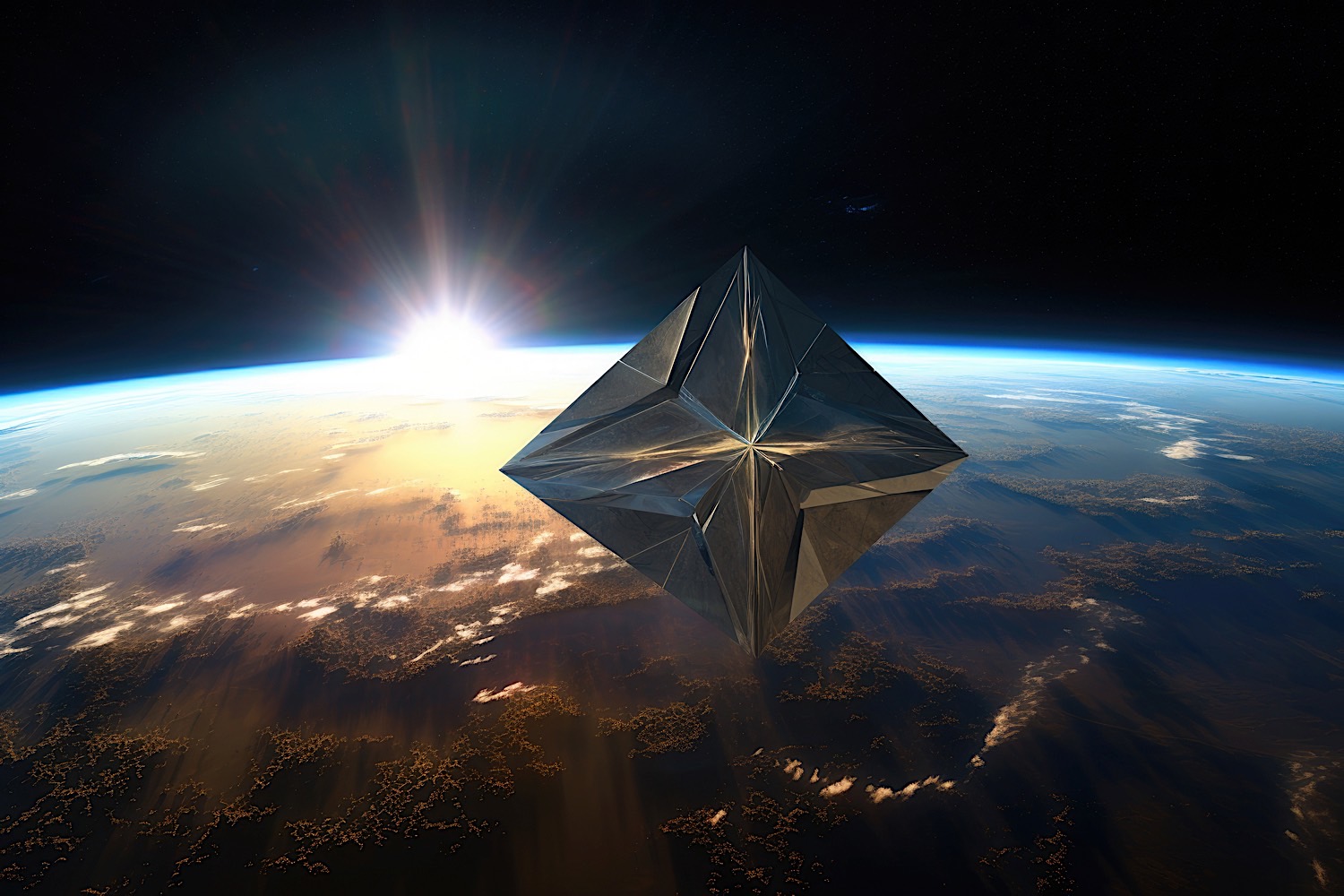
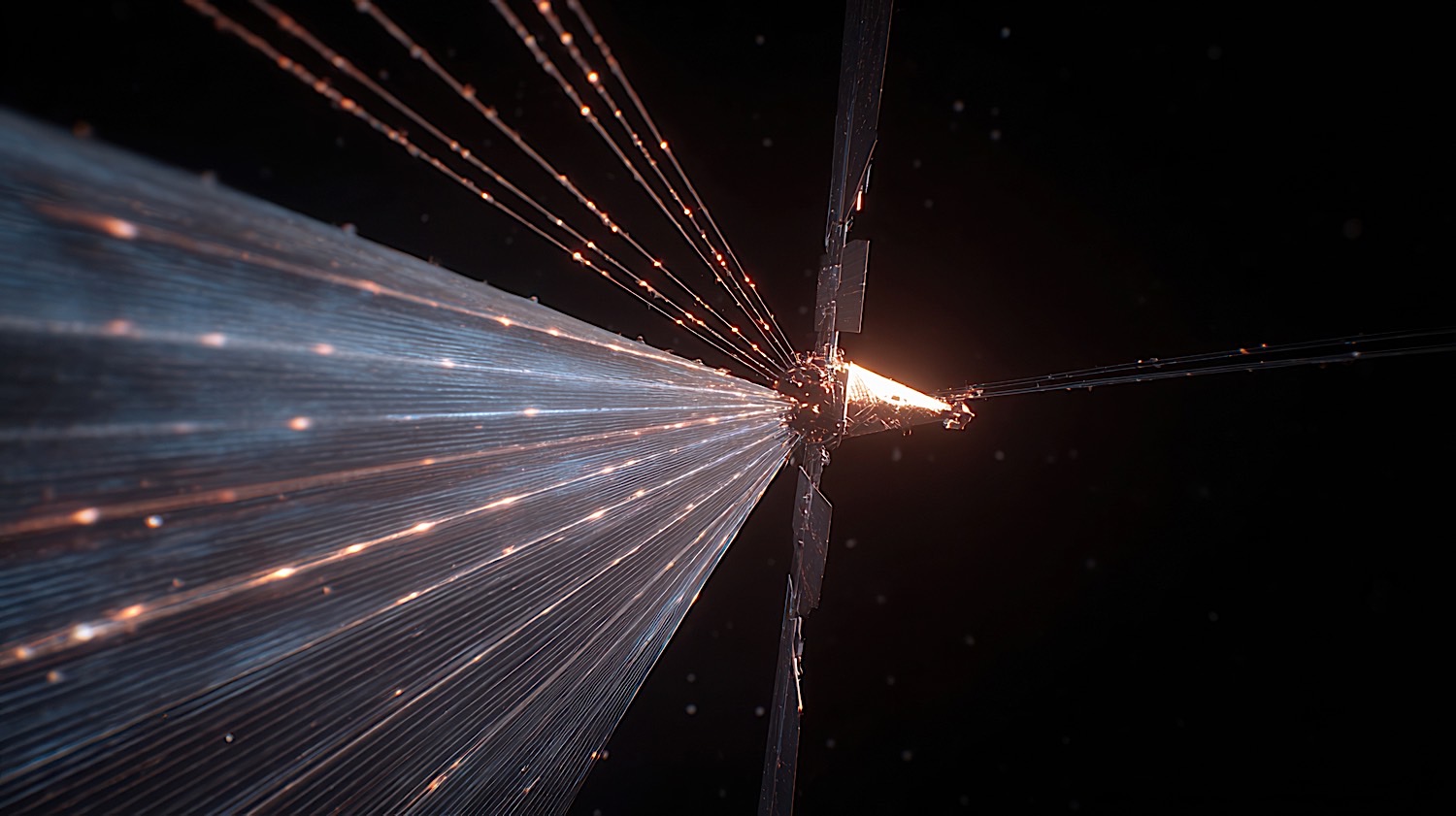
A conventional reflective sail generates thrust perpendicular to its surface. To produce the large transverse thrust needed for an H-reversal, it must be tilted at a high cone angle to the Sun, which reduces the effective illuminated area and couples thrust direction to attitude . The diffractive sail uses microstructured optical gratings to redirect photons sideways while the sail face remains pointed at the Sun. This decouples thrust direction from attitude and keeps the full sail area illuminated . For designers, this is the core architectural trade: a more complex optical surface in exchange for simpler attitude control and higher effective thrust during the critical perihelion phase.
3. The paper’s contribution is a feasibility map, not a hardware design.
The Beihang team used a hodograph method to map the parameter space where H-reversal trajectories are feasible under perihelion-distance constraints. They then developed trajectory design methods for two control strategies: a fixed diffraction angle (one-stage) and a switchable diffraction angle that changes between the inbound and outbound phases (two-stage) . The two-stage strategy is the one that adds the 9 km/s velocity gain. This is a guidance and trajectory optimization contribution. The paper does not address how to manufacture a diffractive sail with those optical properties, how to deploy it, or how to control it thermally.
4. The Apophis case is a benchmark, not a target.
Apophis is used because its orbit is well characterized and it makes a close approach in 2029. NASA has ruled out an impact threat for at least the next century . The simulations use Apophis to compare SFDS performance against reflective sails under a consistent scenario, not to propose an actual deflection mission . The 100 km/s and 200–300 day figures are outputs of that simulation, not mission design commitments.
5. The engineering readiness level is very low.
The preprint is dated August 2026 and has not completed peer review . No diffractive sail of this scale has been flown. The closest flight demonstrations are IKAROS (JAXA, 2010) and LightSail 2 (Planetary Society), both reflective sails, and neither attempted an H-reversal maneuver . The Beihang paper is a mathematical feasibility study. It establishes that the trajectory exists in simulation. It does not establish that the sail can be built, deployed, or controlled to follow it.
Highlights of the Concept
(Periodically updated)
What the paper claims. Under a solar sail lightness number (β) of 0.7 and a target perihelion radius of 0.3 AU, the one-stage SFDS strategy increases impact velocity by 21% and reduces mission duration by 35% compared with a reflective sail. The two-stage strategy adds an additional 9 km/s . For an Apophis impact scenario, both strategies deliver an impactor at approximately 100 km/s in 200–300 days .
Why the velocity matters. Kinetic energy scales with the square of velocity. DART impacted Dimorphos at roughly 6 km/s. At 100 km/s, a given impactor mass carries on the order of 230 times the kinetic energy per kilogram . That is the entire argument for attempting a retrograde intercept rather than a co-orbital trailing impact.
The caveat the popular coverage buries. The Universe Today piece and the Spanish-language coverage describe the concept clearly but do not emphasize that the result is a preprint simulation . One Chinese-language technology account explicitly notes: “This is a preprint, not yet peer-reviewed” . The Beihang paper is a trajectory-feasibility study. It is not a mission proposal, and no space agency has committed to building a diffractive sail for planetary defense.
Citation List
1. arXiv — “Sun-Facing Diffractive Sail H-Reversal Trajectory: Theoretical Feasibility, Design Strategies, and Applications” (abstract)
https://arxiv.org/abs/2608.04596
Summary: Primary source. Zhang, Fu, Wu, Cheng, and Gong, Beihang University. Submitted August 5, 2026. Confirms the 21% velocity increase, 35% mission-duration reduction, and 9 km/s additional gain from the two-stage strategy. States the paper’s scope: feasibility mapping and trajectory design, not hardware development.
2. arXiv — Full text (HTML)
https://arxiv.org/html/2608.04596v2
Summary: The complete preprint. Contains the dynamical model, the hodograph-based feasibility analysis, the one-stage and two-stage diffraction-angle strategies, and the Apophis simulation results. Best source for the engineering-level detail on why reflective sails are limited and how the diffractive sail decouples thrust from attitude.
3. arXiv PDF — Full text
https://export.arxiv.org/pdf/2608.04596
Summary: PDF version of the same preprint. Includes the parameter feasibility domains and the perihelion-constrained phase-matching algorithm for the one-stage strategy.
4. Universe Today — “How Diffractive Solar Sails Could Stop a Killer Asteroid at 100 km/s”
https://www.universetoday.com/articles/how-diffractive-solar-sails-could-stop-a-killer-asteroid-at-100-kms
Summary: The popular article you found. Accurate on the concept and the 100 km/s / 230× energy framing, but does not emphasize that the source is an unrefereed preprint. Useful for communicating the idea to a general engineering audience, not for technical verification.
5. El Confidencial — “El nuevo plan de China para impedir que asteroides impacten en la Tierra: usar velas solares”
https://www.elconfidencial.com/tecnologia/novaceno/2026-09-25/velas-solares-investigacion-espacio-asteroides-asesinos_4432439/
Summary: Spanish-language coverage that explains the H-reversal maneuver and the reflective-vs-diffractive distinction clearly. Confirms the Beihang affiliation and the DART comparison. Useful for European editorial framing.
6. Gizmodo en Español — “China tiene una idea para desviar asteroides mucho más brutal que DART”
https://es.gizmodo.com/china-tiene-una-idea-para-desviar-asteroides-mucho-mas-brutal-que-dart-golpearlos-de-frente-a-100-km-s-usando-unicamente-la-luz-del-sol-2000260551
Summary: Confirms the 21%/35%/9 km/s figures and the Apophis benchmark. Notes that NASA has ruled out an Apophis impact threat for the next century, which is useful for the “benchmark, not target” framing.
7. 网易 — “撞小行星别追尾,迎面撞!中国北航算出100公里每秒逆行航线”
https://www.163.com/dy/article/L7ISDB4T0556BYNQ_pdya11y.html