
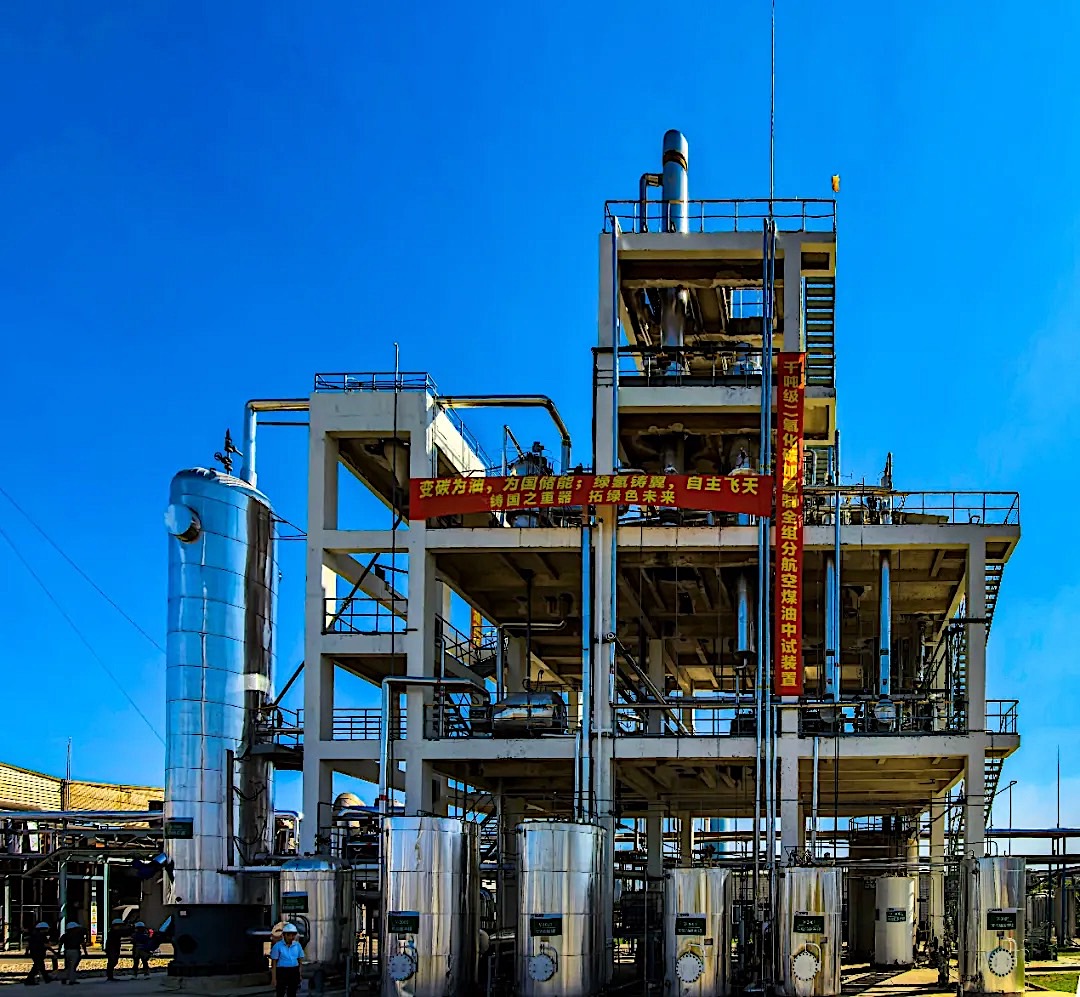
Engineered Design Goal: A Tsinghua University team led by Professors Fei Wei and Chenxi Zhang has demonstrated a one-step catalytic route that converts industrial CO₂ and green hydrogen directly into certified jet fuel at kiloton scale. A 72-hour continuous test at the Meishan, Sichuan pilot plant achieved 97.37% CO₂ conversion, 92.37% selectivity to C₈⁺ aviation-range hydrocarbons, and only 1.67% methane byproduct . The product meets China’s GB 6537-2025 No. 3 Jet Fuel standard and is a full-range aromatic drop-in fuel, unlike paraffinic HEFA SAFs . A 50,000-ton commercial demonstration is planned for Ordos, Inner Mongolia .
Engineered Design Significance: For process engineers, the significance is the reactor and catalyst co-design. The single-step high-pressure fluidized-bed route collapses what conventionally requires multi-stage Fischer-Tropsch or methanol-to-jet processing into one reactor, with a bifunctional catalyst doing the selectivity work that downstream units normally handle.
Top Five Things to Know
(From an Engineering Design Perspective)
1. The catalyst is a nanoscale splitter, not a single active site.
The team’s “catalytic shunt” strategy uses a nano-spinel–zeolite bifunctional coupled catalyst. The spinel component activates CO₂ hydrogenation; the zeolite handles carbon–carbon coupling. The innovation is matching these two functions at the nanoscale so that CO₂ activation and chain growth occur in sequence without the intermediate desorbing or degrading into methane . For catalyst designers, this is the core intellectual property: the spatial arrangement of active sites determines whether the reactor produces jet-range aromatics or a methane-rich gas.
2. The high-pressure fluidized bed was the engineering unknown.
CO₂ hydrogenation runs at elevated pressure, and fluidized beds at pressure behave differently from atmospheric units. The team built a pressure-induced gas–solid multiphase flow regime map and a quantitative design method, then designed and manufactured the high-pressure hydrogenation fluidized-bed reactor domestically . The pilot ran at 100.01% of design capacity with internal temperatures stable within ±2.3°C over the 72-hour test . That thermal stability is the operational proof that the reactor design can hold selectivity at scale.
3. Selectivity is the number that matters, not conversion.
A 97.37% CO₂ conversion is impressive, but the 92.37% C₈⁺ selectivity is what makes the process economically interesting. By comparison, the conventional Fischer-Tropsch route is described as theoretically capped below 50% selectivity for aviation-range fuels . The 1.67% methane selectivity means very little carbon is lost to the least valuable product. For process engineers, this shifts the design problem from “how do we convert more CO₂” to “how do we keep the catalyst from drifting toward methane over thousands of hours.”
4. The product is aromatic, which changes the blending story.
Most current SAF pathways—HEFA from used cooking oil, Fischer-Tropsch from biomass—produce paraffinic fuels with low or zero aromatics. Jet engines and fuel systems have historically relied on aromatics for seal swell and density. Tsinghua’s product is a full-range aromatic fuel matching the molecular profile of conventional petroleum jet fuel, and it met all GB 6537-2025 specifications . For fuel-system designers, this means no blending constraint driven by aromatic deficiency, which is a practical advantage over paraffinic SAFs.
5. The scale-up path is staged, and the economics are projected, not proven.
The Meishan pilot has logged over 2,000 hours of operation . The next step is a 50,000-ton commercial demonstration in Ordos, designed to pair with local renewable energy for green hydrogen . The team estimates a per-tonne cost of roughly 8,800 RMB at assumed green hydrogen, CO₂, power, and steam prices, with a 2.5-year static payback for a 100,000-ton plant at a green aviation fuel tax-inclusive price of 16,100 RMB/tonne . These are projections based on pilot parameters and assumed input costs, not audited commercial figures. The engineering risk sits in catalyst longevity and the cost of green hydrogen at commercial scale.
Highlights
What was validated. The China Petroleum and Chemical Industry Federation convened an expert panel in Beijing on August 17, 2026, and concluded the technology is “world-first” and “internationally leading overall” . The pilot plant in Meishan, Sichuan, completed a 72-hour full-load continuous test with independent verification. The reactor ran at 100.01% of design capacity, temperatures held within ±2.3°C, and the product met all GB 6537-2025 No. 3 Jet Fuel specifications .
The process inputs and outputs. Per tonne of jet-range product, the process consumes approximately 3.65 tonnes of CO₂ and 5,020 Nm³ of hydrogen, plus about 2.5 tonnes of medium-pressure steam and 1,200 kWh of electricity. Through tail-gas recycling and light-hydrocarbon recovery, overall CO₂ utilization exceeds 98% . The team reports 11 authorized invention patents and 41 published papers .
The commercial plan. The Ordos project is described as a 50,000-ton-scale commercial demonstration, with some sources referring to a 10,000-ton first phase and a longer path to 100,000 tons . A separate but related project—a green hydrogen-to-SAF plant with 2 GW of wind power and 400,000 tonnes/year CO₂ capture—has reportedly broken ground, with its 10,000-ton unit commissioning in Ordos . The Tsinghua team’s own commercial demonstration is described as in engineering design stage, not yet under construction .
The honest caveat. The kiloton pilot proves the chemistry and the reactor concept. It does not prove catalyst life over commercial cycles, nor does it prove the economics at green hydrogen prices that may differ from the assumptions. The evaluation panel’s recommendation was to “accelerate” the 10,000-ton demonstration, which is an acknowledgment that the next scale is not yet built . The 92.37% selectivity figure is a 72-hour snapshot; the design question is what that number looks like after 10,000 hours.
Citation List
1. EurekAlert! — “Tsinghua achieves world-first direct CO₂-to-SAF conversion at kiloton scale”
https://www.eurekalert.org/news-releases/1141535
Summary: The most complete English-language technical account. Confirms the 72-hour test figures, the bifunctional catalyst concept, the high-pressure fluidized-bed reactor, the aromatic drop-in fuel distinction, and the 50,000-ton Ordos plan. Notes the Fischer-Tropsch selectivity comparison and the reactor temperature stability.
2. 内蒙古自治区科学技术厅 — “千吨级二氧化碳加氢制可持续航空燃料技术达国际领先水平”
http://kjt.nmg.gov.cn/slb/kjdt/kjtgz/202608/t20260821_2943214.html
Summary: Official government source. Provides the most precise engineering data: 97.37% CO₂ conversion, 92.37% C₈⁺ selectivity, 86.70% mixed aromatics selectivity, 1.67% methane, 3.65 t CO₂/t product, and 5,020 Nm³ H₂/t product. Confirms the pressure-induced flow regime map and domestic reactor design and manufacturing.
3. 人民日报/中国能源报 — “千吨级二氧化碳加氢制SAF技术通过成果评价”
https://paper.people.com.cn/zgnyb/pc/content/202608/24/content_30177418.html
Summary: Authoritative Chinese state media coverage. Confirms the CPCIF evaluation conclusion, the 2,000+ hour cumulative operation, the 72-hour test results, and the per-tonne cost and payback projections. Notes the recommendation to accelerate the 10,000-ton demonstration.
4. 中国化工信息周刊 — “我国攻克世界级难题”
https://www.chemnews.com.cn/c/2026-09-28/782831.shtml
Summary: Strong technical trade coverage. Details the “catalytic shunt” strategy, the nano-spinel–zeolite catalyst, the high-pressure fluidized-bed scale-up challenge, and the economic assumptions behind the 8,800 RMB/tonne cost estimate. Confirms the 98%+ overall CO₂ utilization figure.
5. Sohu — “主席魏飞教授:CO2加氢制全组分SAF技术”
https://www.sohu.com/a/1102182528_777213
Summary: Conference announcement confirming the Ordos project is in engineering design stage and not yet under construction. Describes the 10,000-ton demonstration as the next step and confirms the project pairs local coal-chemical CO₂ with wind and solar hydrogen.
6. 江苏化工网 — “全球首创的二氧化碳一步合成航煤工艺项目”
http://www.jschemnet.cn/index.php/news/info/31541.html
Summary: Confirms the Ordos project status (engineering design, not yet started) and the feedstock pairing of industrial CO₂ with green hydrogen from local renewables. Useful for the “planned, not built” caveat.
7. Alder BioInsights — “Dondel breaks ground on China’s first green hydrogen-to-SAF project”
https://www.alderbioinsights.co.uk/story/dondel-breaks-ground-on-chinas-first-green-hydrogen-to-saf-project/
Summary: Reports a related but distinct project: a 2 GW wind-powered green hydrogen-to-SAF plant with 400,000 t/yr CO₂ capture and a 10,000-ton unit commissioning in Ordos. Useful for context on the broader Chinese e-SAF scale-up landscape, but should not be conflated with the Tsinghua team’s own 50,000-ton commercial demonstration.
8. Sohu/每日经济新闻 — “专访清华大学教授魏飞:如果‘绿色溢价’没有标准,将来会吃亏”
https://m.sohu.com/coo/zmtq/1089332360_115362
Summary: Interview with Professor Wei Fei. Confirms the team is planning a 100,000-ton-scale unit and frames the feedstock advantage (no practical ceiling on CO₂) against the supply limits of used cooking oil and biomass. Useful for the strategic framing, less so for technical data.
9. FuelCellChina — “Tsinghua University and Partners Develop World-First CO2-to-SAF Technology, Passing Authoritative Assessment”
https://www.fuelcellchina.com/Industry_information_details/2097229605920264192.html
Summary: English-language trade summary confirming the core figures and the CPCIF evaluation. Concise secondary confirmation of the 97.37% conversion, 92.37% selectivity, 1.67% methane, and GB 6537-2025 compliance.