
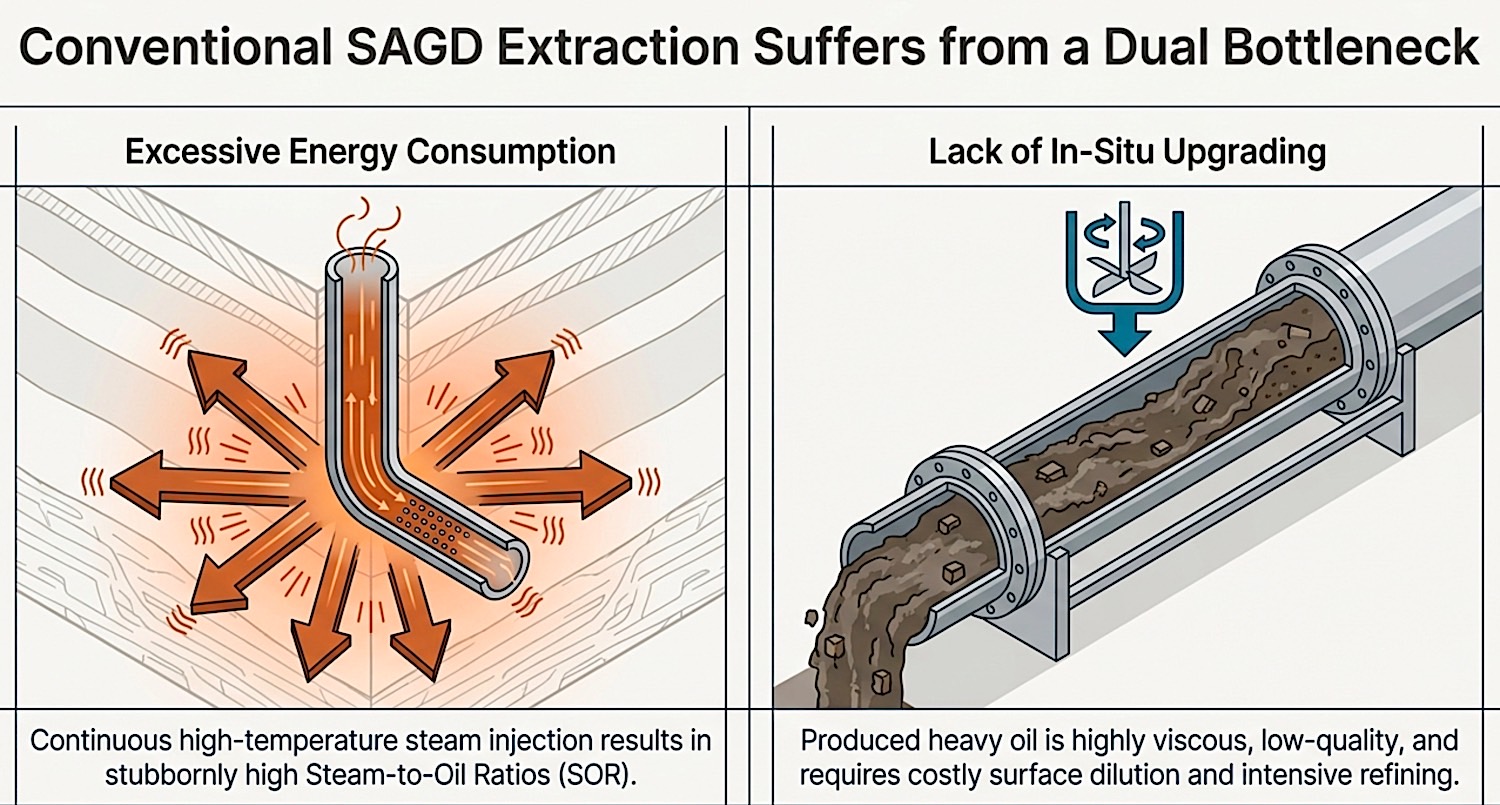
Steam-assisted gravity drainage (SAGD) is the dominant technology for extracting heavy oil and oil sands, but it faces two core engineering bottlenecks: excessive energy consumption and lack of in-situ upgrading capability. (E&OE note below.)
Problems
Conventional SAGD requires continuous injection of high-temperature steam, resulting in a stubbornly high steam-to-oil ratio (SOR). Meanwhile, the produced heavy oil is low-quality and highly viscous, requiring additional surface dilution and upgrading.
Although intermittent SAGD (I-SAGD) can reduce some energy consumption through cyclic shut-in periods, reservoir temperature drops rapidly during shut-in, causing catalyst deactivation and limiting recovery. The fundamental contradiction is that the heat supply and the catalytic reaction time window are mismatched.
Concept Solution
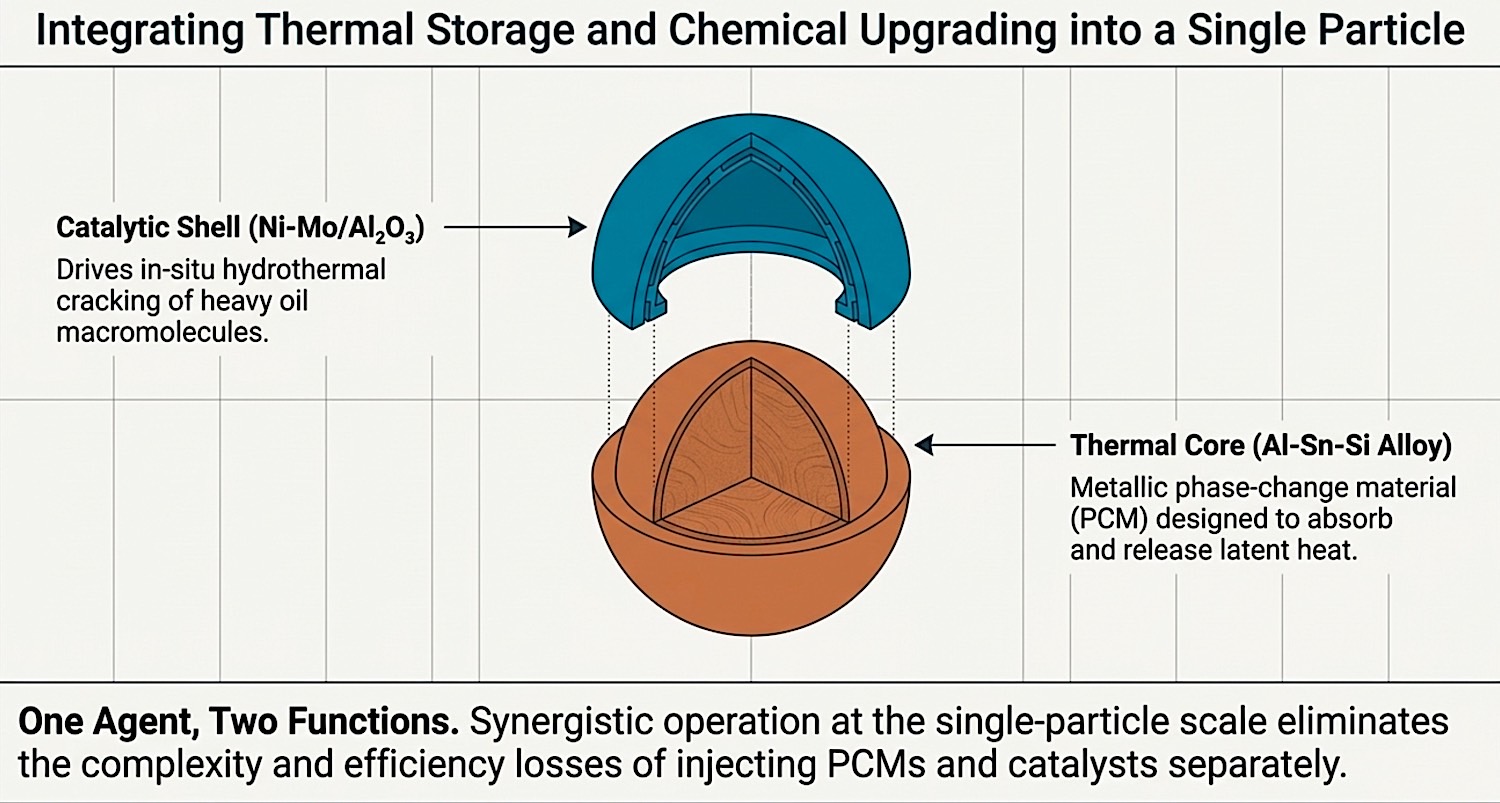
A research team led by Rui Zhao at Xi’an Shiyou University (China University of Petroleum) proposed a bifunctional core-shell nanocatalyst applied to an intermittent SAGD process (CNF-I-SAGD). The core design integrates thermal energy storage and catalytic upgrading into a single particle:
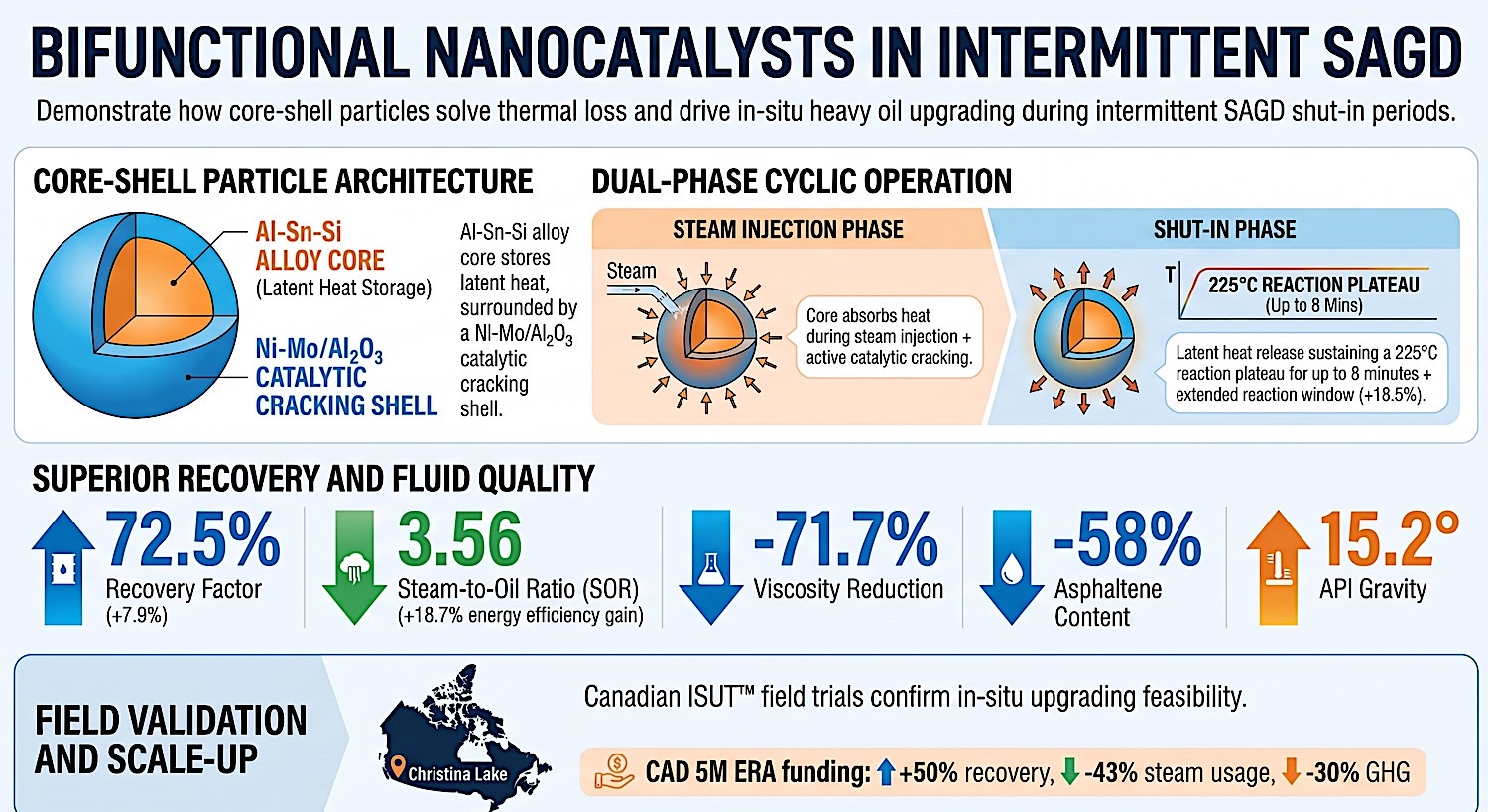
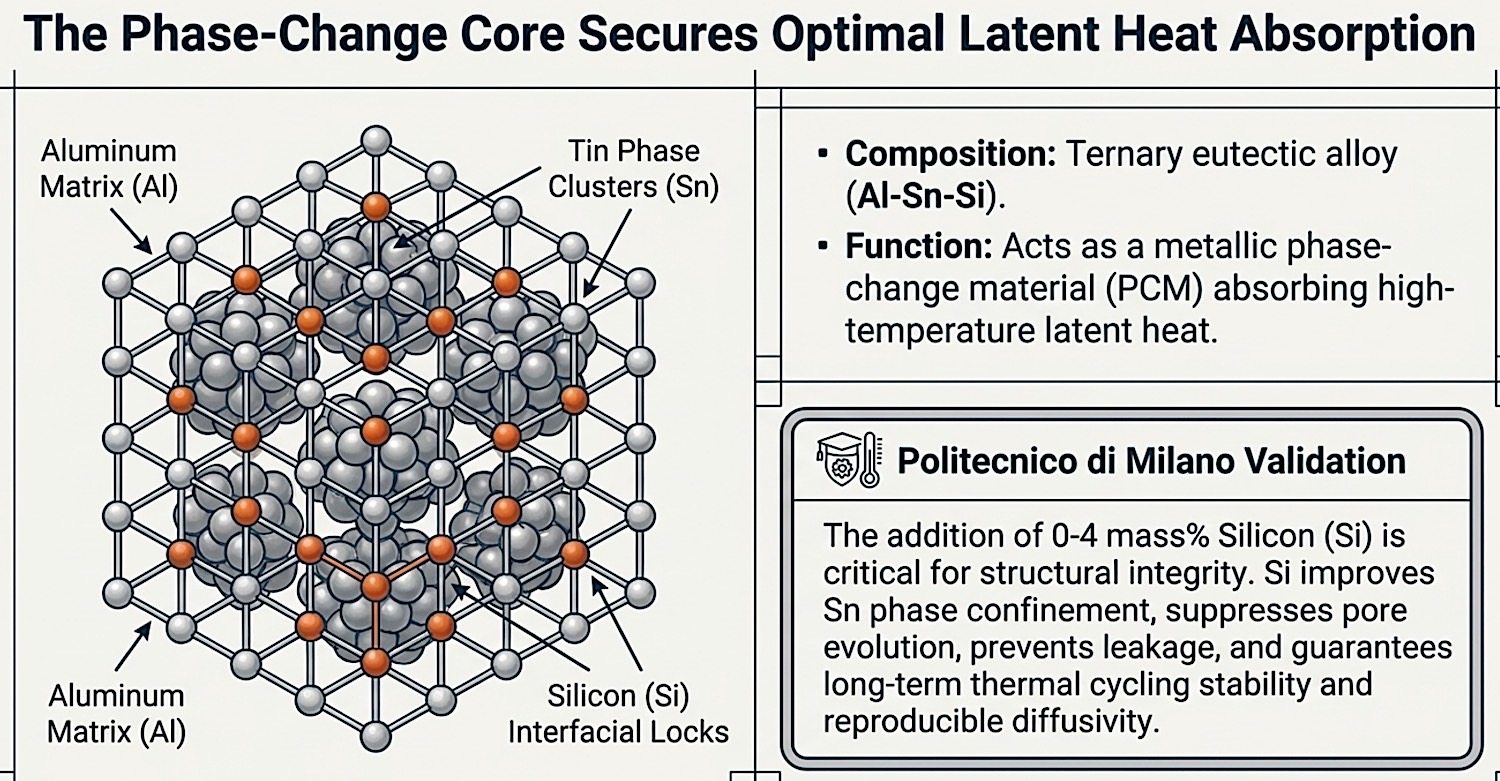
The core uses an Al-Sn-Si ternary eutectic alloy as a metallic phase-change material (PCM) to absorb and store latent heat during steam injection; the shell is Ni-Mo/Al₂O₃, responsible for catalyzing hydrothermal cracking reactions.
Working mechanism: During steam injection, the PCM core melts and stores heat while the shell catalyzes the cracking of heavy oil macromolecules. During the steam shut-in interval, the PCM core releases latent heat, maintaining a temperature plateau near 225°C for up to 8 minutes, allowing the catalytic reaction to continue rather than terminating immediately upon shut-in.
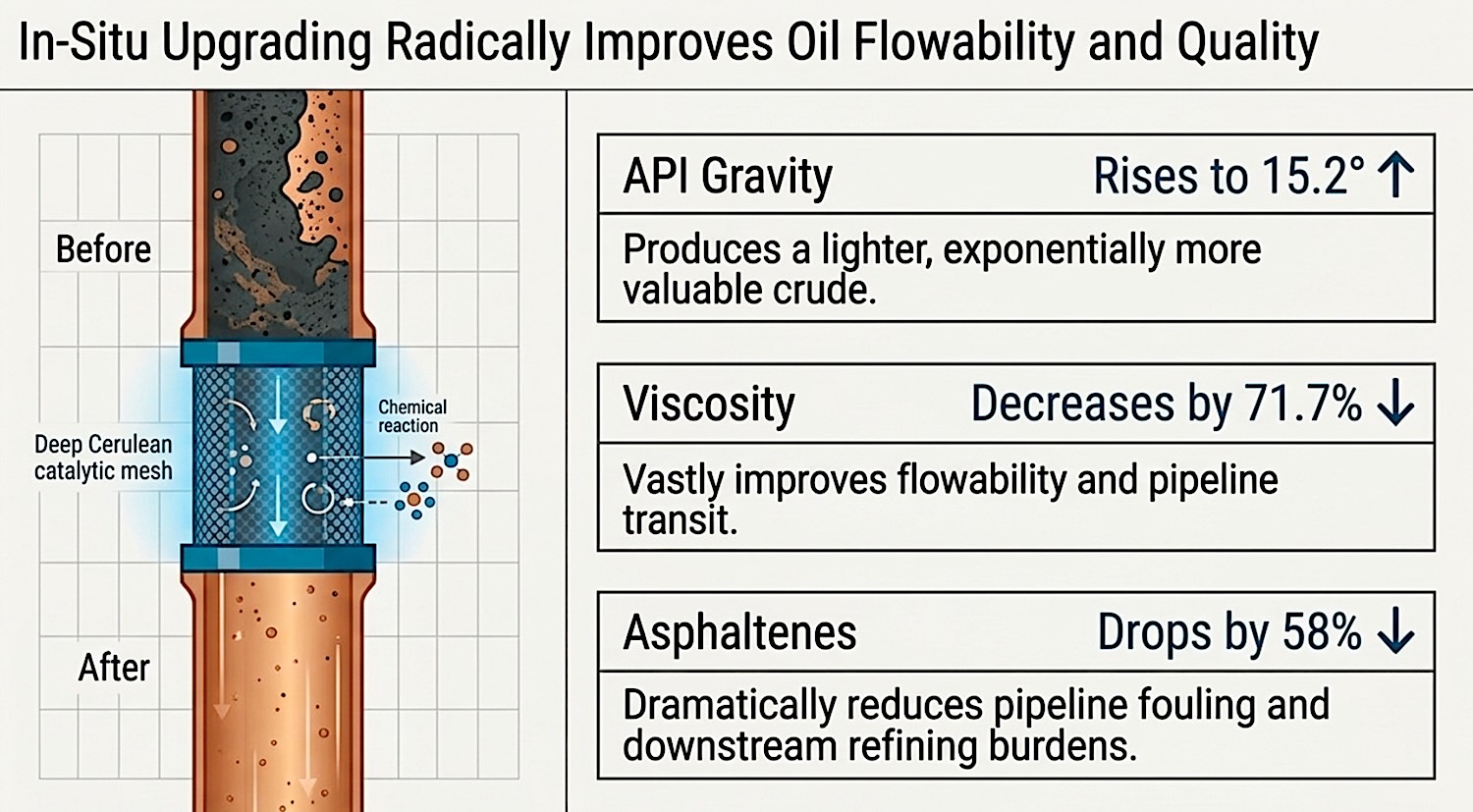
Physical simulation results show: final recovery factor reaches 72.5%, a 7.9% improvement over conventional I-SAGD; instantaneous steam-to-oil ratio drops to 3.56, with energy efficiency improved by 18.7%; produced oil API gravity rises to 15.2°, viscosity decreases by 71.7%, and asphaltene content drops by 58%.
Challenges
1. Material Integrity & Thermal Cycling
Liquid Phase Leakage: Unmodified metallic PCM cores (Al-Sn) suffer from molten Sn phase leakage and severe porosity evolution during repeated thermal melting and solidification cycles.
Matrix Confinement Needs: Maintaining structural durability requires precise silicon additions (Al-40Sn-Si-Mg system) to enforce Sn phase confinement and preserve thermal diffusivity across long-term operational lifetimes.
2. Thermal & Operational Time Constraints
Finite Heat Storage Window: The Al-Sn-Si core maintains a 225°C thermal plateau for up to 8 minutes during steam shut-in, extending active reaction time by 18.5%.
Strict Cyclic Timing: Operations require exact synchronisation between steam injection intervals and shut-in duration; extending shut-in beyond the latent heat release causes rapid reservoir cooling and catalyst deactivation.
3. Subsurface Transport & Chemical Dynamics
Porosity & Placement Limits: Delivering sub-micron core-shell particles uniformly into low-permeability reservoir formations without pore throat plugging or particle aggregation remains a complex flow-assurance hurdle.
Hydrogenation Quenching Requirements: In-situ hydrothermal cracking relies on free-radical initiation and rapid hydrogenation quenching to prevent excessive coking and catalyst shell fouling under reservoir conditions.
4. Scale-Up & Field Integration
CAPEX & Reservoir Heterogeneity: Translating 1-D physical lab simulations to multi-million-dollar commercial SAGD well-pairs demands managing reservoir heterogeneity and fluid bypass.
Infrastructure Integration: Retrofitted steam-generation and surface slurry-handling units must handle catalyst injection without disrupting standard SAGD operation
Five Important Take-Aways
1. The core-shell structure achieves “one agent, two functions.” The Al-Sn-Si alloy core handles thermal energy storage, while the Ni-Mo/Al₂O₃ shell handles catalytic cracking. The two work synergistically at the single-particle scale, avoiding the complexity and efficiency losses of separately injecting PCM and catalyst.
2. The phase-change material extends the catalytic reaction window by 18.5%. During intermittent shut-in, the PCM core releases latent heat to maintain a 225°C temperature plateau, keeping the catalyst active even with “no steam supply.” This is the core source of the energy efficiency improvement.
3. Recovery factor and oil quality improve simultaneously. The 72.5% recovery factor not only outperforms conventional I-SAGD, but the API gravity and viscosity metrics of the produced oil are also significantly improved, meaning surface diluent usage can be greatly reduced, with corresponding decreases in transportation and refining costs.
4. The design logic of the Al-Sn-Si system has been independently validated. Research by a Politecnico di Milano team published in Journal of Alloys and Compounds confirmed that Si addition improves Sn phase confinement within the Al matrix, suppresses pore evolution, and enhances thermal cycling stability. This provides materials-science-level support for the engineering reliability of Al-Sn-Si as a PCM core.
5. The path from laboratory to field has been initially established. NanosTech’s ISUT™ technology in Canada has entered field validation at a Christina Lake SAGD well pair, receiving CAD 5 million in funding from Emissions Reduction Alberta, targeting a 50% increase in recovery factor, 43% reduction in steam usage, and 30% GHG reduction. Although ISUT™ and the catalyst system in this study are not identical, it proves that the technical route of “nanocatalyst-assisted SAGD in-situ upgrading” has field feasibility.
Full Citations
Core Sources:
1. Zhao, R., Zhou, D., Xu, W., & Zhang, Y. (2026). Synergistic in situ upgrading and heat storage in intermittent SAGD enabled by a bifunctional nanocatalyst. Scientific Reports. Nature Publishing Group.
- Type: Peer-reviewed original research article
- Link: https://www.nature.com/articles/s41598-026-72162-1
- Description: Full text of this study, published in a Nature open-access journal. Presents the Ni-Mo/Al₂O₃@Al-Sn-Si core-shell catalyst and CNF-I-SAGD process, with complete physical simulation experimental data, mechanistic analysis, and performance metrics. This is the direct source of all core data in this article.
2. Marola, S., Molteni, M., Bassani, P., & Gariboldi, E. (2026). Effect of Si content on the thermal response and stability of Al-40Sn-XSi-Mg composite PCMs. Journal of Alloys and Compounds, 1065, 1–13.
- Type: Peer-reviewed journal article
- Link: https://www.sciencedirect.com/science/article/pii/S0925838826023571
- Description: Fundamental research by the Politecnico di Milano team on Al-Sn-Si metallic phase-change materials. Systematically examines the effects of Si content on thermal response, cycling stability, and microstructure, providing independent validation of the materials-science rationale for the Al-Sn-Si core as a PCM. Key finding: Si improves Sn phase confinement and suppresses pore evolution.
3. Marola, S., Molteni, M., Bassani, P., & Gariboldi, E. (2026). Thermal response and stability of Al/Al-Si casting alloys modified with Sn for composite metallic PCM applications. Zenodo (Presentation).
- Type: Conference presentation/preprint
- Link: https://zenodo.org/records/23013622
- Description: Supplementary material released by the same team in presentation form, containing more detailed experimental data and CALPHAD thermodynamic modeling results, discussing industrial accessibility and recycled raw material utilization prospects.
4. BioTrade (October 15, 2026). Bifunctional core-shell nanocatalyst-assisted intermittent steam-assisted gravity drainage technology achieves in-situ heavy oil upgrading and efficient thermal energy management.
- Type: Chinese-language science news summary
- Link: https://www.ebiotrade.com/newsf/2026-10/20261015052433180.htm
- Description: Chinese-language compilation report on the Scientific Reports paper, containing concise Chinese summaries of key data, useful as a quick reference for Chinese-speaking readers.
Technical Background and Comparative Sources:
5. NanosTech / Emissions Reduction Alberta. (2026). Field Validation for In-situ Upgrading Technology (ISUT™).
- Type: Government funding project announcement
- Link: https://www.eralberta.ca/projects/details/field-validation-for-in-situ-upgrading-technology-isut/
- Description: Project description from the Alberta government’s Emissions Reduction Alberta for NanosTech’s ISUT™ technology. ISUT™ is an industrial attempt at nanocatalyst-assisted SAGD, with target metrics: recovery factor +50%, steam usage -43%, GHG -30%. Serves as an industry reference for the “laboratory-to-field” transition.
6. Chang, J., Fujimoto, K., & Tsubaki, N. (2003). Effect of initiative additives on hydro-thermal cracking of heavy oils and model compound. Energy & Fuels, 17(2), 457–461.
- Type: Peer-reviewed journal article
- Link: https://doi.org/10.1021/ef020190u
- Description: Foundational research on hydrothermal cracking reaction mechanisms, proposing the “free radical mechanism + hydrogenation quenching” model. A key reference for understanding the chemical nature of Ni-Mo-catalyzed heavy oil cracking. This mechanism is continued in the Ni-Mo/Al₂O₃ shell catalytic function of this study.
7. Tsubaki, N., Chang, J., & Fujimoto, K. (2001). Hydrothermal cracking of residual oils. Acta Petrolei Sinica (Petroleum Processing Section), 17(1), 42–46.
- Type: Peer-reviewed journal article
- Link: https://u-toyama.elsevierpure.com/ja/publications/hydrothermal-cracking-of-residual-oils
- Description: Prior research by the same group as the above, further validating the free radical initiation and hydrogenation effects of Ni/Al₂O₃ and NiMo/Al₂O₃ catalysts in heavy oil hydrothermal cracking.
NOTE: E&O.E. EDI does its best to fact-check, but please be aware that Errors and Omissions are possible in a summary features stories of this type. Always check full citations, thank you.