
Engineering the Time-Compression Engine: Inside CHIEF, the Record-Shattering Hypergravity Facility and its Transformative Potential for Design Innovation (Video inset)
The Gravity-Defying Engineering Milestone
On September 29, 2025, a giant centrifuge named CHIEF1300 spun to life in Hangzhou, instantly claiming the title of the world’s most powerful hypergravity machine. Capable of generating 300 times Earth’s gravity with loads up to 20 tonnes, this engineering marvel forms the core of the Centrifugal Hypergravity and Interdisciplinary Experiment Facility (CHIEF) at Zhejiang University. By December 2025, an even more powerful successor, CHIEF1900, had already broken this record with a staggering 1900 g-tonnes capacity, demonstrating China’s rapid acceleration in extreme-condition engineering research.

What makes these facilities extraordinary isn’t merely their scale, but their ability to fundamentally alter two of engineering’s most constrained dimensions: space and time. By creating gravitational forces once thought impossible for large-scale experiments, these centrifuges compress century-long geological processes into mere days and kilometer-scale structures into laboratory models. This technological breakthrough promises to revolutionize everything from seismic safety testing to materials science, offering engineers an unprecedented tool for simulation and innovation in extreme environments.
Video:
1. Engineering the Unthinkable: The CHIEF Facility Design
1.1 Core Technical Specifications and Record-Breaking Performance
The CHIEF facility represents a quantum leap in hypergravity engineering, featuring a sophisticated multi-centrifuge architecture:
- CHIEF1300: The inaugural unit with 1,300 g-tonnes capacity, generating 300G for 20-tonne loads or higher accelerations for smaller payloads
- CHIEF1900: The record-breaking successor with 1,900 g-tonnes capacity completed just months after CHIEF1300 became operational
- Additional Systems: Three centrifuges and 18 in-flight devices supporting six experimental cabins, with two more powerful centrifuges under construction
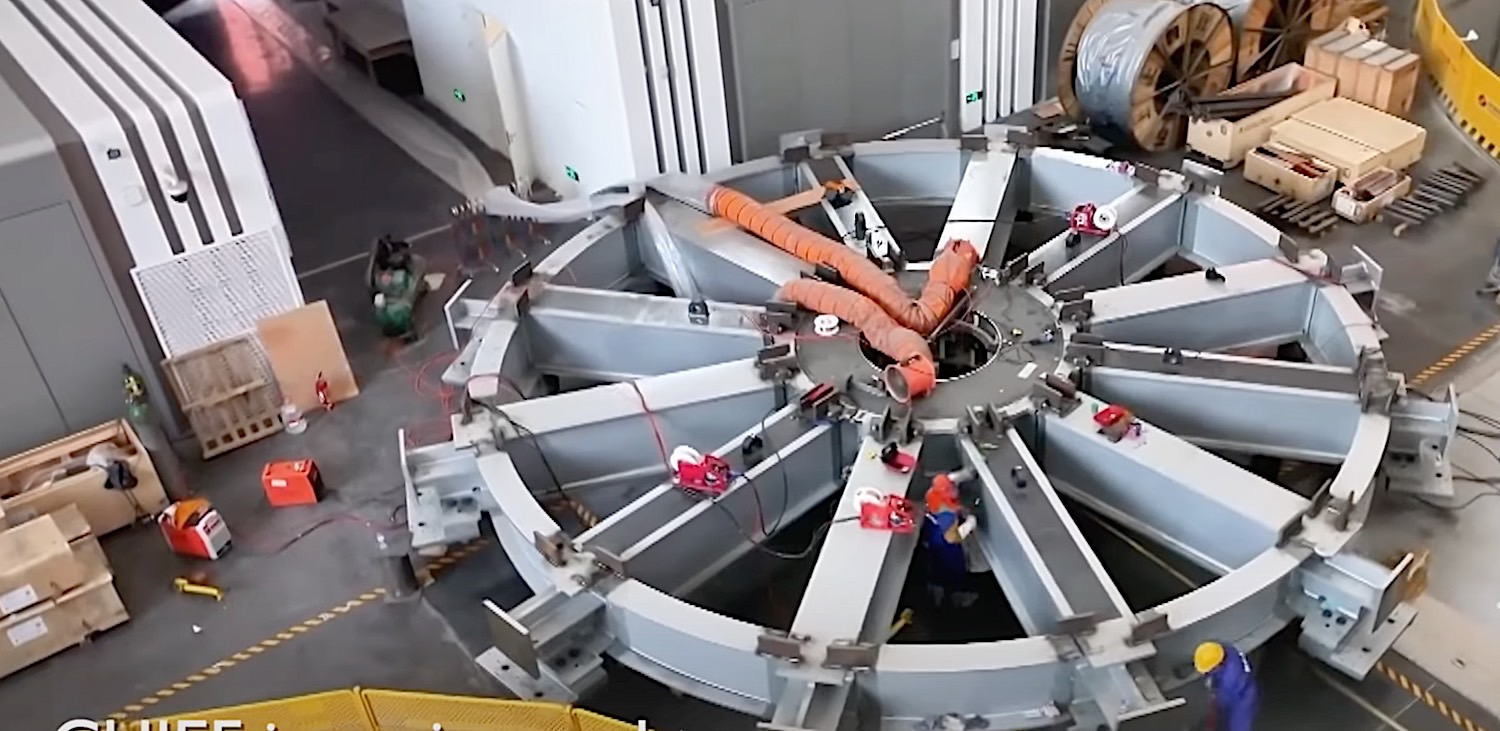
- Physical Dimensions: A 6.4-meter radius spinning arm housed in a 230-square-meter circular basement positioned 50 feet (15 meters) below ground level to minimize operational vibrations
This facility dwarfs previous global benchmarks, decisively surpassing the previous world leader—the 1,200 g-tonne centrifuge at the U.S. Army Corps of Engineers in Vicksburg, Mississippi—and establishing new possibilities in hypergravity experimentation.
1.2 Overcoming Extreme Design Challenges
Engineering such unprecedented capabilities required innovative solutions to formidable technical obstacles:
- Heat Dissipation: The team developed a vacuum-based temperature control system combining specialized coolants with air ventilation to manage extreme thermal loads generated during high-speed rotation
- Structural Integrity: Components capable of withstanding both immense centrifugal forces and complex operational conditions were designed from scratch
- Operational Stability: The entire facility was constructed nearly 50 feet underground to dampen vibrations and ensure precise experimental conditions
- Aerodynamic Management: Advanced vacuum systems mitigate air resistance that would otherwise limit maximum rotational speeds
2. The Physics of Compression: How Hypergravity Transforms Experimentation
2.1 The Space-Time Compression Principle
At the heart of CHIEF’s revolutionary capability is a physical phenomenon Chen Yunmin, the facility’s chief scientist, describes as creating a “space-time compressor.” The principle operates on two transformative axes:
- Spatial Compression: At 100G, a 1-meter physical model experiences forces equivalent to those on a 100-meter structure under normal gravity, allowing engineers to test dam foundations, building designs, or geological formations at laboratory scale
- Temporal Acceleration: The increased gravitational forces dramatically accelerate processes that normally unfold over geological timescales. For instance, a contaminant plume migration that would take a century in natural conditions can be simulated in just 3.65 days at 100G
2.2 The Engineering Implications of Compression
This compression capability transforms experimental methodologies across disciplines:
- Geotechnical Engineering: Century-long soil consolidation processes become week-long experiments
- Environmental Engineering: Millennia-scale pollutant migration can be observed in controlled laboratory settings
- Materials Science: Phase transformations and defect formation that require extreme pressures or long durations become accessible for systematic study
- Structural Engineering: Lifespan fatigue testing of critical infrastructure components can be dramatically accelerated
3. Transformative Applications Across Engineering Disciplines
3.1 Infrastructure and Geotechnical Engineering
CHIEF’s pilot tests have already demonstrated breakthrough applications in critical infrastructure domains:
- Seismic Performance Validation: Researchers have simulated strong earthquakes to verify the seismic resilience of hydropower dam foundations under extreme stress conditions
- Offshore Engineering: The facility has quantified how 4-meter-high waves and 20-meter tsunamis affect seabed stability, providing essential data for offshore wind farm site selection
- Underground Construction: Hypergravity testing enables simulation of long-term stability in tunneling, mining, and underground waste disposal facilities
3.2 Energy and Resource Exploration
The extreme conditions recreate environments otherwise inaccessible for systematic study:
- Deep-Sea Resource Extraction: CHIEF has successfully reproduced the 2,000-meter deep sea pressure environment to evaluate methane hydrate extraction methods and safety protocols
- Geothermal Systems: Enhanced understanding of fluid-rock interactions under extreme pressure-temperature conditions
- Nuclear Waste Management: Long-term behavior of containment systems and geological repositories can be accelerated for validation
3.3 Advanced Materials Development
The facility enables novel materials synthesis approaches:
- Defect-Free Alloys: Researchers have already synthesized metal alloys with reduced defects and enhanced strength-ductility combinations through hypergravity processing
- Composite Materials: Studying phase separation and reinforcement distribution in extreme gravitational fields
- Functional Materials: Creating gradient structures and unique microstructures impossible under normal gravitational conditions
3.4 Environmental Science and Climate Resilience
Hypergravity experimentation addresses pressing environmental challenges:
- Climate Adaptation: Testing coastal defense structures against intensified storm surges and sea-level rise scenarios
- Pollution Mitigation: Accelerated studies of contaminant transport through soil and groundwater systems
- Carbon Sequestration: Validating long-term stability of geological carbon storage formations
4. Global Collaboration and the Future of Extreme-Condition Engineering
4.1 An Open Platform for International Research
Despite its groundbreaking capabilities, CHIEF is designed as a collaborative rather than exclusive resource. According to chief scientist Chen Yunmin, the facility will operate as “an open, shared hub for frontier science,” with explicit invitations for “world’s top research groups” to utilize its capabilities. This collaborative approach mirrors how major scientific facilities like CERN or ITER operate, recognizing that the most significant breakthroughs often emerge from international scientific cooperation.
4.2 Implications for Global Engineering Practice
The emergence of such unprecedented testing capabilities will inevitably reshape engineering approaches worldwide:
- Accelerated Innovation Cycles: Compression of testing timelines from years to days could dramatically shorten development periods for critical technologies
- Enhanced Safety Standards: More comprehensive extreme-condition testing may lead to more resilient infrastructure design codes
- New Simulation Paradigms: Validating computational models against hypergravity experiments will improve predictive capabilities across engineering domains
- Educational Opportunities: The facility offers unparalleled training grounds for next-generation engineers in extreme-condition design
Conclusion: Redefining Engineering Boundaries
The CHIEF hypergravity facility represents more than a series of broken records—it embodies a fundamental shift in how engineers can interrogate materials, structures, and systems under conditions previously confined to theoretical modeling or catastrophic natural events. By literally compressing space and time, this engineering marvel transforms century-scale geological processes into week-long experiments and kilometer-scale infrastructure into laboratory models.
For the engineering community, facilities like CHIEF offer unprecedented opportunities to validate designs, discover new materials, and solve grand challenges in energy, infrastructure, and environmental sustainability. As these capabilities become more accessible through international collaboration, they promise to accelerate innovation across virtually every engineering discipline.
Perhaps most significantly, CHIEF demonstrates how pushing engineering boundaries in one domain—creating extreme gravitational forces—unlocks transformative possibilities across countless others. In this sense, the facility serves as both a remarkable technical achievement and a powerful reminder that tomorrow’s engineering solutions often begin with today’s willingness to attempt what seems impossible.
Sources:
- Xinhua. (2025, September 29). China Focus: China debuts world’s mightiest centrifuge, unleashing ultra-intense gravity.
- Interesting Engineering. (2025, December 31). *China’s record 1900g-tonne hypergravity machine compresses space, time*.
Additional Technical Note: The g-tonne metric represents the product of gravitational acceleration (in g) and mass (in tonnes), providing a comprehensive measure of a centrifuge’s capacity that accounts for both acceleration and payload size. CHIEF1900’s 1,900 g-tonne capacity represents the current global maximum for this metric.