
Launching the Workshop, Not Just the Science
While many missions launch science instruments, NASA’s On-Orbit Servicing, Assembly, and Manufacturing 1 (OSAM-1) mission, now in advanced integration, is launching the workshop itself. OSAM-1 represents a fundamental shift in spacecraft design philosophy—from one-time-use, monolithic craft to serviceable, upgradable, and manufacturable assets. The design challenges behind this mission are a definitive case study in extreme Design-for-Assembly (DFA) and advanced robotics.
Key Engineering Subsystems & Design Challenges
The OSAM-1 mission is a trio of firsts, demanding complex engineering solutions across robotics, materials science, and fluid dynamics.
| Subsystem | What It Is | Primary Engineering Focus | Key Design Challenges |
|---|---|---|---|
| Robotic Core | SPIDER (Space Infrastructure Dexterous Robot) | Precision Robotics and Control Algorithms | Micro-gravity dynamics, sub-millimeter precision, and real-time machine vision/autonomy. |
| Manufacturing | MAM (MakerSat Manufacturing) Payload | In-Space Materials Science and 3D Printing | Microwave curing of composites, material stability in vacuum, and structural validation of in-orbit parts. |
| Foundational Servicing | RSGS (Rendezvous, Servicing, Grasping System) | Interface Innovation and Fluid Dynamics | Refueling a satellite (Landsat 7) not designed for servicing, and zero-G hypergolic fluid handling. |
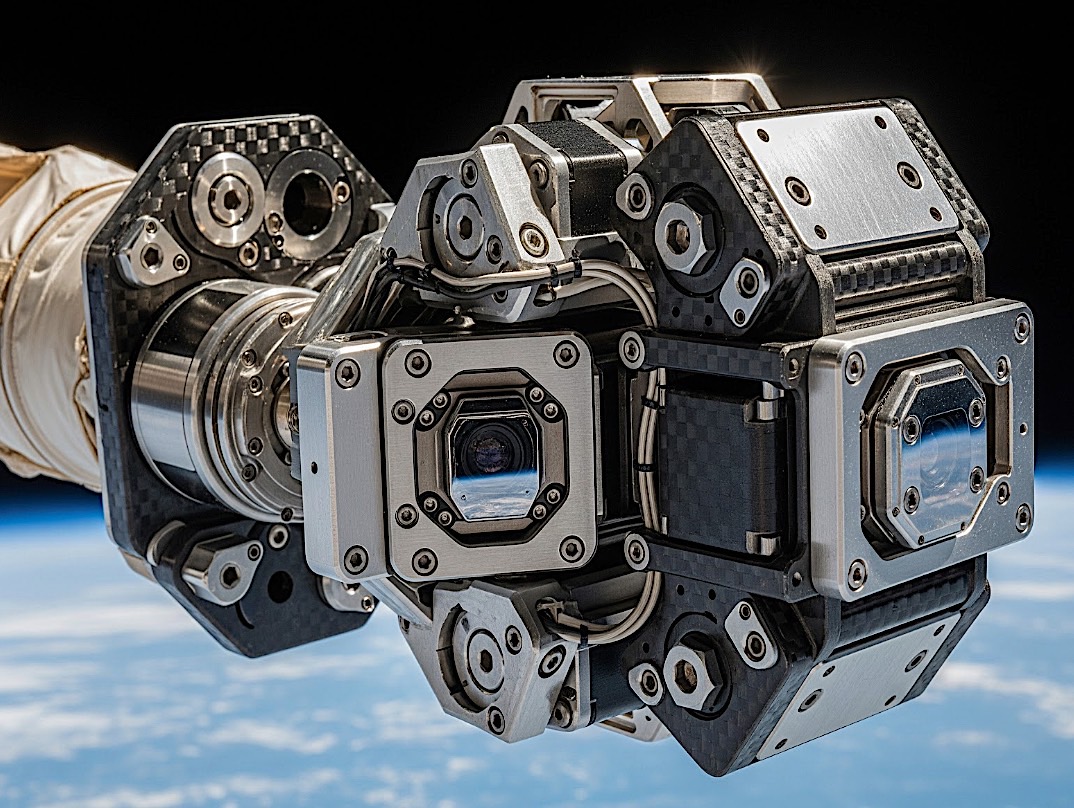
1. The Robotic Core: SPIDER’s Precision in a Hostile Environment
The heart of the OSAM-1 factory is the Space Infrastructure Dexterous Robot (SPIDER). This 5-meter robotic arm is equipped with a “Tool Changeout Mechanism” that allows it to swap out specialized end-effectors, effectively giving the spacecraft a full toolkit.
Design Challenges
- Micro-gravity Dynamics: Operating a multi-jointed, flexible arm in orbit is fundamentally different from a fixed-base robot on Earth. Every movement of SPIDER induces reaction forces and torque on the host satellite. Engineers must implement complex control algorithms to simultaneously counteract these forces, stabilize the satellite, and ensure the arm reaches its target accurately.
- Absolute Precision: SPIDER is tasked with interfacing with existing satellites, such as plugging a fuel line into the Landsat 7’s fill/drain valve. This task, which the satellite was never designed for, requires sub-millimeter accuracy. This must be achieved despite the massive temperature fluctuations in space causing thermal expansion and contraction of all materials.
- Autonomy & Machine Vision: Given the significant time delay (latency) between Earth and the satellite, direct, continuous joystick control is impossible. SPIDER must rely on on-board processing, using cameras and LiDAR to build a real-time 3D model of its workspace. This enables it to adjust motions on the fly, a necessary level of autonomy for success.
Source: NASA’s OSAM-1 Mission Overview page details SPIDER’s role and specifications.
Citation: NASA. “OSAM-1: On-Orbit Servicing, Assembly, and Manufacturing 1.” NASA.gov. <https://www.nasa.gov/mission/osam-1/>
2. The Manufacturing Breakthrough: The MAM System’s Microwave Curing
The MakerSat Manufacturing (MAM) payload represents the “manufacturing” part of the mission. Its goal is to 3D-print two 10-meter-long composite beams and then assemble them into a functional solar array, a key step toward building large structures in space.
Design Challenges
- Novel Process: Microwave-Enhanced Curing: Traditional 3D printing methods (heat or UV light) struggle with the vacuum of space, where convective heating is absent. MAM uses “microwave-enhanced thermal curing” of a resin-impregnated composite feedstock (likely a carbon fiber/thermoset polymer). This highly innovative process ensures a strong, even cure in a zero-convection environment.
- Material Science: The specialized feedstock must maintain structural stability during the violent launch phase, become pliable for the printing process, and then cure into a rigid, space-worth beam that is resistant to outgassing, extreme thermal cycling, and atomic oxygen erosion.
- Structural Validation: A core engineering and ethical challenge: How do engineers qualify and certify the strength and durability of a component that was manufactured in an environment (low-Earth orbit) that cannot be fully replicated in a ground-based test facility? This pushes the boundaries of predictive simulation and in-situ non-destructive evaluation techniques.
Source: Maxar Technologies, the prime contractor, has published technical blogs and videos on the MAM system.
Citation: Maxar Space Infrastructure. “Building in Space: A Look at the Technology Behind OSAM-1’s In-Space Manufacturing.” Maxar Blog. <https://blog.maxar.com/space-infrastructure/2023/building-in-space-a-look-at-the-technology-behind-osam-1s-in-space-manufacturing>
3. The Foundational Act: RSGS and Robotic Refueling
Before the manufacturing phase, OSAM-1 will demonstrate its Rendezvous, Servicing, Grasping (RSGS) capabilities by performing its first feat: robotically refueling the aging Landsat 7 satellite.
Design Challenges
- Interface Innovation: Landsat 7 was launched decades ago and was never designed with refueling in mind. Engineers had to design a “Mission Repair Kit” of tools capable of robotically cutting through the satellite’s protective thermal blanket, unscrewing a custom safety cap, and attaching a specialized fill nozzle. This is a profound case study in designing tools for unplanned serviceability.
- Fluid Handling in Zero-G: Transferring hypergolic propellant—a highly corrosive and volatile fuel—in the absence of gravity demands extreme precision. The system requires sophisticated pressure management and vapor recovery systems to prevent leaks, avoid introducing dangerous air bubbles into the receiving satellite’s lines, and ensure the safety of the entire operation.
Source: NASA’s Goddard Space Flight Center, which manages the servicing payload, has detailed animations and technical documents.
Citation: NASA Goddard. “OSAM-1: Servicing a Satellite Not Designed for It.” NASA.gov Video Feature. https://svs.gsfc.nasa.gov/14410 (Includes detailed animation and explanation).
Next Steps for the OSAM-1 Mission
The integration and final testing of the SPIDER arm and MAM payload are underway at the Goddard Space Flight Center. The final steps before launch involve comprehensive end-to-end simulations, particularly focusing on the autonomous decision-making required by SPIDER and the structural health monitoring of the in-space manufactured components.
The Broader Impact: Design for Serviceability and Future Factories
While OSAM-1 is a technology demonstration, its success will rapidly transition the aerospace industry toward a new paradigm: **Spacecraft as long-term assets**.
The lessons learned from OSAM-1—specifically in zero-G refueling interfaces, autonomous robotic assembly, and in-space materials qualification—directly inform several future initiatives:
Commercial On-Orbit Servicing: Establishing a viable commercial sector for satellite repair, relocation, and debris removal.
- Deep Space Habitats: Providing the foundational knowledge for robotically assembling large, complex structures like lunar or Martian habitats that are too large to launch in a single piece.
- Sustainable Space Architecture: Moving away from launching materials and toward launching the *means of production*, drastically lowering the cost and increasing the capability of future space missions.
- OSAM-1 is not merely refueling a satellite; it is engineering the first steps toward a sustainable, industrial ecosystem in space. The mission stands as a critical bridge between today’s fixed-lifetime satellites and tomorrow’s orbital factories.
Additional Information/ Research:
- Northrop Grumman’s Mission Extension Vehicle (MEV): A commercial precedent for satellite servicing. Their technical papers on rendezvous and docking are highly relevant.
- The American Society of Mechanical Engineers (ASME): Search their publications for papers on in-space manufacturing and assembly.
- The DARPA Robotic Servicing of Geosynchronous Satellites (RSGS) Program: OSAM-1’s heritage. DARPA publishes detailed program updates and technical accomplishments.