
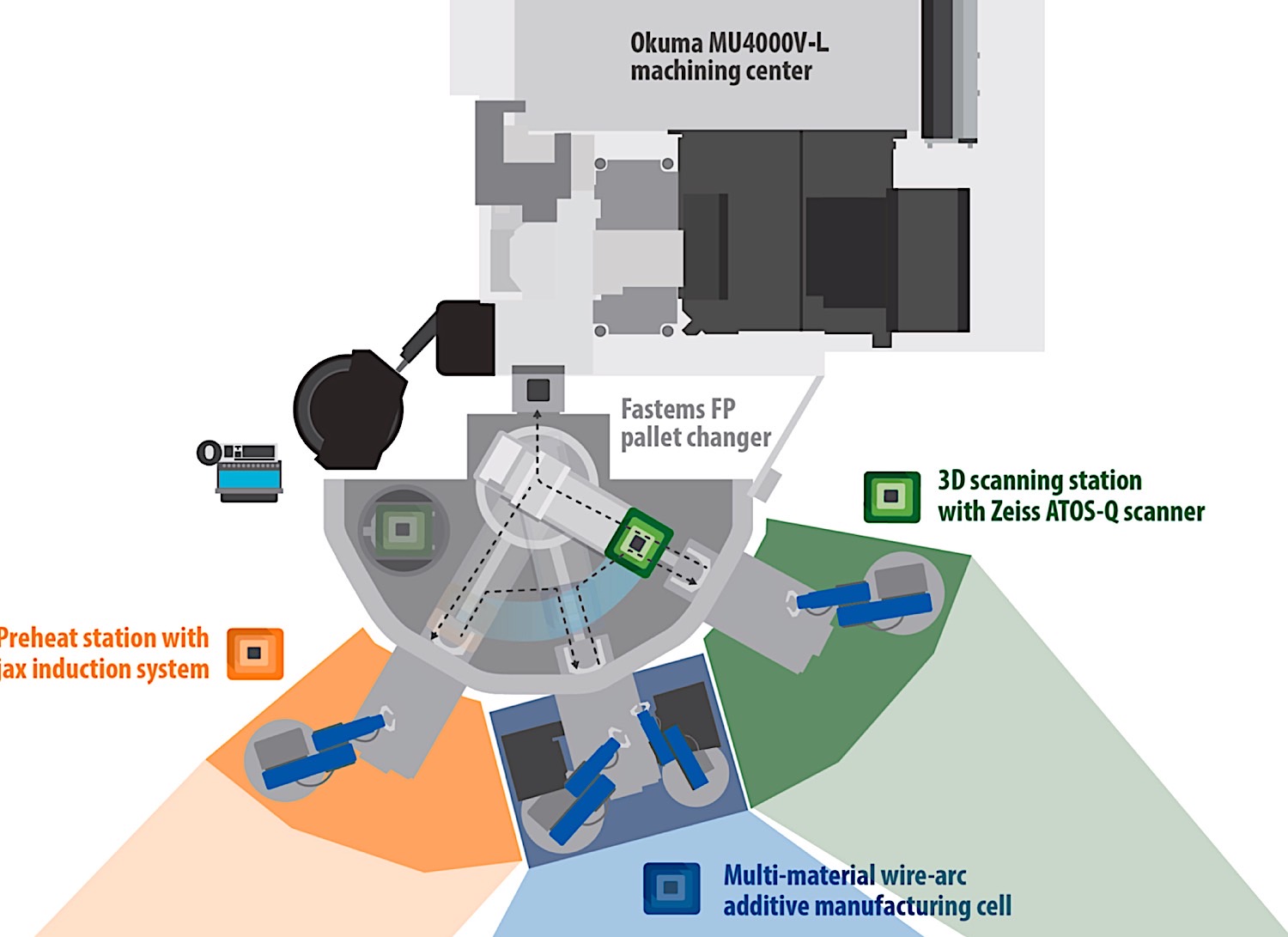
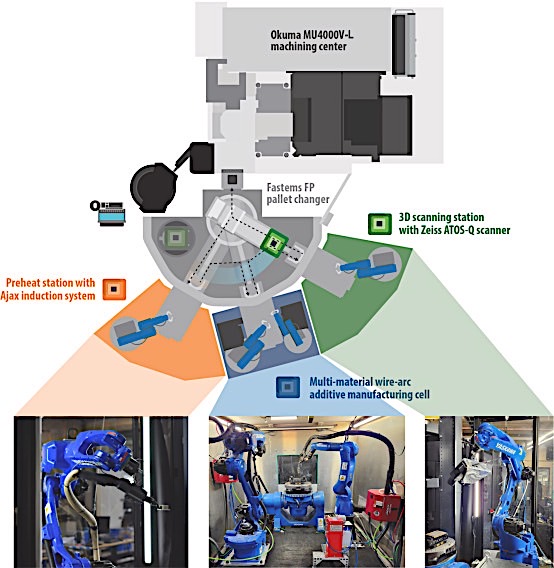
Engineered Design Goal: Oak Ridge National Laboratory has published details of Future Foundries, a first-generation convergent manufacturing platform that links four modular, vendor-agnostic process cells—robotic wire-arc additive manufacturing (WAAM), induction heating, optical metrology, and machining—through an automated pallet handler and a ROS 2-based digital thread . The platform targets high-mix, low-volume production and field-deployable manufacturing. ORNL reports production cycle reductions of up to 68% when workflows run concurrently .
Engineered Design Solution: For engineering designers, the significance is not any single cell’s capability. It is the decision to treat the factory floor as a software-coordinated system in which parts carry their own data through the process chain, and each cell can be swapped or upgraded without rebuilding the whole platform.
Top Five Things to Know
(from an Engineering Design Perspective)
1. The digital thread follows the pallet, not the clock.
Each cell can operate independently, but data remains spatially aligned by defining it relative to the pallet. Data follows parts through the production process. High-precision temporal alignment across processes is generally not required; a standard Network Time Protocol server provides enough synchronization . This is a deliberate architectural choice: it lowers the coordination burden between cells and allows asynchronous operation. For system designers, it means the integration problem is data association, not hard real-time orchestration.
2. Vendor-agnostic modularity is the adoption strategy.
The platform integrates commercial equipment from multiple vendors: Lincoln Electric WAAM power sources, Yaskawa robots, Ajax Tocco induction heating, Zeiss ATOS-Q optical scanning, Okuma 5-axis machining, and Fastems pallet automation . The design intent is explicit: allow small and medium-sized enterprises to adopt and customize modules without being locked into a single proprietary ecosystem . Each module is a self-contained unit with its own utilities and networking, enabling modification or removal with minimal disruption to the overall platform . For industrial designers specifying production systems, this is a counter-argument to turnkey integrated cells.
3. The pallet handler is the physical and logical backbone.
A Fastems rotary pallet tower holds up to eight standardized pallets with self-centering vises for consistent registration. Parts load from a side station and route between cells, reducing manual handling and downtime . The pallet is the unit of registration and the unit of data association. This means fixturing design and pallet standardization become first-order engineering constraints: if the part cannot be registered repeatably on a pallet, the digital thread has nothing stable to reference.
4. The first case study is a repair workflow, not a new-build workflow.
The platform’s first demonstrated part is a marine communications antenna bracket, chosen as a representative field-maintainable component. A CAD model was generated by reverse-engineering an original bracket through an on-board 3D scan . The workflow interleaves all four processes to fabricate, transform, and repair the component. ORNL frames this as reducing manual part handling and streamlining process flow . For designers, the repair use case is more demanding than new-build: the starting geometry is imperfect, and the process must adapt to what is actually there rather than what a nominal model specifies.
5. The cast-and-forge substitution claim is a capacity argument, not a quality claim.
ORNL positions Future Foundries against a 40% decline in U.S. domestic casting capacity over two decades . The platform is presented as a way to supplement existing casting and forging capacity for critical components, not replace it. The engineering takeaway is about lead time and lot size: convergent manufacturing can produce small batches of mission-critical parts without waiting for a casting supplier’s schedule. It does not claim to match casting’s per-part cost at volume.
Highlights
What was published. The peer-reviewed article “Future foundries: A convergent manufacturing platform” appeared in Additive Manufacturing Letters, Volume 17, Article 100364, April 2026, by Ghosh, Hoffmann, Heinrich, Fillingim, Vaughan, Post, and Feldhausen . The platform was developed at DOE’s Manufacturing Demonstration Facility at ORNL in approximately five months with 40 researchers . It received a 2025 R&D 100 Award .
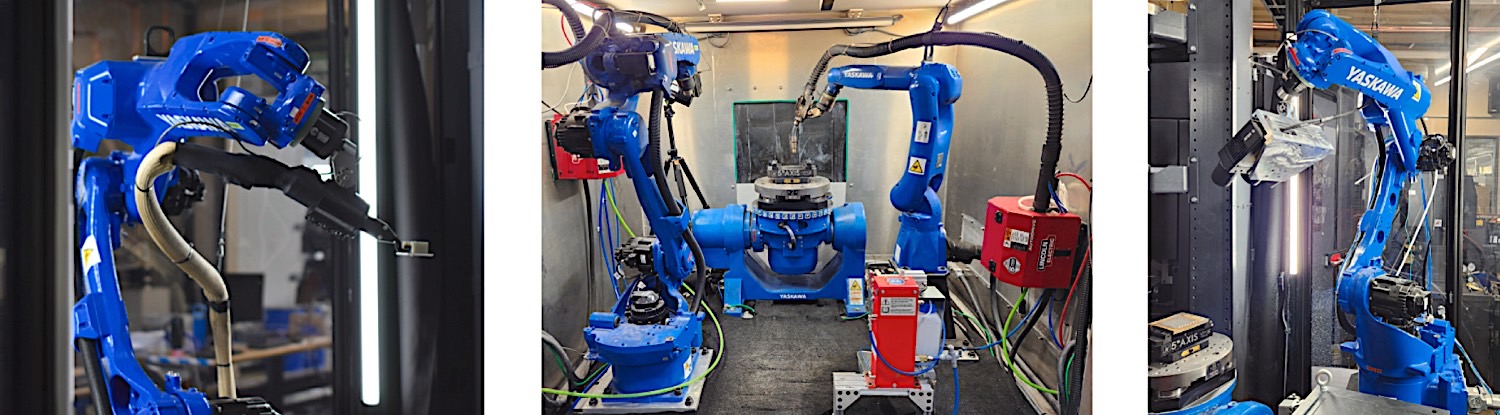
The hardware configuration. The WAAM cell uses two Yaskawa robots (GP7, GP12) with Lincoln Electric Power Wave R450 robotic power sources for multi-material builds. The induction heating cell uses an Ajax Tocco tool on a Yaskawa GP12 robot for substrate preheating and in-situ thermal treatment, specifically for alloys such as H13 and nickel-aluminum-bronze where controlled heating mitigates cracking and residual stress. Metrology uses a Zeiss ATOS-Q optical 3D scanning system on a Yaskawa GP12 robot for in-situ dimensional inspection against CAD. Machining uses an Okuma MU4000V-L 5-axis center .
The software layer. ROS 2 provides supervisory control, integrating robot motion planning, toolpath execution, end-effector control, simulation, visualization, and thermal process control. The motoros2 package interfaces with the Yaskawa robots. Process recipes are standardized, transferable workflows that encapsulate expert knowledge into executable instructions, allowing operators to reproduce complex multi-process builds and experts to remotely monitor and optimize operations .
The honest caveat. All published performance and capability claims originate from ORNL’s own research team and institutional communications. The 68% cycle reduction figure appears in ORNL’s organizational news release but is not detailed in the peer-reviewed abstract, which describes the platform’s design and case studies without quantifying cycle-time improvement . The platform is described as “first-generation research system” . No independent production deployment or third-party validation has been reported. The cast-and-forge substitution claim is a strategic framing, not a demonstrated economic comparison.
Citation List
1. Oak Ridge National Laboratory — “Future Foundries: A Convergent Manufacturing Platform” (publication record)
https://www.ornl.gov/publications/future-foundries-a-convergent-manufacturing-platform/
Summary: Official ORNL publication record for the peer-reviewed article. Confirms authors, journal (Additive Manufacturing Letters, Vol. 17, Article 100364, April 2026), and the abstract describing the four vendor-agnostic cells, ROS 2 digital thread, and two case studies. The authoritative citation for the technical paper.
2. ScienceDirect — “Future foundries: A convergent manufacturing platform” (full text)
https://www.sciencedirect.com/science/article/pii/S2772369026000125
Summary: Full-text access to the peer-reviewed article. The most detailed source for equipment specifications: Yaskawa GP7/GP12 robots, Lincoln Electric Power Wave R450, Ajax Tocco induction, Zeiss ATOS-Q, Okuma MU4000V-L, Fastems pallet tower with eight pallets. Details the ROS 2 architecture, motoros2 package, data-relative-to-pallet design, and the marine antenna bracket case study. Best source for engineering-level detail.
3. OSTI.GOV — “Future foundries: A convergent manufacturing platform” (DOE record)
https://www.osti.gov/pages/biblio/3020909-future-foundries-convergent-manufacturing-platform
Summary: DOE Office of Scientific and Technical Information record confirming the article’s funding (DOE EERE, grant AC05-00OR22725; EE0008303) and abstract. Useful for confirming federal sponsorship and the paper’s official status.
4. Oak Ridge National Laboratory — “Future Foundries to transform US additive manufacturing” (news release)
https://www.ornl.gov/organization-news/future-foundries-transform-us-additive-manufacturing
Summary: ORNL organizational news release. Source for the 68% cycle reduction claim, the five-month/40-researcher development timeline, the 2025 R&D 100 Award, the 40% domestic casting decline figure, and the modular self-contained unit design description. Also includes quotes framing the platform as democratizing manufacturing for SMEs. Note: the 68% figure appears here but not in the peer-reviewed abstract.
5. OSTI.GOV — Full-text PDF of the article
https://www.osti.gov/servlets/purl/3020909
Summary: Accessible PDF of the full article. Contains the equipment-level detail and the digital thread architecture description, including the ROS 2 rosbag logging, NTP synchronization approach, and the process recipe concept. Useful if the ScienceDirect link is paywalled.
6. Oak Ridge National Laboratory — “Future Foundries” program page
https://www.ornl.gov/content/future-foundries
Summary: Official program overview. Confirms the Fastems FPT500 palletized system, Okuma MU4000V, Lincoln Electric WAAM, Ajax Tocco induction, and Zeiss ATOS Q scanner. States targets of catching 99% of targeted flaws and reducing QC measures by 75%. Useful for the platform’s stated quality-control objectives.
7. Oak Ridge National Laboratory — “ORNL debuts convergent manufacturing platform at IMTS 2024”
https://www.ornl.gov/news/ornl-debuts-convergent-manufacturing-platform-imts-2024
Summary: Earlier news release from the platform’s 2024 public debut. Provides context on the IMTS demonstrations (wind turbine gear repair, cast-substitute component, injection-molded challenge coins) and the SME framing (more than 80% of U.S. manufacturing companies are small- or medium-sized). Useful for historical context but predates the 2026 peer-reviewed publication.
8. Mendeley — “Future foundries: A convergent manufacturing platform” (catalogue record)
https://www.mendeley.com/catalogue/7a53bb90-0c51-333b-b806-93305e1309e5/
Summary: Reference manager catalogue entry confirming the citation details. Not a primary source but useful for citation verification.