
For years, the commercial space economy operated on a convenient assumption: whenever a satellite operator needed to reach orbit, SpaceX’s Falcon 9 would be available. That assumption expired in Q3 2026, triggering a structural crisis in access to space . The core problem is a severe mismatch between surging launch demand and available rocket capacity. (See Note Errors and Omissions below. E&OE)
Problem
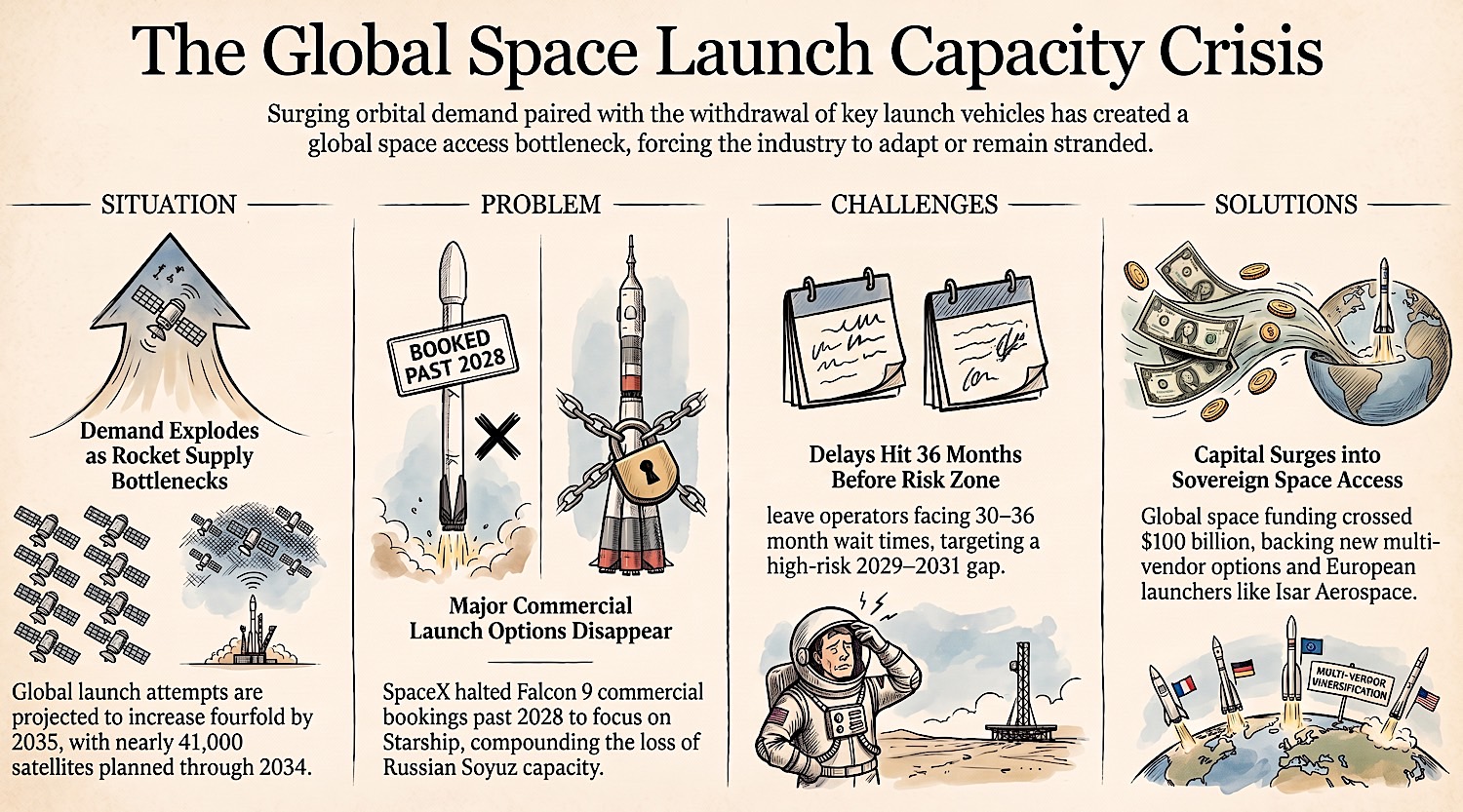
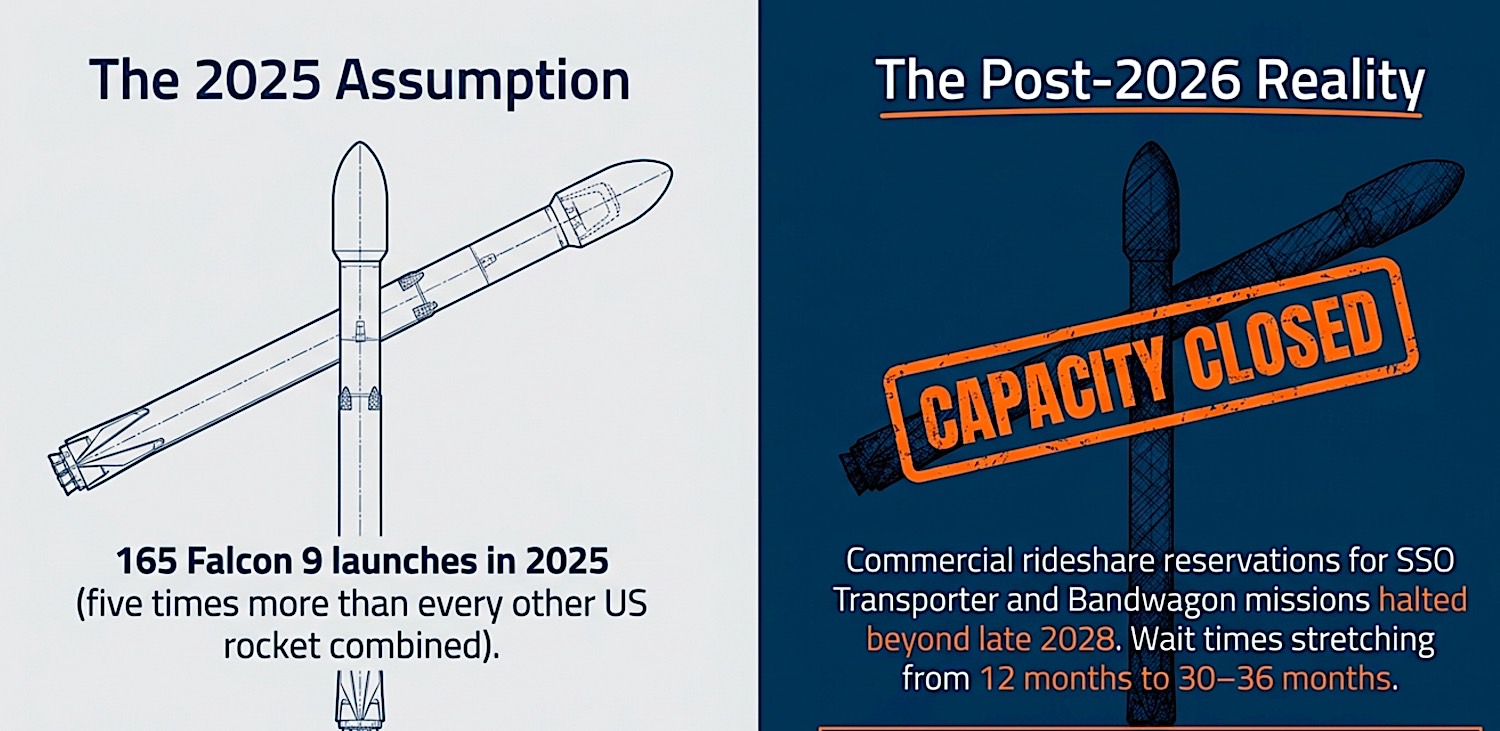
SpaceX has stopped accepting rideshare reservations beyond late 2028 and has effectively turned away dedicated Falcon 9 commercial customers, as it transitions focus to its own Starlink constellation and the unproven Starship system.
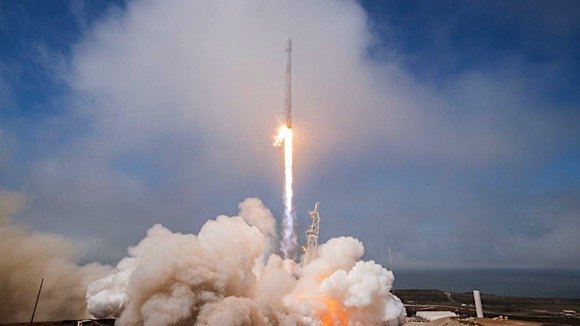
The result is a launch bottleneck that could strand satellite operators for years, with wait times stretching from roughly 12 months to 30–36 months . This bottleneck threatens to delay entire constellations, disrupt downstream services from broadband to Earth observation, and expose national security vulnerabilities as governments compete for scarce orbital slots .
Overview — The Space Launch Bottleneck
- Core Crisis: The commercial space sector faces a severe structural mismatch between surging satellite deployment demand and available rocket launch capacity, marking the end of cheap, abundant orbital access.
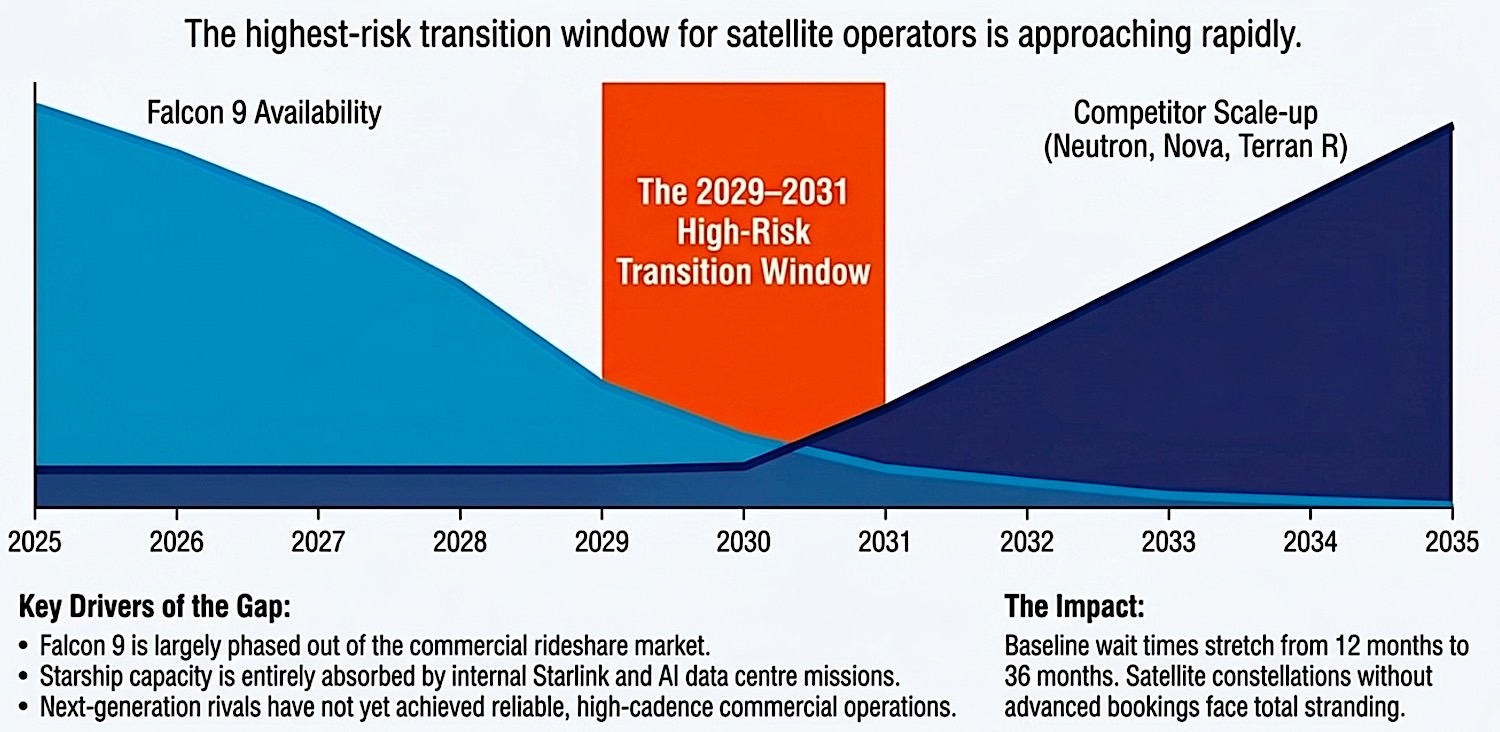
- Escalating Delays: Customer wait times for securing launch slots have expanded from a typical 12 months to 30–36 months.
- Capital Inflow: Driven by launch scarcity, global space investment is on track to cross $100 billion for the first time in 2026 as operators and governments scramble to back alternatives and secure sovereign access
Solutions
The market’s response has been a surge of capital into competing launch providers, fundamentally reshaping the industry’s structure from SpaceX monopoly toward a multi-polar launch ecosystem. Global space investment is on track to cross $100 billion for the first time in 2026**, reaching $92.5 billion in just the first nine months, driven largely by the launch capacity shortage . This capital is flowing to SpaceX alternatives at an unprecedented rate. Blue Origin raised at least $10 billion in its first external funding in 26 years .
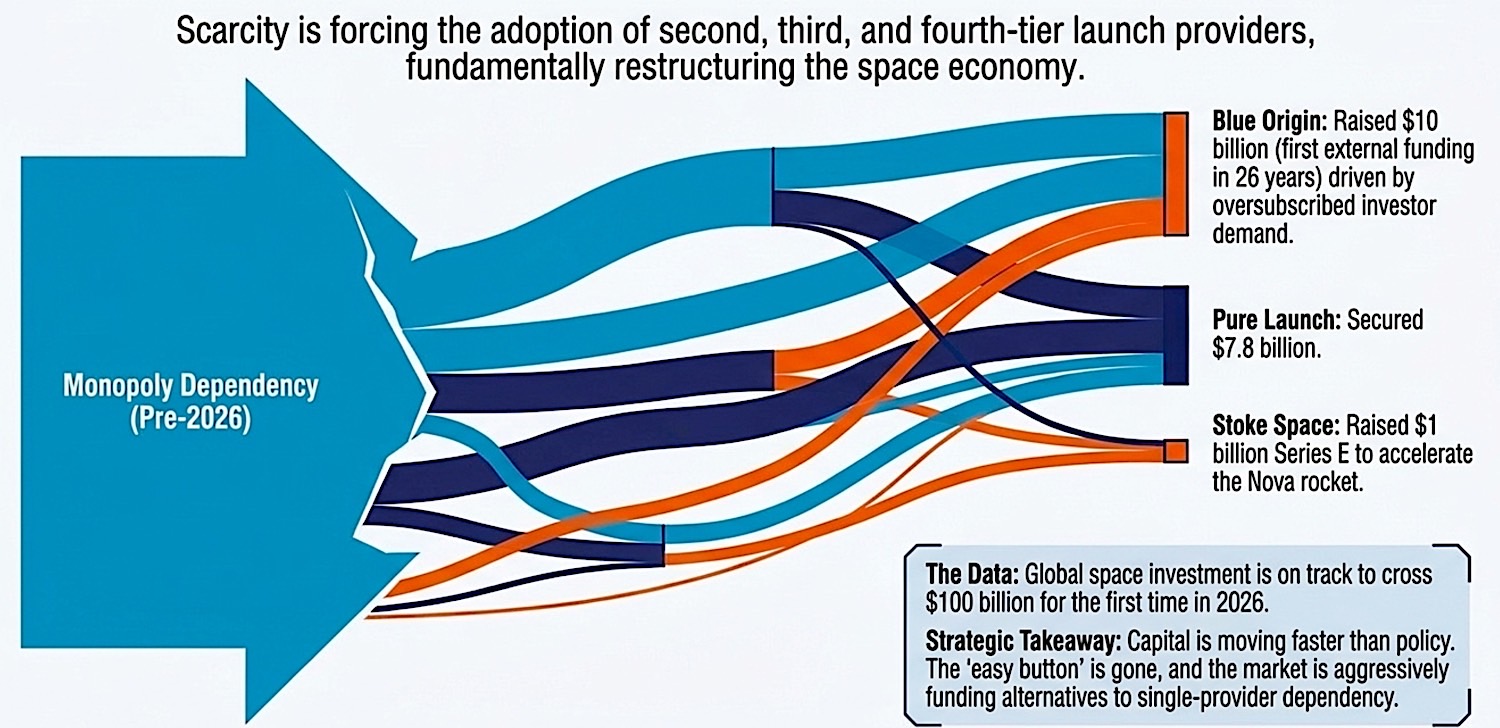
**Stoke Space** secured $1 billion to develop its larger Nova rocket . Pure Launch raised $7.8 billion . Europe attracted a record **$6.3 billion in Q3 alone, its highest global investment share since 2019, as governments shifted from “renting access to orbit” to “paying to own it” . New providers are also making concrete progress: China recovered a Long March 10B booster at sea, India’s Skyroot flew the country’s first private rocket to orbit, and Germany’s Isar Aerospace became the first commercial rocket company to reach orbit from Western European soil .
Background
The launch crisis has multiple compounding causes.
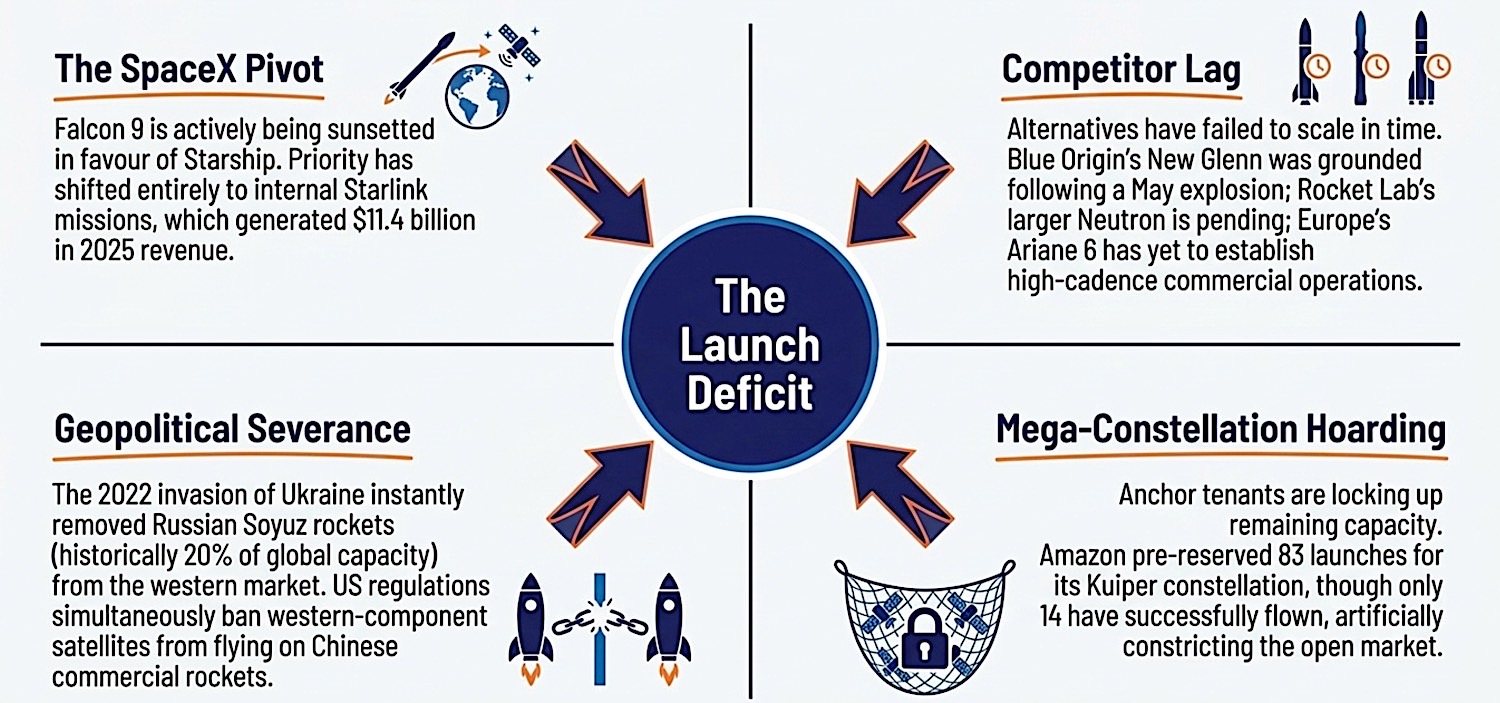
First, SpaceX’s strategic pivot is the immediate trigger.
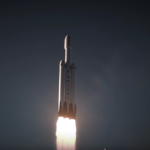
Falcon 9 conducted 165 launches in 2025—the most of any rocket globally and five times more than every other US rocket combined . Two-thirds of those served Starlink, with the remainder split between government and commercial missions including the popular rideshare program that enabled small satellite operators to reach space at costs as low as $3,000 per kilogram . SpaceX is now sunsetting Falcon 9 in favor of Starship, which reached orbit for the first time on September 28, 2026, but its commercial availability remains unclear given SpaceX’s focus on more profitable internal priorities like Starlink (which generated $11.4 billion in 2025 revenue) and planned orbital AI data centers .
Second, geopolitical disruption removed a major supply source.
Before Russia’s 2022 invasion of Ukraine, Russian Soyuz rockets handled roughly one-fifth of global launch capacity. That route is now closed .
Third, competitors have not yet scaled.
Rocket Lab launched only 18 Electron rockets in 2025 and has yet to fly its larger Neutron. Blue Origin’s New Glenn is grounded after a May explosion. Europe’s Ariane 6 and India’s PSLV launch only a few times annually .
Fourth, Amazon pre-reserved massive capacity.
In 2022, Amazon ordered 83 launches for its Leo constellation, of which only 14 have launched, locking up significant availability .
Fifth, demand itself has exploded.
ABI Research forecasts orbital launch activity will increase more than fourfold, from roughly 220 attempts in 2023 to approximately 970 by 2035 . Analysys Mason forecasts nearly 41,000 satellites will launch between 2026 and 2034—before accounting for recently announced mega-constellations from SpaceX, Starcloud, and Blue Origin that add hundreds of thousands more .
Five Important Take-Aways
1. The launch shortage is funding a structural shift away from SpaceX dependence. Space Capital CEO Chad Anderson called the current moment “the best thing to happen to the launch industry in a decade,” explaining that scarcity is forcing the market to adopt second, third, and fourth launch providers . Blue Origin’s first external raise in 26 years and Stoke Space’s $1 billion round are direct consequences of operators and investors seeking alternatives to a single-provider dependency .
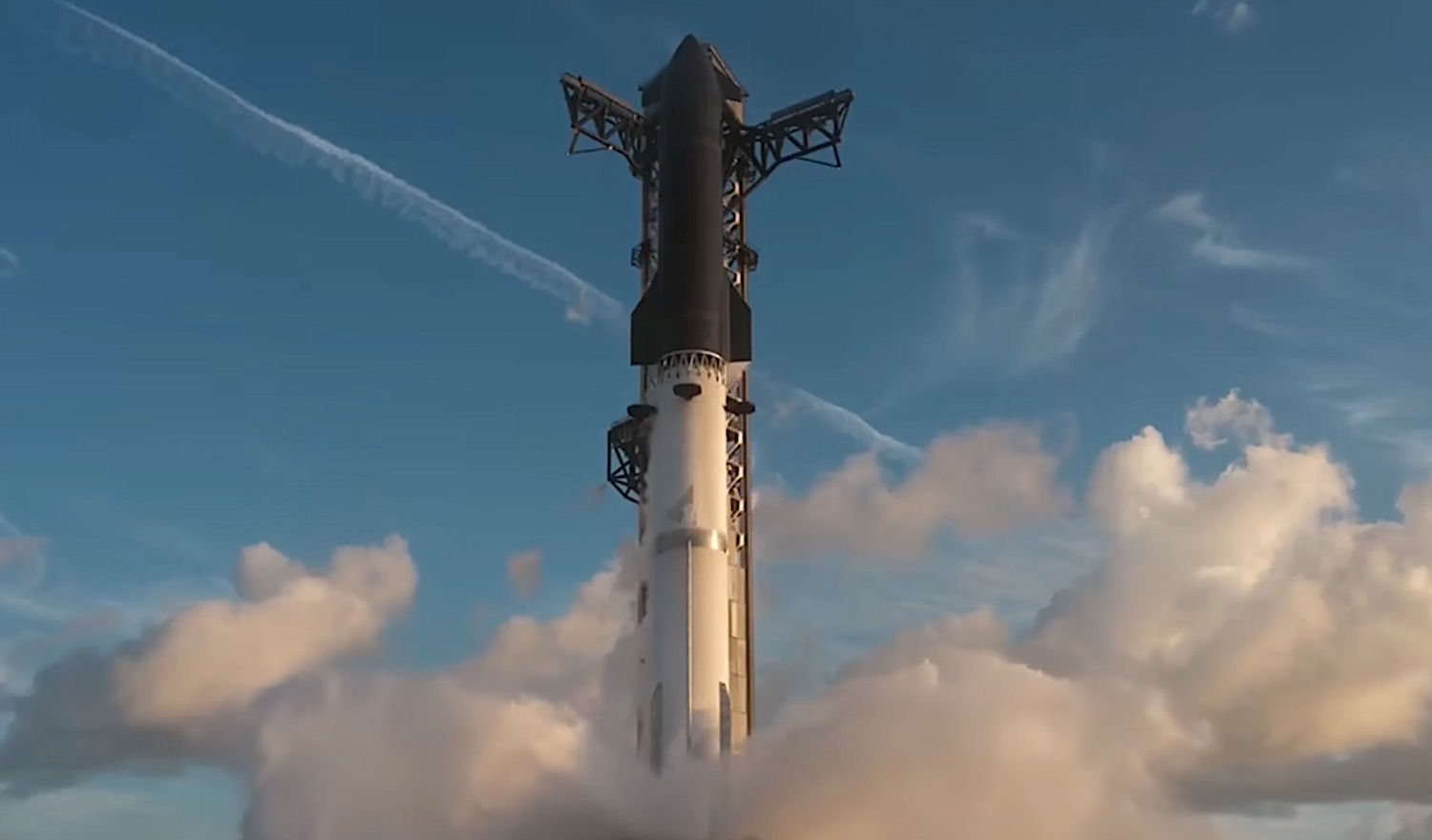
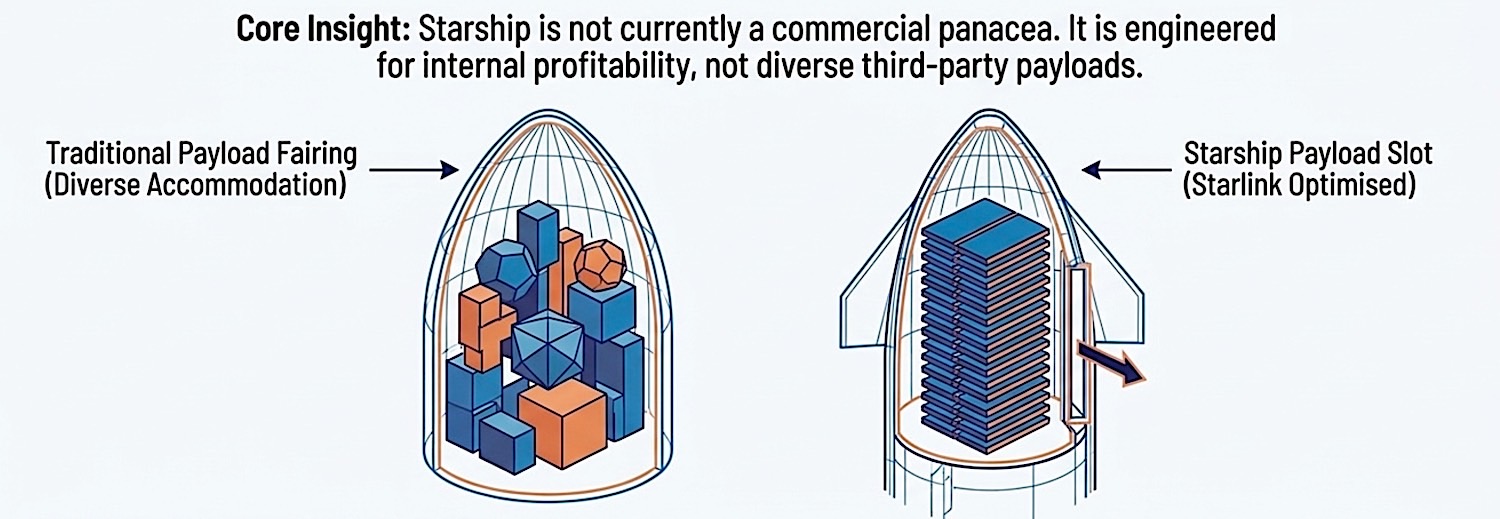
2. Starship’s commercial availability is the single biggest variable in resolving the crisis. SpaceX’s transition to Starship is the root cause of the shortage, but whether Starship will serve external commercial customers at scale is unknown. Starship is designed around flat Starlink satellites deployed through a side slot, a configuration that may not accommodate bulkier third-party payloads . Anderson warned that companies building business models around Starship access are taking significant risk: “I don’t know when they’re going to make that capability available” .
3. Europe is experiencing a record investment surge as sovereign access becomes a strategic priority. Europe’s $13.5 billion in first-nine-months 2026 investment already exceeds every previous full-year total . Isar Aerospace’s successful Spectrum launch from Norway—the first commercial orbital flight from continental Europe—marked a breakthrough, with the company targeting 40 launches per year and a second site in Nova Scotia by 2028 . EU officials framed it explicitly as a sovereignty issue: “Europe’s independent access to space just got a major boost” .
4. The 2029–2031 window is the highest-risk period for satellite operators. Industry analysts identify this period as particularly dangerous: Falcon 9 may be largely gone from the commercial market, Starship will be increasingly consumed by SpaceX’s internal Starlink and data center missions, and new competitors like Neutron, Terran R, and Nova are unlikely to have reached reliable high-cadence operations . Some companies are already securing alternative capacity years in advance; D-Orbit has locked launches through 2029, and Portal Space Systems purchased a Falcon 9 for 2028 and is reselling excess capacity .
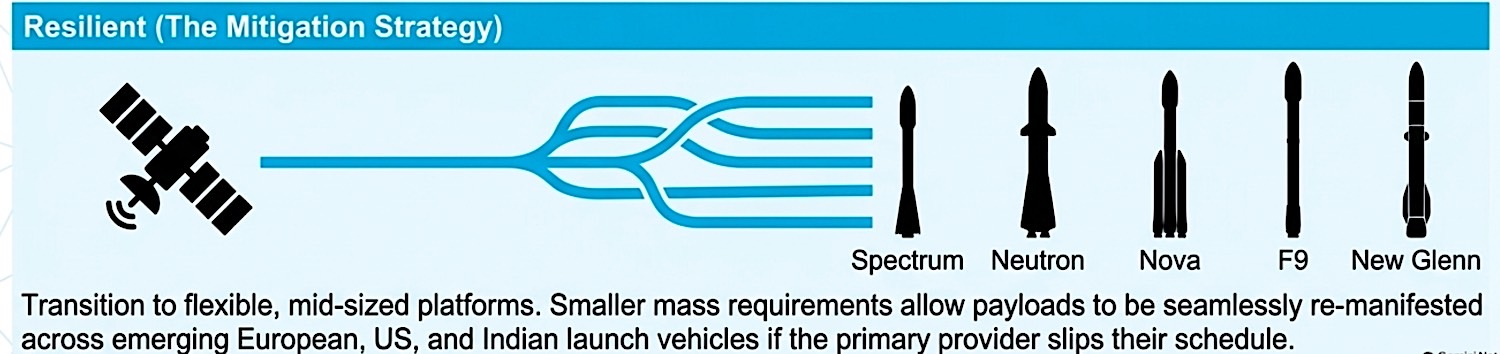
5. The shortage is reshaping satellite design and business models toward smaller, more flexible platforms. Operators are increasingly opting for mid-sized satellites that can fly on a wider pool of launch vehicles, and rideshare arrangements are becoming more sophisticated as capacity tightens . ABI Research notes that this bottleneck will accelerate adoption of in-space servicing models—repair, upgrade, and refueling—as operators seek to extend the life of existing assets rather than wait years for new launches . The era of cheap, abundant Falcon 9 rideshares is ending, and the industry is being forced to design for launch scarcity.
Core Sources:
1. Space Capital. (2026, October). Q3 2026 Space IQ Report. New York-based venture capital firm investing exclusively in the space economy.
- Type: Industry investment report
- Link: https://www.linkedin.com/posts/spacecapital_the-q3-space-iq-is-out-925-billion-invested-activity-7515751399297552385-fiju
- Description: Primary source for $92.5 billion invested through Q3 2026, $100 billion full-year projection, $6.3 billion European Q3 record, launch shortage driving new provider funding, and SpaceX’s halt on rideshare reservations beyond 2028. The foundational data source for this analysis.
2. New Scientist. (2026, September 30). A lack of rockets is creating a crisis for space technology companies.
- Type: Science/technology journalism
- Link: https://www.newscientist.com/article/2591502-a-lack-of-rockets-is-creating-a-crisis-for-space-technology-companies/
- Description: Detailed analysis of the launch crisis mechanics, including 30–36 month wait times, Falcon 9’s 165 launches in 2025, SpaceX’s Starlink revenue ($11.4 billion), Russian Soyuz’s removal from the market, and Starship’s Starlink-specific deployment design. Key source for understanding the structural causes.
3. AIAA / SatNews. (2026, July 21). SpaceX Halts New Commercial Rideshare Reservations Beyond 2028 as Launch Schedule Fills.
- Type: Industry news brief (AIAA aggregation of SatNews report)
- Link: https://aiaa.org/2026/07/21/spacex-halts-new-commercial-rideshare-reservations-beyond-2028-as-launch-schedule-fills/
- Description: Confirms SpaceX’s halt on new commercial bookings for SSO Transporter and Bandwagon rideshare missions beyond late 2028. Concise primary confirmation of the policy change.
4. Bloomberg. (2026, July 22). SpaceX Is Turning Away Falcon Customers in Major Bet on Starship.
- Type: Financial journalism (Bloomberg, subscriber access)
- Link: https://www.bloomberg.com/news/articles/2026-07-23/spacex-is-turning-away-falcon-customers-in-major-bet-on-starship
- Description: Reports that SpaceX has started turning away dedicated Falcon 9 commercial customers, not just rideshare. Underscores the scale of Musk’s bet on Starship. Key source for the “turning away customers” framing.
5. Bloomberg. (2026, October 12). Space Investment to Top $100 Billion in 2026 After SpaceX IPO.
- Type: Financial journalism
- Link: https://www.bloomberg.com/news/articles/2026-10-13/space-investment-to-top-100-billion-in-2026-after-spacex-ipo
- Description: Bloomberg’s coverage of the Space Capital report, including Chad Anderson’s quote that 2021 “looks like a blip” compared to current investment levels, and his warning about Starship-dependent business models.
6. TipRanks. (2026, October 12). Space Sector Funding Surpasses $100 Billion as SpaceX IPO and Falcon 9 Retirement Fuel Rival Rocket Makers.
- Type: Financial news aggregation/analysis
- Link: https://www.tipranks.com/news/space-sector-funding-surpasses-100-billion-as-spacex-ipo-and-falcon-9-retirement-fuel-rival-rocket-makers-like-blue-origin
- Description: Details Blue Origin’s $10 billion raise (first external funding in 26 years) and Stoke Space’s $1 billion Nova round. Anderson’s “best thing to happen to the launch industry in a decade” quote. Key source for competitor funding figures.
7. ABI Research. (2026, March 2). Space Traffic Jam: Sky-High Demand for Satellites, Limited Launch Capacity.
- Type: Market research analysis
- Link: https://www.abiresearch.com/market-research/insight/7787514-space-traffic-jam-sky-high-demand-for-sate
- Description: Forecasts launch activity growth from 220 attempts (2023) to ~970 (2035). Details infrastructure bottlenecks, launch pad constraints, and downstream economic impacts on telecommunications, Earth observation, and defense. Key source for demand-side analysis and satellite design implications.
8. Analysys Mason. (2026, April). The satellite launch bottleneck may soon leave operators stranded.
- Type: Telecom/space consulting firm research report
- Link: https://www.analysysmason.com/contentassets/2938a32369fa49919c42e61ecacd8e1c/analysys_mason_satellite_launch_bottleneck_apr2026.pdf
- Description: Forecasts nearly 41,000 satellite launches between 2026–2034 (excluding newly announced mega-constellations). Details AST SpaceMobile’s unrealistic launch expectations and the mass constraints of large satellites (6,000kg) limiting the pool of capable launchers from 104 to 48 vehicles.
9. SatNews / Via Satellite. (2026, September 7). German commercial rocket earns Europe some autonomy in the satellite launch market.
- Type: Industry news (Via Satellite)
- Link: https://www.yerepouni-news.com/german-commercial-rocket-earns-europe-some-autonomy-in-the-satellite-launch-market/
- Description: Coverage of Isar Aerospace’s Spectrum launch from Andøya, Norway—first commercial orbital flight from continental Europe. Includes Isar CEO Daniel Metzler’s statement that launch capability is “the biggest bottleneck in the entire industry,” and analysis of Spectrum’s competitive positioning versus Falcon 9 rideshare on total delivered-to-orbit cost.
10. iXBT.com. (2026, September 20). «Вечеринка закончилась». SpaceX перестала принимать новые коммерческие заказы на Falcon 9.
- Type: Russian-language technology news
- Link: https://www.ixbt.com/news/2026/09/21/437396-vecerinka-zakoncilas-spacex-perestala-prinimat-novye-kommerceskie-zakazy-na-falcon-9-a-zameny-etoi-rakete-net.html
- Description: Identifies 2029–2031 as the highest-risk transition window. Notes that Avio CEO Giulio Ranzo characterized the situation as “the party is over.” Reports that D-Orbit has secured launches through 2029 and Portal Space Systems is reselling Falcon 9 capacity.
11. Fly News (Spanish). (2026, October 10). La escasez de lanzamientos amenaza al desarrollo del New Space.
- Type: Spanish-language aerospace news
- Link: https://fly-news.es/espacio/la-escasez-de-lanzamientos-amenaza-al-desarrollo-del-new-space/
- Description: Spanish-language analysis of the launch crisis with particular focus on implications for Spanish and European satellite operators. Confirms US regulations barring satellites with American components from flying on Chinese rockets, further limiting alternatives.
12. ANI News. (2026, October 12). Global Space Investment set to cross USD 100 billion for first time.
- Type: News agency report
- Link: https://aninews.in/news/business/global-space-investment-set-to-cross-usd-100-billion-for-first-time20261013195249/
- Description: Confirms European investment figures ($6.3 billion Q3, $13.5 billion first nine months) and the key quote: “Governments with urgent requirements are now the anchor customer, and countries that spent a decade renting access to orbit are paying to own it.”
NOTE: E&O.E. EDI does its best to fact-check, but please be aware that Errors and Omissions are possible in a summary features stories of this type. Always check full citations, thank you.