
Conventional crude oil refining relies on thermal distillation—an energy-intensive process that consumes approximately one percent of global energy use . While membrane technologies have long been viewed as a potential energy-efficient alternative, their industrial adoption has been limited by fundamental materials challenges. Now, an international team of researchers has developed a new class of ultrathin polymer membranes that overcome these barriers.
Locking Pores at the Nanoscale
The breakthrough centers on a class of materials known as Polymers of Intrinsic Microporosity (PIMs), which possess a sponge-like structure with sub-nanometer pores ideally suited for separating molecules by size and type . However, these polymers historically swell when exposed to hydrocarbons, causing pores to expand and lose their selectivity .
The research team, led by Exactmer in collaboration with Queen Mary University of London, the University of Edinburgh, KAUST, UCL, and international partners including SINOPEC, developed an in-situ crosslinking approach that stabilizes the polymer structure during membrane formation . This process locks the pores in their optimal configuration, producing what the researchers call Polymers of Locked Intrinsic Microporosity (PLIMs) .
Dr. Zhiwei Jiang, who led the research as Head of Membrane Research at Exactmer and is now Assistant Professor at Nanyang Technological University, explains: “The key was stabilising the structure before the polymer had a chance to swell. This preserves the tiny pores that make molecular separation possible, while still allowing hydrocarbons to flow through very quickly” .
Exceptional Performance with Real Crude Oil
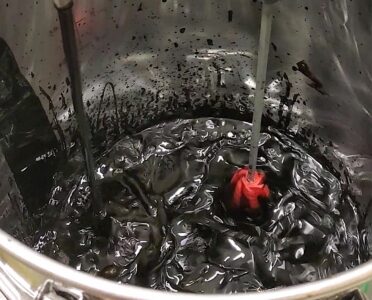
When tested with synthetic crude oil, PLIM membranes demonstrated up to ten-fold higher permeance than existing state-of-the-art membranes while maintaining high selectivity . In tests using real Arabian Extra Light crude oil, the membranes achieved two significant performance metrics:
- Removed 99.8% of hydrocarbons heavier than 15 carbon atoms (C15+)
- Reduced sulfur-containing compounds by 93%, a critical step in protecting downstream catalysts and equipment from degradation
The membranes also performed strongly with refinery streams such as virgin naphtha, efficiently separating light hydrocarbons (C4-C6) suitable for fuel upgrading from heavier fractions used in plastics and chemical production—all at permeances comparable to commercial desalination membranes .
Designed for Industrial Scale
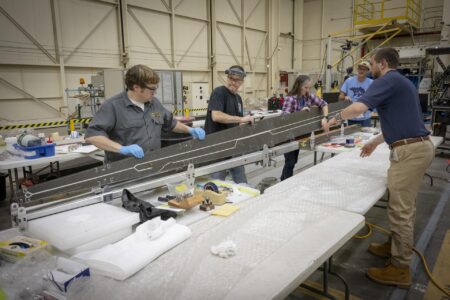
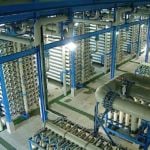
Crucially, the researchers demonstrated that the membranes can be manufactured at scale. Using roll-to-roll processing, they produced sheets over a meter wide and integrated them into standard spiral-wound membrane modules commonly used in industrial filtration installations .
Dr. Adam Oxley, first author of the research paper and now Deputy Vice President Membranes at Exactmer, notes: “These membranes aren’t just laboratory curiosities. They can be produced using established manufacturing techniques and fitted into existing industrial module designs. At Exactmer, we are building these new techniques into membranes used for high value separations in organic solvents” .
Long-term testing showed stable performance over 30 days of continuous operation, indicating strong potential for real industrial deployment .
A More Sustainable Pathway for Refining
As the global energy system transitions toward lower-carbon alternatives, demand for fuels, chemicals, and materials derived from hydrocarbons continues. Improving the efficiency of existing separation processes remains essential for reducing emissions during the transition period .
By enabling membrane-based separations that are both fast and selective, PLIM technology could help industries from oil refining to pharmaceuticals cut energy consumption dramatically, reduce carbon emissions, operate with smaller and more flexible processing units, and integrate selective desulfurization earlier in the refining process .
The same pore-locking concept could be extended to other liquid separation challenges, including chemical manufacturing, solvent recovery, and emerging bio-based feedstocks .
Industry and Research Validation
Dr. Zachary P. Smith, Associate Professor of Chemical Engineering at MIT, commented on the significance of the work: “As all chemists know, ‘like dissolves like.’ So, how can you separate hydrocarbon liquids using a hydrocarbon polymer without the polymer itself dissolving while in use? Livingston and his team have developed an approach to ‘lock’ their polymers in place, making them stable under aggressive conditions” .
Ryan P. Lively, Professor at Georgia Tech’s School of Chemical & Biomolecular Engineering, added that the membranes “are more than 100 times more productive than the first generation membrane materials—the fact that this was achieved along with improved separation efficiency is a remarkable achievement” .
The team is now exploring greener solvents for membrane manufacture and investigating how PLIM membranes could be deployed in targeted hybrid processes alongside existing refinery infrastructure .
Sources
- Queen Mary University of London: https://www.qmul.ac.uk/news/latest-news/2026/science-and-engineering/se/new-membrane-technology-could-transform-hydrocarbon-processing-by-slashing-energy-use.html
- Chemeurope: https://www.chemeurope.com/en/news/1189006/new-membrane-technology-could-transform-hydrocarbon-processing-by-slashing-energy-use.html
- BingX (English): https://bingx.com/en/news/post/thin-membranes-strip-of-heavy-hydrocarbons-from-crude-oil
- EurekAlert!: https://www.eurekalert.org/news-releases/1132197
- Interesting Engineering: https://interestingengineering.com/innovation/membranes-strip-heavy-hydrocarbons-from-crude-oil
- Eureka Magazine: https://www.eurekamagazine.co.uk/content/news/new-polymer-membranes-unlock-faster-hydrocarbon-separation
- Science Magazine (Original Publication): DOI: science.org/doi/10.1126/science.aed1111