
For more than a century, electricity generation has followed a simple formula: burn something—coal, gas, or oil—or capture nature’s forces—wind, water, or sun—to spin a turbine. Each approach has its costs, whether in fuel, infrastructure, or environmental impact. Now, researchers at Louisiana State University have invented a method to generate electricity that requires no fuel at all, relying instead on temperature differences between two phase-changing materials. Under laboratory conditions, the system has demonstrated energy conversion efficiency rivalling natural gas plants—opening a path to clean, distributed power generation that could transform how we think about energy .
The Problem with Today’s Power: Conversion
More than 60% of the energy generated by wind, solar, natural gas, or coal power never reaches the customer. Most of it is lost during the conversion to electricity—a staggering inefficiency that drives up fuel consumption and electricity costs for consumers and businesses alike .
This is where the LSU invention offers a radical departure. Rather than converting heat into mechanical energy and then into electricity—a multi-step process riddled with losses—the LSU system directly converts thermal energy into electrical energy. The result is a breakthrough in simplicity and efficiency.
How It Works: Phase Change Meets Conductivity
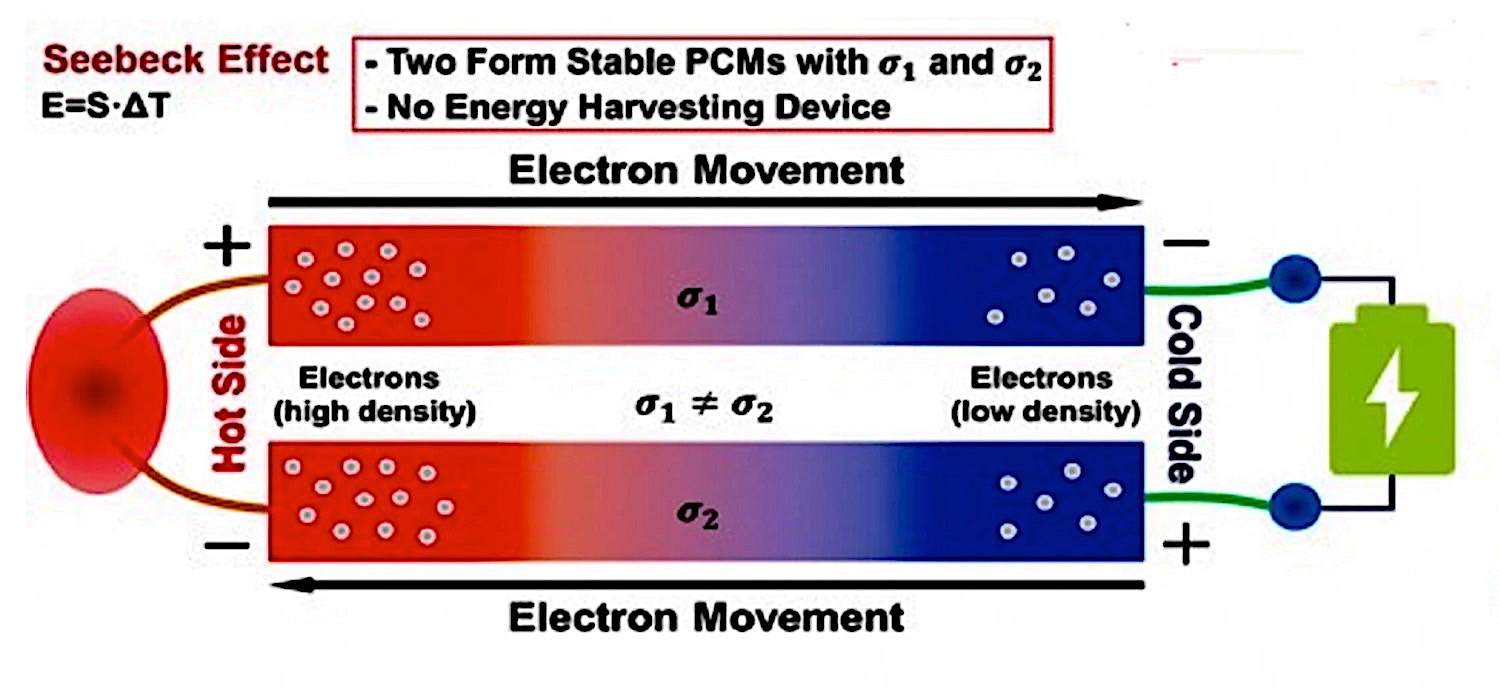
The discovery, led by LSU Professor of Mechanical Engineering Guoqiang Li and Postdoctoral Researcher Chengbin Yu, is built around a clever physical principle. Two composite materials are connected in a system. Each material changes from solid to liquid and liquid to solid at different temperatures, and each exhibits different electrical conductivity during these phase transitions. When connected, these differences can produce electricity .
Remarkably, only a small temperature difference is needed to trigger energy harvesting. “Only a small temperature difference is needed—1.8 degrees Fahrenheit, or 1 degree Celsius, will trigger energy harvesting,” Li explained. “When we connect these two phase-changing materials, electricity is produced.”
Under laboratory testing, the system achieved an energy conversion efficiency of 50% at a temperature difference of 18 degrees Fahrenheit (10 degrees Celsius). This places it on par with natural gas-fired power plants and ahead of coal, wind, and solar thermal systems, though the researchers note that performance metrics may change when the technology is scaled up .
The researchers explored two methods to create the conductivity differences needed to capture electricity:
1. Carbon Nanotube Method: Carbon nanotubes serve as conductors for the electrons that generate the electric current .
2. Water and Carbon Dioxide Method: This approach relies on water and carbon dioxide to create the necessary conductivity gradient .
“Our process does not add carbon dioxide to the atmosphere, so it is a sustainable, environmentally friendly form of energy,” Li said .
- Source: LSU research announcement with detailed technical explanation from lead researcher. | May 2026 | LSU News | https://www.lsu.edu/blog/2026/05/green_energy_final.php
Real-World Applications: Salt Water and Waste Heat
The potential applications are as practical as they are diverse. Among the scenarios the researchers are exploring:

Rooftop Salt Water Storage: A tank of sun-warmed salt water on the roof of a building could be connected to another tank inside the building. The temperature difference between the two—driven by solar heating—would be enough to generate electricity .
Industrial Waste Heat Recovery: The waste heat vented by industrial plants could warm a salt water tank, which would then be connected to another tank at ambient temperature. The temperature difference would power electricity generation, essentially capturing energy that would otherwise be lost .
The choice of salt water is deliberate. It is cheap, abundant, and can store larger amounts of heat than fresh water alone. This makes the technology particularly useful and accessible along coastlines, though salt water can also be easily created by adding salt to fresh water if natural sources are unavailable .
The researchers are planning larger-scale trials to improve output voltage and current, an effort that will require partnering with the energy industry .
- Source: Details on applications and commercialization planning. | May 2026 | LSU News | https://www.lsu.edu/blog/2026/05/green_energy_final.php
- Source: Additional context on applications and patent protection. | May 2026 | Advanced Carbons Council | https://advancedcarbonscouncil.org
Commercial Potential and Economics
The inventors are optimistic about the commercial viability of their process. The ingredients needed to fabricate the composite materials are already commercially available. Implementation costs would be limited to initial construction, maintaining temperature and conductivity gradients, and routine maintenance—since no fuel is required .
The economics are compelling. Fuel normally accounts for 40% to 60% of operating costs for coal power plants and 60% to 80% for natural gas plants. Eliminating fuel costs entirely could fundamentally change the economics of electricity generation, particularly in remote or off-grid locations where fuel transport is expensive .
Li and Yu have worked with LSU’s Office of Innovation & Technology Commercialization to pursue patent protections for both the nanotube and carbon dioxide methods. The university is now seeking partners to help bring the discovery to market .
“This pioneering work by our brilliant scientists helps position LSU as a leader in sustainable energy solutions that will transform the future of power generation,” said Robert Twilley, LSU Vice Chancellor of Research and Economic Development .
“We are excited to work with Drs. Li and Yu to pursue the potential for these breakthrough technologies,” added Grace Myers, senior commercialization officer at the Office of Innovation & Technology Commercialization .
- Source: Commercialization strategy and university support. | May 2026 | LSU News | https://www.lsu.edu/blog/2026/05/green_energy_final.php
- Source: Quotes on commercialization potential and impact. | May 2026 | Advanced Carbons Council | https://advancedcarbonscouncil.org
What Sets This Apart
The LSU invention stands out in the crowded field of alternative energy research for several reasons:
Fuel-Free Operation: Unlike solar, wind, or geothermal, this technology doesn’t capture existing natural energy flows—it generates electricity from temperature differences that can be created anywhere.
Modest Temperature Requirements: A temperature difference of just 1 degree Celsius is enough to trigger energy harvesting. This opens up applications in environments where temperature gradients are small but persistent.
No Carbon Footprint: The process does not add carbon dioxide to the atmosphere, making it truly sustainable.
Scalable Applications: From rooftop installations to industrial waste heat recovery, the technology can be deployed at multiple scales and in diverse settings.
The Path Forward
The researchers are now seeking to move beyond the lab and into larger trials. This next phase will require collaboration with energy industry partners to improve output voltage and current, validate performance at scale, and refine the technology for commercial deployment .
The fundamental discovery—that phase-changing materials with different conductivity profiles can generate electricity from modest temperature differences—could spawn entirely new categories of power generation. In a world increasingly focused on energy efficiency and decarbonization, the ability to convert even small temperature gradients into useful electricity represents a true paradigm shift .
Sources Summary
|
Description |
Date |
Author/Source |
Link |
|
LSU research announcement with technical details and researcher quotes |
May 2026 |
LSU News |
|
|
Advanced Carbons Council coverage of the LSU invention |
May 2026 |
Advanced Carbons Council |
s