
Why Submillimetre? Piercing the Cosmic Veil
Dust in the centres of galaxies absorbs and scatters visible light, meaning most regions of active star formation—and entire galaxies—remain virtually invisible in the usual wavelength ranges. Submillimetre waves help us see through the dust. In this range, cold dust and gas become transparent, revealing what lies beyond them.
Over half the light we receive is observable at (sub)millimetre wavelengths, yet we have mapped only a small portion of the sky at sufficient spatial resolution and sensitivity to detect and resolve distant galaxies or star-forming cores within their large-scale environments.
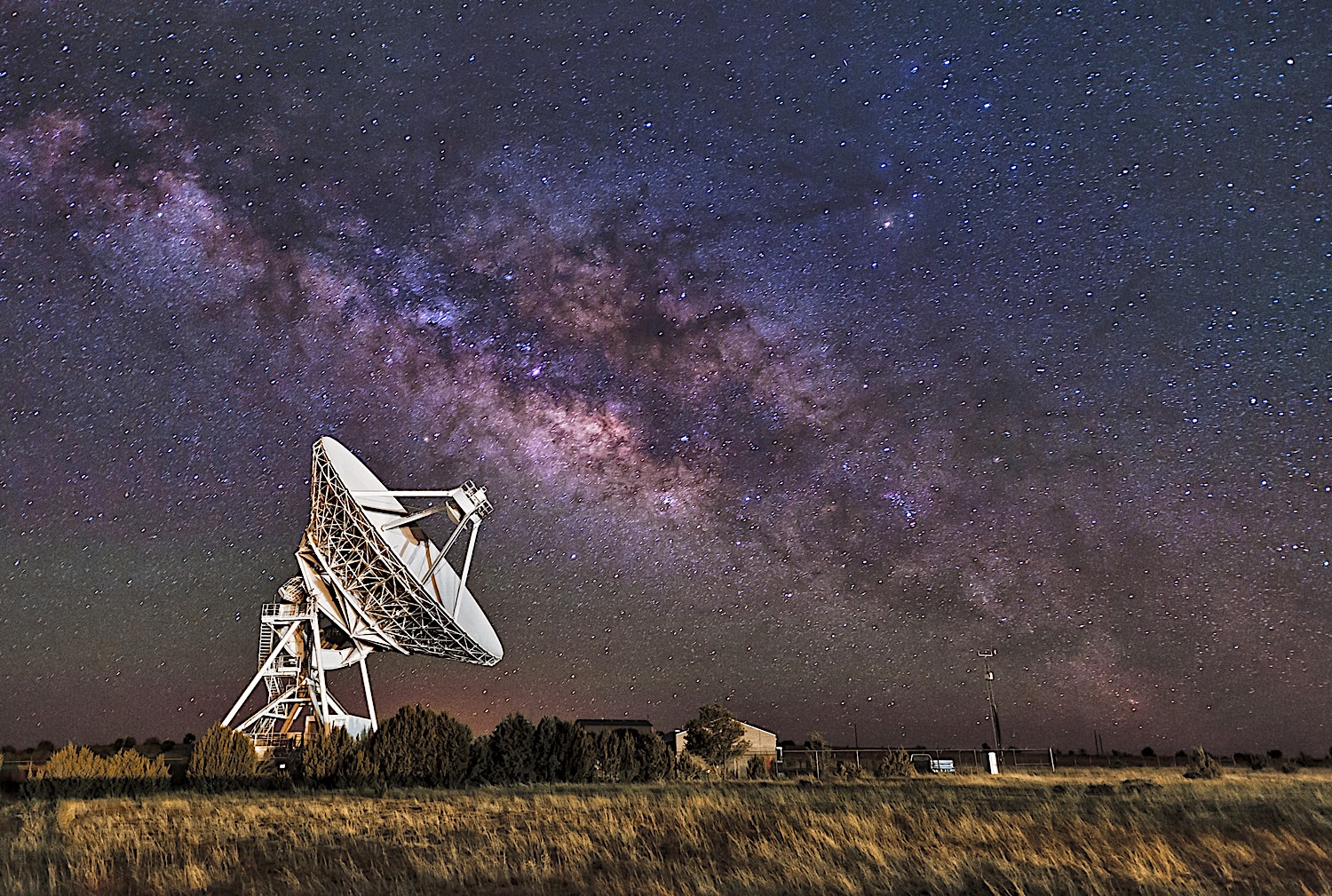
Traditional Radio Telescope:
A Wide-Angle View: AtLAST vs. ALMA
Currently, the primary instrument for such observations is the Atacama Large Millimeter/submillimeter Array (ALMA) in Chile, which consists of 66 antennas. It works like a microscope: it provides a very detailed but narrow view—in a single observation, it covers a section of the sky thousands of times smaller than the visible disk of the Moon.
AtLAST will take a fundamentally different approach, acting as a wide-angle camera able to take a census of dusty locations across the universe.
Engineering a Giant: The 50-Metre Design
The primary 50-metre dish of AtLAST would be designed with aluminium panels in the mirror and a massive steel backing structure. In total, it would weigh about 4,400 tonnes and would include a 12-metre secondary mirror—itself larger than most telescopes—to help deliver its wide field of view.
The design is an innovative “rocking chair” concept with six instrument bays, two of which are mounted on Nasmyth platforms inside a large receiver cabin. The telescope is designed to be capable of 3 degrees per second scanning and 1 degree per second squared acceleration, with a surface accuracy of ≤20 micrometres root mean square half wavefront error, corresponding to a Ruze efficiency >50% at 950 GHz.
It would be located near ALMA on the Chajnantor Plateau in the Atacama Desert, at an altitude of over 5,000 metres, where the thin and dry atmosphere provides an exceptionally clear “window” for submillimetre observations.
Powered by Clean Energy: A Sustainable Observatory
AtLAST is designed to be a pioneer in sustainability. The telescope would be entirely powered by renewable energies, using a novel, tailored hybrid energy regeneration system. As the telescope slows after moving, its kinetic energy can be recovered as electric charge, like in a hybrid car.
To run a power-hungry, 50-metre-class observatory at a remote, high-altitude site without fossil fuels, the project is testing combinations of solar power, energy storage in batteries and metal hydride, as well as recovery of braking energy. The researchers also plan to use near-zero carbon power to produce the steel and aluminium. The hope is that AtLAST will set a pattern for how large observatories can do ambitious science without jeopardizing Europe’s climate targets.
The project also integrates energy justice principles. Findings from participatory workshops revealed that sharing surplus energy generated by AtLAST with the neighbouring community of San Pedro de Atacama could fulfil up to 66% of the town’s electricity demand, making electricity more affordable and accessible. Local residents currently face energy prices more than double those in Santiago.
The Science: Revealing Hidden Galaxies and the Missing Universe
AtLAST’s survey capabilities will open multiple frontiers in astrophysics:
Hidden Galaxies: AtLAST will peer into dusty regions where galaxies blur together, reaching the “confusion limit” where individual galaxies cannot be distinguished. It has the potential to find up to 50 million hidden galaxies in 1,000 hours of observations.
The Baryon Cycle: It will map the large-scale flow of baryonic matter (hot and cold gas) in and around galaxies—matter that has proven hard to find using traditional visible wavelengths.
Cosmology and Dark Matter: By mapping the evolution of galaxies over cosmic time, AtLAST will help pin down the accelerated expansion of the universe due to dark energy and the nature of dark matter.
Star and Planet Formation: Peering into molecular clouds and debris discs around young stars, it will give us greater insight into how stars and planets form.
Solar Science: AtLAST can study the solar atmosphere and the variability of solar flares as has never been done before.
Astrobiology: By spotting molecules that might be the building blocks of life, AtLAST could help astronomers answer how life emerges in the universe.
The Dynamic Sky: Perhaps the greatest science would come from the unknown—unexpected discoveries such as new transient, short-lived events that only appear at submillimetre wavelengths and only AtLAST’s large field of view can reveal.
A Global Collaboration and a 50-Year Vision
The AtLAST project is a true international effort. Researchers from Europe, Chile, South Africa, Canada, Taiwan, Thailand, New Zealand, Japan, and the USA are refining the concept. Japan had previously considered building its own 50-metre submillimetre dish—”We realised that we should join forces,” said Cicone.
AtLAST is designed to operate for 50 years, with the goal of making it “not just a throwaway, disposable telescope,” Mroczkowski said, but rather one with a long life and upgradeable instrumentation that can benefit future generations of astronomers. It is designed to slot into a new generation of giant observatories set to reshape astronomy in the 2040s, following Europe’s Extremely Large Telescope.
Sources Summary
|
Description |
Date |
Author/Source |
Link |
|
Original feature on AtLAST from Horizon Magazine, EU Research and Innovation |
June 2026 |
Jonathan O’Callaghan, Innovation News Network |
|
|
Original feature on AtLAST from Horizon Magazine |
May 2026 |
Jonathan O’Callaghan, Horizon Magazine |
|
|
Universe Space Tech coverage of AtLAST’s design and clean energy goals |
May 2026 |
Universe Space Tech |
|
|
The conceptual design study of AtLAST, published in Astronomy & Astrophysics |
2025 |
Mroczkowski et al., A&A |
|
|
AtLAST project homepage news and community updates |
2025-2026 |
AtLAST Consortium, University of Oslo |
|
|
AtLAST’s sustainability and energy justice efforts in the Atacama |
September 2025 |
University of Oslo (AtLAST project) |
https://www.atlast.uio.no/news-and-events/news/2025/pioneering-energy-justice.html |