

This week we’re profiling two research pathways for heavy oil assets. The first path asks how to get more value out of heavy oil that is still in the ground; the second asks what to do with wells that have nothing left worth producing. Both are engineering problems defined by what already exists—existing reservoirs, existing wells, existing surface infrastructure—rather than greenfield design.
Path One: Nanoparticle-Assisted SAGD
The Engineering Design Problem
Steam-assisted gravity drainage is thermally inefficient. Steam demand is high, heat losses are significant, and the steam chamber does not develop uniformly. The produced bitumen also comes out with high asphaltene content, which means it still needs dilution and upgrading before it can move by pipeline . Nanoparticles are being investigated as a way to address several of these problems at once: improving heat transfer, adsorbing asphaltenes in situ, and in some formulations catalyzing upgrading reactions.
What the Recent Research Shows
Iron oxide nanoparticles improve recovery and oil quality, but placement and dose matter more than chemistry alone. A 2026 study in The Canadian Journal of Chemical Engineering tested Fe₃O₄ nanoparticles in SAGD physical models at concentrations of 1000, 3000, and 5000 mg/kg of porous media, with varying spatial distribution . The uniformly dispersed 1000 ppm case achieved the highest recovery—83%—along with the most uniform heat flux and the greatest asphaltene retention, with an asphaltene retention index of 0.23. The produced oil showed reduced high-molecular-weight species, partial breakdown of heavy hydrocarbons, lower viscosity, and weakened asphaltene networks . The design implication is that nanoparticle-assisted SAGD is a placement-engineering problem: a well-delivered low dose outperforms a poorly distributed high dose.
A bifunctional nanocatalyst approach targets the intermittency problem. A separate 2026 study in Scientific Reports proposed a Ni-Mo/Al₂O₃@Al-Sn-Si core-shell nanocatalyst that combines two functions: the Al-Sn-Si ternary eutectic alloy core acts as a phase-change material for thermal energy storage, while the Ni-Mo/Al₂O₃ shell catalyzes hydrothermal cracking . In intermittent SAGD, where steam injection is cycled on and off, the PCM core releases latent heat during shut-in periods, maintaining a temperature plateau near 225°C for up to 8 minutes and extending the catalyst’s effective high-temperature operating time by 18.5%. The reported results: 72.5% final recovery (7.9% above conventional intermittent SAGD), instantaneous steam-oil ratio reduced to 3.56, energy efficiency improved by 18.7%, API gravity increased to 15.2°, viscosity reduction of 71.7%, and asphaltene content decreased by 58% . For process designers, the interesting move is using the catalyst particle itself as a thermal buffer—integrating energy storage and reaction function in the same injected material.
Design Takeaways
The transferable engineering insight is not “add nanoparticles.” It is that nanoparticle-assisted SAGD requires co-design of particle chemistry, concentration, carrier fluid, and injection strategy. The University of Calgary doctoral work on this topic found that among water-, oil-, and emulsion-based CoFe₂O₄ nanofluids, the emulsion carrier provided the deepest nanoparticle penetration, and co-injection with steam achieved the highest recovery and reduced normalized cumulative steam-oil ratio . The delivery method is as much a design variable as the particle itself.
Path Two: Eclipse Energy’s Microbial Hydrogen from Depleted Wells
The Engineering Problem
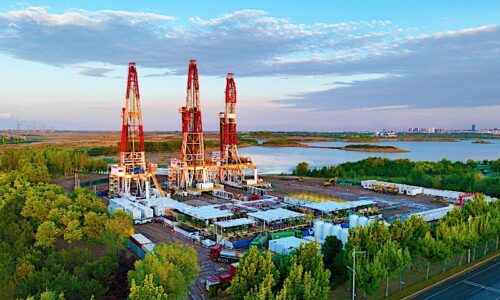
Depleted oil wells are liabilities. They must be plugged and abandoned, and the infrastructure above them—wellheads, surface facilities, rights-of-way—has already been paid for. Eclipse Energy (formerly Gold H2) is developing a process that turns these wells into subsurface bioreactors. Water, microbes, and nutrients are injected into the reservoir; the microbes break down residual hydrocarbons and release hydrogen gas, which is produced through the existing wellbore .
What the Recent Demonstrations Show
The West Texas pilot ran for 30 consecutive days. Eclipse completed a second field trial in West Texas in late 2026, producing hydrogen for 30 days straight before stopping the test . The company did not disclose exact volumes, rates, or hydrogen concentration, but claimed a production rate more than four times that of its first California trial . That first trial, conducted in June 2025 under the Gold H2 name in California’s San Joaquin Basin, achieved 400,000 parts per million of hydrogen in produced gases—40% of the gas stream . The West Texas site was described as a more challenging geological environment, which is the relevant engineering point: success under harder conditions is a stronger signal than a repeat under favorable ones.
The infrastructure reuse is the core economic argument. Eclipse’s CEO frames the advantage directly: “You have billions of dollars in a field that’s already been deployed—the wells are drilled, the surface facilities are installed, the [rights-of-way] are there” . In the West Texas pilot, hydrogen injected at one well flowed to a second well approximately 600 feet away, demonstrating inter-well transport through the reservoir . The produced gas was gathered through existing natural gas infrastructure, then processed and sold alongside natural gas .
The engineering partnership is now in place. In April 2026, Eclipse signed a memorandum of understanding with Wood, the global engineering and consulting firm, to collaborate on commercialization and global deployment. Wood will provide engineering design, downstream expertise, advisory support, decarbonization strategy, lifecycle assessment, and levelized cost of hydrogen analysis . Wood’s own estimate of an achievable production cost is $0.56/kg, against Eclipse’s target of $0.50/kg . Weatherford is identified as an execution partner .
Design Takeaways and Caveats
The process releases CO₂ alongside hydrogen. Eclipse says some CO₂ remains sequestered in the reservoir, and escaping CO₂ can be captured and potentially reused for enhanced oil recovery . The microbial system also faces competition: other microbes in the well can consume hydrogen, which would reduce net yield . Well integrity and geochemical environment selection are identified as open challenges for commercial viability . The company hopes to have commercial activity within three years and believes individual wells could produce for 10–20 years . These are projections, not demonstrated performance.
Citation List
1. Scientific Reports — “Synergistic in situ upgrading and heat storage in intermittent SAGD enabled by a bifunctional nanocatalyst”
https://www.nature.com/articles/s41598-026-72162-1
Summary: Peer-reviewed study of a Ni-Mo/Al₂O₃@Al-Sn-Si core-shell nanocatalyst combining phase-change thermal storage with catalytic upgrading. Reports 72.5% recovery, SOR of 3.56, 18.7% energy efficiency improvement, API gravity increase to 15.2°, and 58% asphaltene reduction. Best source for the PCM-integrated catalyst concept.
2. The Canadian Journal of Chemical Engineering — “In-situ asphaltene capture with iron oxide nanoparticles in steam-assisted gravity drainage (SAGD)”
https://onlinelibrary.wiley.com/doi/10.1002/cjce.70307
Summary: Peer-reviewed study of Fe₃O₄ nanoparticles in SAGD. Reports 83% recovery with uniformly dispersed 1000 ppm nanoparticles, asphaltene retention index of 0.23, and improved produced-oil quality. Confirms that spatial distribution and concentration control are the critical design variables.
3. University of Calgary doctoral thesis — “Integrating Nanoparticles into Steam-Assisted Gravity Drainage (SAGD) Process”
https://ucalgary.scholaris.ca/items/a32a344a-2b9e-45e9-9e9f-f850331f28ce
Summary: Comprehensive experimental and numerical study of nanoparticle-assisted SAGD. Finds emulsion-based CoFe₂O₄ nanofluid provides deepest penetration and best recovery when co-injected with steam. Useful for the carrier-fluid and injection-strategy design argument.
4. World Energy — “Texan start-up targets disused oil wells for low-cost hydrogen extraction”
https://www.world-energy.org/article/55461.html
Summary: Reports the Wood-Eclipse MOU, the $0.50/kg target, the process description (water, microbes, nutrients injected into depleted wells), the June 2025 California first-hydrogen claim, and Weatherford as execution partner.
5. gasworld — “Texan start-up produces hydrogen for 30 days in depleted oil reservoir”
https://www.gasworld.com/story/texan-start-up-produces-hydrogen-for-30-days-in-depleted-oil-reservoir/2264249.article/
Summary: Reports the West Texas 30-day pilot, the four-times-greater production rate versus California, the 40% hydrogen concentration from the earlier California trial, Wood’s $0.56/kg estimate, and the identified challenges: geochemical environment selection, well integrity, and microbial competition.
6. Fast Company — “This Houston startup is using old oil wells to make clean hydrogen”
https://www.fastcompany.com/91641135/this-houston-startup-is-using-old-oil-wells-to-make-clean-hydrogen
Summary: Detailed feature with the CEO’s infrastructure-reuse argument and the 600-foot inter-well hydrogen transport observation. Notes the CO₂ co-production and the 10–20 year production potential per well.
7. Eclipse Energy press release — “Eclipse Energy and Wood to Scale Hydrogen Production from End-of-Life Oil Fields”
https://eclipseenergy.co/category/press-release/
Summary: Primary source confirming the April 21, 2026 MOU signing and the scope of Wood’s engineering and advisory role. Also lists the June 2025 Gold H2 California field trial announcement.
8. Franceinfo — “Microbes, pétrole et hydrogène : l’audacieux recyclage d’une start-up texane”
https://www.franceinfo.fr/replay-radio/bientot-chez-vous/microbes-petrole-et-hydrogene-l-audacieux-recyclage-d-une-start-up-texane_8265065.html
Summary: French-language report confirming the 30-day pilot, the $8 million raised, the 10–20 year well-life estimate, and the three-year commercial target. Notes the regulatory question of converting old wells to hydrogen production rather than plugging them.
9. FuelCellChina (reprinting Hydrogen Insight) — “US start-up that says it can produce hydrogen at $0.50/kg from depleted oil reservoirs signs deal with engineer Wood”
https://www.fuelcellchina.com/Industry_information_details/8521.html
Summary: English-language trade coverage with process detail: water flooding, onsite fermentation unit for microbes and nutrients, CO₂ sequestration in reservoir, and Wood’s scope including lifecycle assessment and levelized cost analysis.