
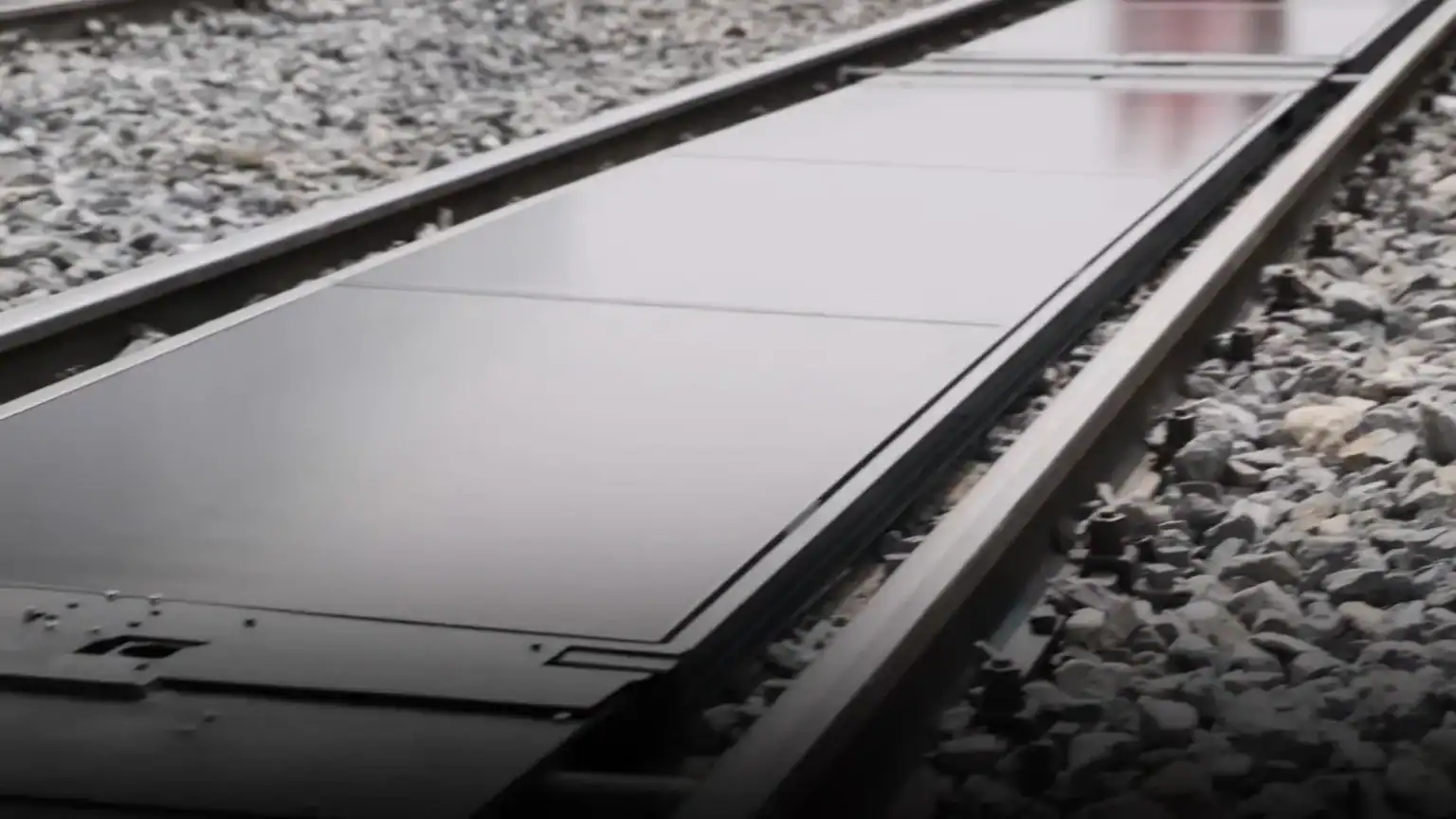
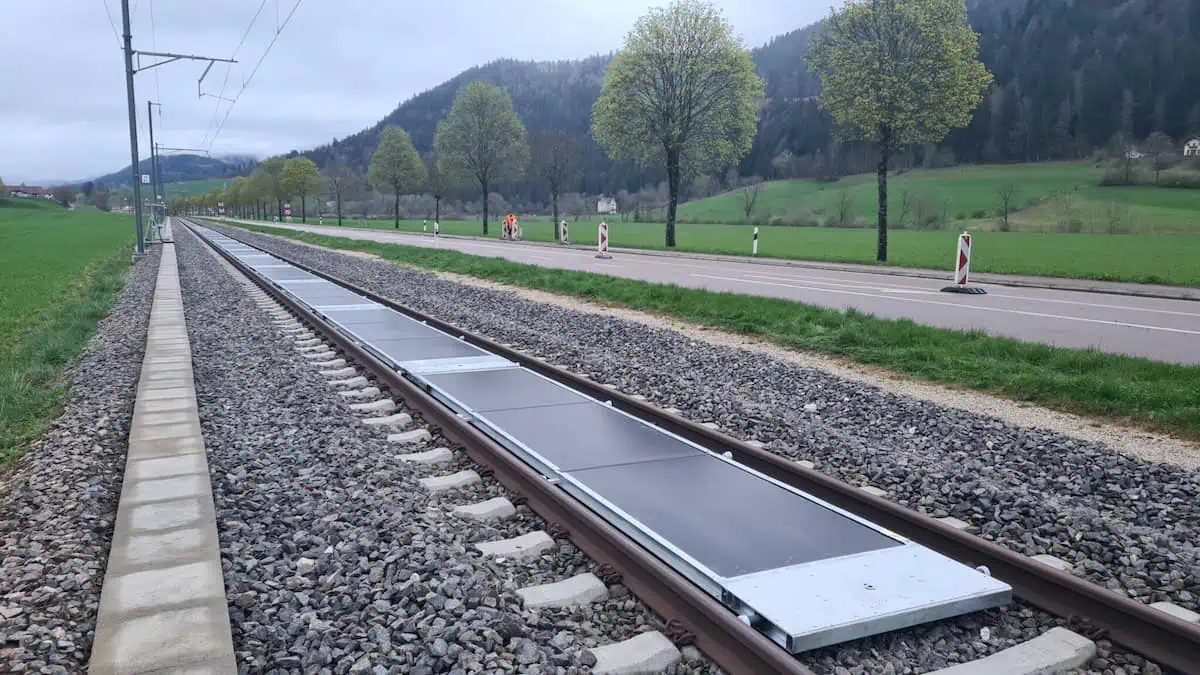
An innovative “green project” in Switzerland has trains running over solar power panels. In a pilot project, a train line in western Switzerland now carries two kinds of traffic: trains, cargo and passengers above, and electricity generation below. On a 100-meter stretch of active railway near the village of Buttes, 48 solar panels sit flush between the rails, low enough for trains to pass directly over them and removable enough for crews to take them away when the track or panels need work.
The installation, developed by the Swiss startup Sun-Ways, is small—its 18 kilowatts of capacity could generate about 16,000 kilowatt-hours of electricity a year, roughly the annual use of a few European households . But this is just a pilot program. If the system works safely on a busy rail line, it could point to a new way of expanding solar power without covering farmland, forests, or mountain slopes with panels .
The “Eureka” Moment and the Path to Reality
The idea was born in 2020, when Sun-Ways founder Joseph Scuderi was standing on a train platform and noticed the unused space between the rails . Five years later, after a mountain of obstacles, the idea became a working prototype. The Buttes project, which became operational on April 24, 2025, is being watched well beyond Switzerland .
The path to approval was far from smooth. In 2023, Switzerland’s Federal Office of Transport rejected the project outright, citing railway safety and maintenance concerns . Separately, the International Union of Railways expressed concerns about micro-cracks developing in the panels over time, heightened fire risk, and reflections that could distract train drivers . Sun-Ways spent months addressing every objection, commissioning independent safety reviews, reinforcing panels with tougher materials, adding anti-glare coatings, and installing built-in sensors to monitor panel health . One clever solution to dirt buildup: brushes mounted on trains that clean the panels as locomotives pass over them . Regulators approved the deal after 10 months of deliberation .
A Solar Farm Hidden in Plain Sight
Railways contain an obvious but difficult-to-use resource: long, exposed corridors of open space. The idea behind Sun-Ways is simple. Instead of building solar farms on new land, place photovoltaic panels in the unused strip between the rails. The company says its panels can be installed by a special railway machine developed with the Swiss track maintenance company Scheuchzer . The machine lays the one-meter-wide panels “like carpet,” using a piston system to unfurl preassembled modules along the track . Scheuchzer says the system could eventually install up to 1,000 square meters of panels per day .
The key feature is removability. Railways are not exactly empty real estate. They are critical infrastructure that must be inspected, repaired, and cleared quickly. A permanent installation between the tracks would likely be a nonstarter. Sun-Ways designed the panels so crews can detach them for maintenance, then reinstall them afterward . “This will be the first time that solar panels will be installed on a railway track with trains that pass over them,” Scuderi said .
Why This is Harder Than It Looks
Solar panels between rails sound almost obvious. In practice, the railway environment is harsh. Panels may face vibration, dust, metal particles, snow, ballast movement, and repeated pressure waves from passing trains . They must not distract drivers. They must not interfere with signaling systems, inspection equipment, or emergency work. They also must keep working when laid flat, a less efficient angle than many rooftop arrays .
The Buttes pilot sits on Line 221, operated by regional rail company TransN in the canton of Neuchâtel . During the three-year test, scheduled to run through April 2028, Sun-Ways will study installation and removal, glare, track inspections, compatibility with railway equipment, maintenance impacts, dirt accumulation, and energy performance . The tests now underway are meant to determine whether those answers hold up outside a prototype setting .
Where the Electricity Goes and the Global Ambition
For now, the electricity from the pilot feeds into the local power grid . But Sun-Ways has broader ambitions. The company says the power produced between the rails could eventually serve several uses: reinjected into the railway company’s low-voltage network to power switches, signals, and stations; fed into the local electricity network; or—the ultimate goal—reinjected into the traction energy network that powers the locomotives themselves . “In the long term, our ambition is to produce energy between the rails and re-inject it into the traction current of the trains so that it is practically 100% self-propelled,” Scuderi said .
That remains a distant target. Trains use large amounts of power, and the Buttes pilot is tiny. But rail networks are vast, and that is what makes the idea appealing. Sun-Ways has estimated that panels across Switzerland’s roughly 5,000 kilometers of railway could produce about one terawatt-hour of electricity per year, or roughly 2% of the country’s electricity consumption . The company has an even larger vision. “There are over a million kilometres of railway lines in the world,” Sun-Ways co-founder Baptiste Danichert said. “We believe that 50 per cent of the world’s railways could be equipped with our system” . That estimate should be treated as an ambition, not a forecast, as many tracks run through tunnels, shaded corridors, snow-heavy regions, or areas where maintenance demands would make solar installation impractical .
Interest Beyond Switzerland
The project is being closely watched internationally. Sun-Ways has signed a collaboration agreement with SNCF, the French rail operator, giving it access to production data, technical results, and operational feedback from the pilot . SNCF is France’s largest electricity consumer and second-largest landowner, and its teams are studying how the panels affect maintenance operations and infrastructure availability . If all goes well, France may soon follow suit . South Korea, Spain, and Indonesia have also shown interest in the technology .
For the United States, the implications are even larger. The U.S. rail network is about 140,000 miles (225,000 km) long—the largest rail transport network of any country in the world . Even a fraction of that corridor would represent a huge untapped resource, one that requires no land acquisition, no rezoning battles, and no disruption to farms or habitat .
The Land Problem in Solar Power
Solar energy has become one of the cheapest and fastest-growing sources of electricity in the world. But as countries build more of it, the question of where to put panels has become more contentious . Rooftops are useful, but not every roof is suitable. Large solar farms can be built quickly, but they can compete with agriculture, wildlife, or scenic landscapes . In Switzerland, that tension has become especially visible in debates over solar installations in the Alps. In 2023, voters rejected a proposal to place solar panels on mountainsides .
Railway solar fits into a broader trend meant to bypass these issues by putting panels on already-built or already-disturbed spaces . Developers have experimented with solar along highways, over canals, on reservoirs, above parking lots, and on farms. These approaches will not replace conventional solar farms, but they can reduce pressure on undeveloped land . As Lubomila Jordanova, CEO and founder of Plan A, noted: “This system uses the vast network of underutilised railway tracks for solar energy generation, creating a highly scalable, efficient, and environmentally friendly way to produce clean power. A key advantage of this innovation is that it capitalises on existing infrastructure, eliminating the need for acquiring additional land for solar farms” .
Answering the Key Question
For now, the Swiss pilot will answer a more practical question: not whether the world has enough railway space for solar panels, but whether solar panels can survive the railway . Over three years, the test will monitor glare, dirt accumulation, panel deterioration, track compatibility, and actual energy production . If the data is correct, the implications go far beyond one sleepy Swiss village. Rail operators in Europe are watching, and Sun-Ways has already been looking for opportunities in the US and Asia .
A technology that turns existing rail corridors into linear solar farms without consuming a single acre of new land is exactly the kind of solution a crowded, energy-hungry world needs . The trains are already running, and now everyone waits to see what survives .
Sources Summary
|
Description |
Date |
Author/Source |
Link |
|
Original feature on the Buttes pilot, including technical details, regulatory hurdles, and global potential |
June 2026 |
Tibi Puiu, ZME Science |
https://www.zmescience.com/science/news-science/solar-panels-over-train-tracks-switzerland/ |
|
SNCF’s official partnership announcement with Sun-Ways and pilot details |
February 2026 |
Groupe SNCF |
https://www.groupe-sncf.com/en/innovation/solar-power-between-rails |
|
Planet Ark overview of the pilot, its potential, and the ambition for self-propelled trains |
September 2025 |
Ashmeeta Subra, Planet Ark |
https://www.planetark.com/newsroom/news/swiss-startup-brings-solar-power-to-railways |
|
The Economic Times deep-dive on the pilot, its significance, and the US potential |
June 2026 |
The Economic Times |
|
|
International Railway Journal coverage of SNCF’s monitoring of the pilot |
February 2026 |
International Railway Journal |
https://www.railjournal.com/technology/sncf-explores-in-track-solar-panels/ |
|
Swissinfo coverage of the Sun-Ways and SNCF collaboration |
February 2026 |
SWI swissinfo.ch |
https://www.swissinfo.ch/eng/various/swiss-solar-rail-project-sharing-know-how-with-france/90875644 |
|
pv magazine coverage of the pilot and SNCF partnership |
February 2026 |
pv magazine Global |
|
|
transN’s local announcement of the pilot’s inauguration and technical specs |
April 2025 |
transN |
https://www.transn.ch/projets/installation-photovoltaique-sun-ways/ |