
Deep beneath a hillside, inside a crystal-clear sphere the size of a 10-story building, a revolution in fundamental physics is quietly unfolding. The Jiangmen Underground Neutrino Observatory (JUNO) has released its first results—and they are already rewriting the rules of the game.
Based on just 59 days of data, the experiment has achieved the most precise measurements ever of how neutrinos change as they travel, reducing uncertainties on two key parameters by a factor of 1.6 compared to decades of combined experimental results . The findings, published as a cover story in the journal Nature on June 10, 2026, confirm that JUNO is performing beyond its design specifications and is firmly on track to solve one of the most persistent mysteries in physics: the mass ordering of neutrinos .
The Elusive “Ghost Particle”
Neutrinos are among the most abundant particles in the universe, yet they are also the least understood. They carry no electrical charge, have a mass so small it is nearly impossible to measure directly, and interact with other matter so rarely that trillions pass through the human body every second without leaving a trace . Scientists often call them “ghost particles” for their uncanny ability to evade detection.
But despite their elusive nature, neutrinos hold the keys to some of the biggest questions in physics. They are produced in vast quantities by nuclear reactions in the Sun, in supernovae, and in nuclear reactors. The fact that they do interact with matter—however rarely—means they can carry information from places that light cannot reach, including the core of a star or the earliest moments after the Big Bang .
The challenge has always been catching them in the act.
JUNO: A Marvel of Engineering
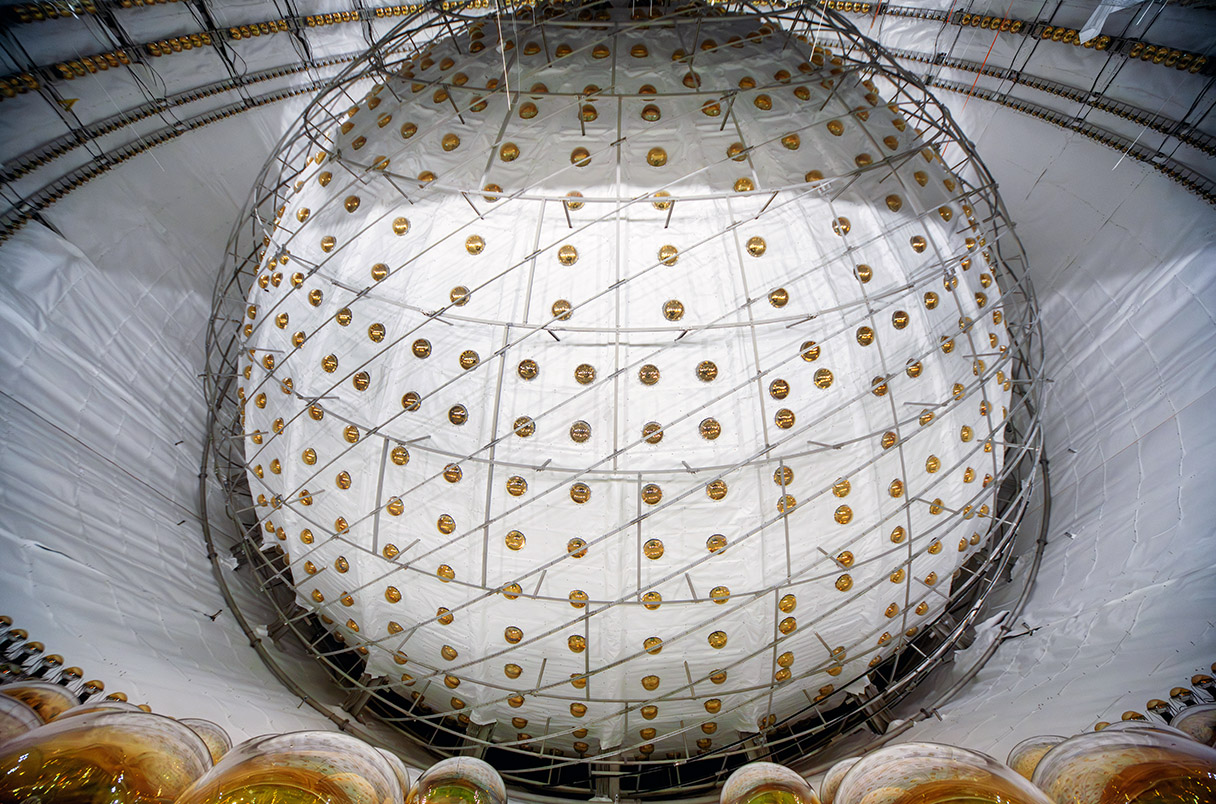
JUNO is designed to meet that challenge head-on. Located 700 meters underground in Guangdong Province to shield it from interference caused by cosmic radiation, the detector is an astonishing piece of engineering . Its heart is a 35.4-meter diameter acrylic sphere—the world’s largest transparent spherical detector—filled with 20,000 metric tons of a highly purified liquid scintillator .
The sphere is supported by a stainless-steel truss and immersed in a 44-meter-deep water pool . Lining its inner surface are more than 45,000 sensitive light sensors, including 20,000 large photomultiplier tubes (PMTs) and 25,600 smaller ones . These PMTs, which the team had to invent and build from scratch to achieve the required efficiency, act as thousands of vigilant eyes . They are designed to capture the faintest flash of light produced when a neutrino—specifically, an electron antineutrino from a nuclear reactor—occasionally collides with a proton in the liquid, creating a detectable signal whose energy reveals the neutrino’s properties .
The detector cost roughly $300 million to build and is the culmination of an international collaboration involving more than 750 researchers from 75 institutions across 17 countries and regions .
The First Results: Precision and Promise
JUNO officially began taking data in August 2025, and its first scientific results are a resounding validation of its design . By analyzing data from nuclear power plants 53 kilometers away, the collaboration measured two key parameters governing neutrino oscillation—the process by which the three types (or “flavors”) of neutrinos morph into one another as they travel .
The precision achieved reduced the uncertainties on these parameters by 40%, a leap forward that Nature reviewers described as establishing JUNO as “a key player in the emerging precision era of neutrino oscillation physics” . The reviewers further noted that this first analysis “builds confidence that the detector will be able to determine the mass ordering” .
This measurement is not just a scientific trophy. In the Standard Model of particle physics, the mixing and oscillation of neutrinos are described by just six parameters. JUNO aims to measure three of these to a precision of better than 1% . The first results confirm that this ambitious goal is within reach.
The Big Prize: Solving the Mass Ordering Mystery
The primary goal of JUNO is to answer a question that has puzzled physicists for decades: what is the mass ordering (or hierarchy) of neutrinos?
Scientists know that neutrinos come in three mass states, but they do not know whether there are two light mass states and one heavy one, or vice versa . This may seem like an obscure detail, but it has profound implications. The mass hierarchy could determine the feasibility of experiments designed to probe whether the neutrino is its own antiparticle—a property that could explain why there is more matter than antimatter in the universe . It could also provide crucial insights into how supernova explosions work and how the cosmos evolved .
To determine this, JUNO’s researchers need to measure the energy spectrum of electron neutrinos from the reactors with extraordinary precision—about 3%, double the precision of any previous similar detector. The oscillations create small, tightly spaced ripples on the spectrum, and the direction these ripples shift reveals the mass hierarchy . With just 59 days of data, JUNO has already produced a spectrum showing “tantalizing ripples” that are “pretty pronounced” , leading physicists to believe they are now “sure to meet their once aspirational goal” .
A Global Race with a Clear Leader
This is not a solitary effort. Around the world, huge, accelerator-driven neutrino experiments are being built to compete for the same prize. Japan’s Hyper-Kamiokande (Hyper-K) is scheduled to start taking data in 2028, and the United States’ Deep Underground Neutrino Experiment (DUNE) won’t receive its first neutrino beam until 2031 .
For now, JUNO is clearly in the lead .
“It’s very impressive,” said Kate Scholberg, a neutrino physicist at Duke University. “The thing they are ultimately after is incredibly ambitious, but it looks like there’s nothing that’s obviously going to prevent them from reaching their goal.”
Yifang Wang, the JUNO spokesperson, reflected on the achievement: “We started to have a high-quality physics data almost at the first shot.”
What’s Next
With the detector’s performance now validated, the road ahead is clear: collect more data. JUNO has been running smoothly for nine months, and the collaboration expects to release a steady stream of new findings starting this summer . Beyond the mass ordering, JUNO’s mission includes the study of supernova neutrinos, geo-neutrinos (emitted from the Earth’s interior), solar neutrinos, and atmospheric neutrinos, as well as the search for physics beyond the Standard Model .
The race to unlock the secrets of the ghost particles is just beginning, and JUNO has taken the first decisive stride into a new era of precision neutrino physics.
Sources Summary
|
Description |
Date |
Author/Source |
Link |
|
JUNO first results published as Nature cover story, with detailed account of the experiment, physics goals, and global race context |
June 10, 2026 |
Adrian Cho, Science (AAAS) |
|
|
Report on JUNO achieving record neutrino measurements, with data on detector performance and Chinese & international collaboration |
June 11, 2026 |
Li Menghan, China Daily |
https://global.chinadaily.com.cn/a/202606/12/WS6a2b5c3fa310d6866eb4ddc2.html |
|
Official press release from the Institute of High Energy Physics (IHEP), the lead institution, detailing the Nature publication and technical capabilities |
June 11, 2026 |
IHEP, Chinese Academy of Sciences |
http://english.ihep.cas.cn/nw/han/y26/202606/t20260610_1161472.html |
|
Xinhua/People’s Daily coverage of the Nature publication, primary goal of mass ordering, and future research plans |
June 11, 2026 |
Xinhua/People’s Daily Online |
|
|
CGTN coverage highlighting the precision improvement and confirmation of the “solar neutrino tension” |
June 11, 2026 |
CGTN |
|
|
EurekAlert! press release summarizing the Nature paper, reviewer comments, and a quote from Nobel laureate Arthur McDonald |
June 10, 2026 |
EurekAlert! |